
METRO Magazine Logo
MenuMENU
SearchSEARCH

Report helps determine how much transit reduces pollution emissions

Researchers used tap-on tap-off rider data to quantify the emissions saved by buses and commuter rail lines.

August 27, 2019
Report helps determine how much transit reduces pollution emissions

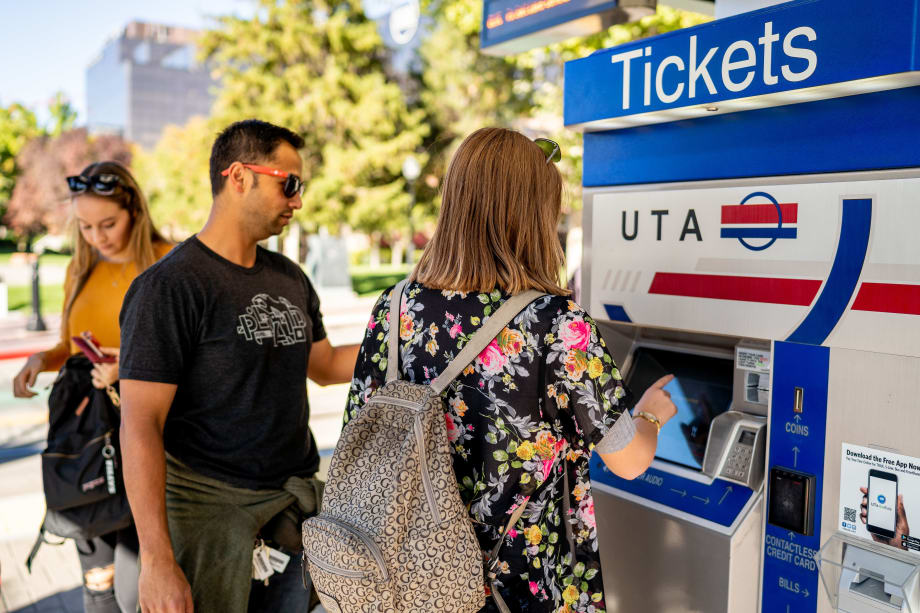
Approximately half of Utah Transit Authority passengers use an electronic fare medium.

University of Utah

3 min to read


Approximately half of Utah Transit Authority passengers use an electronic fare medium. University of Utah

With the use of better rider tracking tools, a new report from the University of Utah and the Utah Transit Authority can better answer the question: How much does public transit reduce pollution emissions?

Researchers used tap-on tap-off rider data to quantify the emissions saved by buses and commuter rail lines, and also project how much additional emissions could be saved by upgrading the bus and rail fleet.

High-resolution rider data
A couple of recent technological advances have enabled University of Utah researchers Daniel Mendoza, Martin Buchert and John Lin to answer the question with a level of detail previously unparalleled.

The first is the advance of tap-on tap-off farecards that provide anonymized data on where those riders who have electronic passes enter and exit public transit. Approximately half of UTA’s passengers use an electronic fare medium. “Now we can truly quantify trips in both time and space,” Mendoza says. “We accounted for all of the 2016 passenger miles by scaling the farecard data, and we know which trips farecard holders make on buses, light rail and commuter rail.”

The second is the General Transit Feed Specification system. It’s the data source that supplies Google Maps with transit information to help users find the bus or train they need. With that data source, the researchers could track where and how often UTA’s buses and trains run.

So, with high-resolution data on the movement of both vehicles and passengers, the researchers could paint a nearly comprehensive picture of public transit along the Wasatch Front.

Balancing emissions
So, with that data, the researchers could quantify the emissions produced and miles traveled of the transit systems (TRAX light rail uses electricity produced outside the Wasatch Front, hence the emissions aren’t in Salt Lake’s air) and balance that with the miles traveled by passengers and the estimated amount of car travel avoided by riding transit.

On weekdays during rush hours, and in densely populated areas, the balance was clearly on the side of reduced emissions. “That tapers off significantly during the evening hours, on the outskirts of the city, and definitely during the weekends,” Mendoza says. In those situations, the number of passengers and how far they rode transit did not offset certain criteria pollutant emissions. (Criteria pollutants are six common air pollutants that the EPA sets standards for through the Clean Air Act.)

For transit to improve its regional reduction in emissions, particularly PM2.5 and NOx, the following strategies, alone or in combination, could be employed: more daily riders per trip, more clean-fuel buses and train cars and/or fewer low-ridership trips.

Ad Loading...

What-ifs
The current study looks at the bus and train fleet as they are now, with some UTA buses around 20 years old and FrontRunner trains whose engines are rated a Tier 0+ on a 0-4 scale of how clean a locomotive’s emissions are (Tier 4 is the cleanest; UTA is scheduled to receive funds programmed through the Metropolitan Planning Organizations to upgrade FrontRunner locomotives to Tier 2+). So, Mendoza and his colleagues envisioned the future.

“What if we upgrade all these buses, some of them from 1996 or so?” Mendoza says. “They emit a significantly larger amount than the newer buses, which are 2013 and newer.”

What if, they asked, UTA upgraded their buses to only 2010 models and newer, fueled by either natural gas or clean diesel? And what if the FrontRunner engines were upgraded to Tier 3?

Emissions of some pollutants would drop by 50%, and some by up to 75%, they found.

“Now, with this information, UTA can go to stakeholders and funding agencies and say, ‘Look, we’ve done this analysis,” Mendoza says. “This is how much less we can pollute.’”

The study was conducted in cooperation with the Utah Transit Authority and the Utah Department of Environmental Quality, Division of Air Quality.


More Management

Cover photo for A Practical Guide for Selling to Private Equity
MotorcoachApril 3, 2026

How Motorcoach Operators Can Prepare for a Private Equity Sale

Essential strategies to strengthen your business before entering a private equity transaction.

Read More →
A fleet of Caltrain electrified trains on tracks
Railby StaffApril 3, 2026

Funding Gap Could Force Caltrain to Slash Service, Close Stations

The Peninsula Corridor Joint Powers Board recently met for a budget workshop, during which staff outlined the significant service reductions Caltrain could be forced to make without new external funding. 

Read More →
METRO's People Movement with MCI President Rob Marion
Managementby Staff and News ReportsApril 3, 2026

NFI Group Taps New MCI President and More in People Movement

In this edition, we cover recent appointments and announcements at Alstom, VIA Metropolitan Transit, Transdev US, and more, showcasing the individuals helping to shape the future of transportation.

Read More →
Ad Loading...
A subway train stopped at the 48th Street platform in Manhattan.
Managementby Staff and News ReportsApril 1, 2026

Manhattan’s Central Business District Travel Climbs to 6.3 Million Daily Trips as Transit Leads Growth

Although volumes remain below pre-pandemic levels, NYMTC’s latest Hub Bound report shows rising transit use, shifting commute patterns, and continued recovery.

Read More →
frontrunner bus
SponsoredApril 1, 2026

Breaking Accessibility Barriers with the Low Floor Frontrunner Minibus

Accessible transit isn’t a feature—it’s a responsibility. This whitepaper explores how the Low-Floor Frontrunner is redefining mobility with a breakthrough design that removes barriers, empowers riders, and delivers measurable operational advantages for agencies. Discover why this next generation minibus is setting a new standard for inclusive transportation.

Read More →
An MBTA commuter rail at a station.
Railby StaffMarch 31, 2026

Massachusetts Announces Summer Savings for Commuter Rail Riders

With major events and increased travel expected across the state this summer, the Administration is focused on making sure people have a reliable, affordable alternative to driving so we can reduce congestion, support daily commuters, and keep Massachusetts moving.

Read More →
Ad Loading...
A MARTA employee using the new Better Breeze fare ticket machines.
Managementby StaffMarch 30, 2026

Updated: MARTA’s New 'Better Breeze' Fare System Goes Live

The new system introduces tap-to-pay, touchscreen kiosks, and updated Breeze cards, with both old and new systems running through May.

Read More →
ABA Marketplace Report
Motorcoachby StaffMarch 30, 2026

ABA Marketplace Drives $124.9M in Business, New Report Finds

As the American Bus Association marks its 100th year, a new ABA Foundation report highlights the Marketplace’s role as a key revenue engine for the bus and group travel industry.

Read More →
Coach USA, Samsara cover shot
Technologyby Alex RomanMarch 30, 2026

How Coach USA Is Using AI to Prevent Bus Accidents

As motorcoaches navigate increasingly congested urban corridors filled with pedestrians, cyclists, scooters, and distracted drivers, safety leaders across the industry are confronting a growing challenge: visibility.

Read More →
Ad Loading...
Five different gold commemorative Smart Trip card designs.
Managementby StaffMarch 27, 2026

WMATA Proposes Revised FY2027 Budget as System Marks 50 Years of Service

Updated financial plan reflects ridership growth and cost controls as the Washington region’s transit system celebrates five decades of operations.

Read More →