



New York MTA marks millionth OMNY tap
The system launched as a limited public pilot on May 31 at 16 subway stations along the Lexington Avenue 456 line and on all Staten Island buses.

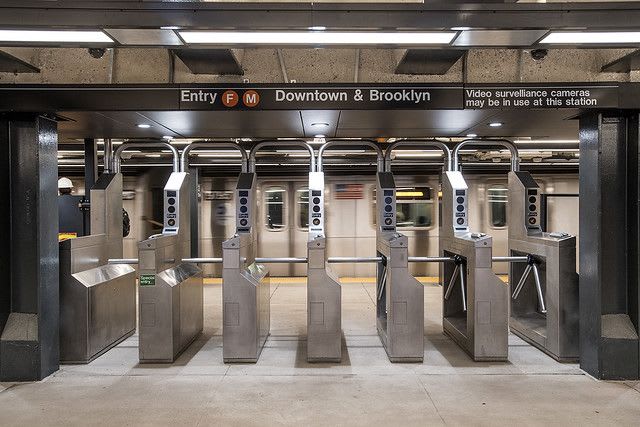
OMNY readers accept contactless cards from Visa, Mastercard, American Express, and eventually Discover Card as well as Apple Pay, Google Pay, Samsung Pay, and Fitbit Pay.
Via Patrick J. Cashin/MTA
OMNY readers accept contactless cards from Visa, Mastercard, American Express, and eventually Discover Card as well as Apple Pay, Google Pay, Samsung Pay, and Fitbit Pay.
Via Patrick J. Cashin/MTA
New York’s Metropolitan Transportation Authority (MTA) announced that a subway customer entering the Fulton Center station provided the one millionth successful tap on the new OMNY fare payment system, a milestone accomplished at a much higher usage rate than initially estimated.
OMNY launched as a limited public pilot on May 31 at 16 subway stations along the Lexington Avenue 456 line and on all Staten Island buses. Within the first three days, subways and bus customers used OMNY more than 18,000 times, far exceeding original estimates of 7,000 taps in the first week. Nearly three months later, average usage rates are three to four times greater than expected, topping 22,000 per weekday and leading to the million-tap milestone just 69 days after the public launch.
Also unexpected was the surprisingly high number of OMNY customers using smartphones for payment, with 80% using through digital wallets compared to 20% using OMNY through contactless cards.
OMNY readers accept contactless cards from Visa, Mastercard, American Express, and eventually Discover Card as well as Apple Pay, Google Pay, Samsung Pay, and Fitbit Pay.
MTA customer usage of digital wallets far exceeds the retail industry’s 15% usage of digital wallets, which highlights high interest in contactless payment technology and a strong appetite for contactless payment options. The MTA’s initial OMNY usage estimates were based on similar digital wallet and contactless card usage in retail industries, and the success of OMNY shows that New Yorkers are quick to adapt to new uses for technology but limited by available contactless payment options.
Contactless payment technology has been readily available for years in many countries where those residents regularly use bank-issued contactless cards for payment. Similarly through OMNY, tourists and non-domestic customers familiar with contactless technology never have to wait at a fare vending machine or station booth, allowing easy and seamless entry into the subway system with their own smartphone or contactless card. So far, customers from 93 countries outside of the U.S. have paid their fares using OMNY, with 62% percent of those customers coming from Great Britain, Canada, Italy, Germany, and France.
OMNY, which stands for One Metro New York, is the first transit fare payment system with open-loop contactless payments, which means that riders can pay their subway or bus fare by tapping contactless credit, debit, and reloadable prepaid cards, mobile phones, smart watches, and other wearable devices. It will eventually be available across the MTA’s two commuter railroads as well.
More Technology

From Hardware to Digital Partner: Luminator Charts Its Next Chapter
CEO Magnus Friberg discusses Luminator’s shift toward becoming a digital partner, the growing importance of software and interoperability, and how AI can help agencies improve operations and passenger experience.
Read More →
Beyond the Checklist: A Structured Approach to Transit Maintenance
Reliability-Centered Maintenance helps transit agencies move beyond routine checklists to focus limited resources on the assets and failures that have the greatest impact on safety, reliability, and service.
Read More →
NJ TRANSIT Advances Bus Technology Upgrades Across Statewide Fleet
More than 1,500 buses now feature upgraded technology designed to improve arrival predictions and provide free Wi-Fi, with deployment expected to reach nearly 2,000 buses by the end of 2026.
Read More →

Building a Flexible Path to Transit Electrification
John Hroncich discusses BAE Systems’ modular and scalable approach, lessons learned from decades of real-world operations, and how agencies can identify electrification strategies that fit their fleets.
Read More →
Biz Briefs: Alstom Lands Canadian Contract, LYT to Supply California TSP, and More
In METRO's latest installment, we take a look at recent news from Complete Coach Works, Beep, FlixBus, and more partnerships making headlines across the transportation sector.
Read More →
From Legacy Silos to Conversational Intelligence
What if transit leaders could ask any operational question and get a trusted answer in seconds? Conversational AI is transforming how agencies use their data.
Read More →
USDOT Announces Rail Vehicle Replacement Grants, Chattanooga AV Shuttle Funding
More than $191 million in federal funding will help three transit agencies replace aging rail vehicles and support a new autonomous shuttle service in Chattanooga.
Read More →
Bus Tech Talk: Keeping Transit Technicians Ahead of the Technology Curve
LA Metro’s Obed Mejia discusses technician training, evolving maintenance technology, fleet replacement, and strategies for getting the most out of today’s transit fleets.
Read More →
Biz Briefs: RIPTA Unveils New Frontrunners, Clevland RTA Adds New Siemens, and More
In METRO's latest installment, we take a look at recent news from Siemens, Prevost, Dodge, and more partnerships making headlines across the transportation sector.
Read More →
Why Simulating Pedestrian Movement Has Become Essential for Modern Rail Stations
Pedestrian microsimulation is helping rail planners identify bottlenecks, test station designs, and prepare complex transit hubs for growing passenger volumes.
Read More →