




RELATED: MARTA chief calls for $100B investment in mobility, tech
Super Bowl weekend doubles MARTA ridership
On Super Bowl Sunday, 155,000 customers took MARTA rail to enjoy activities downtown and see the big game.
February 5, 2019
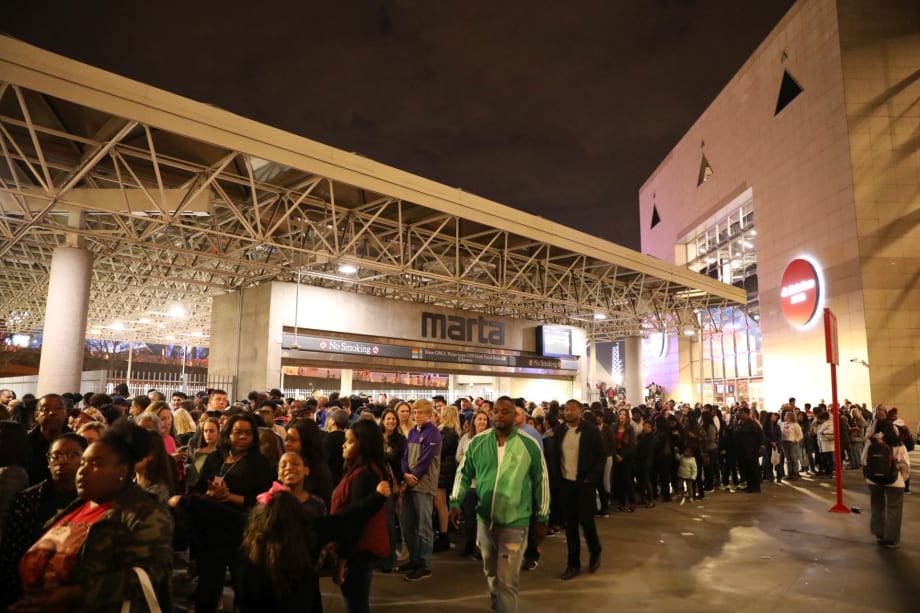
MARTA Rail Operations remained flexible during the entire 10-day period of activities, adjusting service, adding trains, and even beginning 24-hour service a day earlier to accommodate the addition of a late-night concert to the event schedule.
MARTA
2 min to read
MARTA Rail Operations remained flexible during the entire 10-day period of activities, adjusting service, adding trains, and even beginning 24-hour service a day earlier to accommodate the addition of a late-night concert to the event schedule.
MARTA
The Metropolitan Rapid Transit Authority (MARTA) moved over a half-million customers during the three-day Super Bowl weekend as massive crowds took advantage of 24-hour rail service.
Saturday marked MARTA’s busiest travel day in decades, with an estimated 270,000 rail riders, more than double the number seen on a typical Saturday. Parking lots throughout the system were filled as customers parked their cars and took transit to avoid downtown parking fees and gridlock.
On Super Bowl Sunday, 155,000 customers took MARTA rail to enjoy activities downtown and see the big game. Riders were greeted by more than 600 Transit Ambassadors, positioned throughout MARTA’s 38 rail stations. These re-deployed administrative employees worked over 3,000 hours during the 10-day operational period.
MARTA Rail Operations remained flexible during the entire 10-day period of activities, adjusting service, adding trains, and even beginning 24-hour service a day earlier to accommodate the addition of a late-night concert to the event schedule.
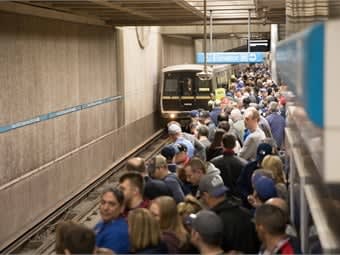
Saturday marked MARTA’s busiest travel day in decades, with an estimated 270,000 rail riders, more than double the number seen on a typical Saturday.
MARTA
“Our performance proved MARTA was ready,” said Chief of Rail Operations David Springstead. “We had two minor issues, one involving a trespasser near the tracks and another caused by a small fire on adjacent CSX property, where we implemented our contingency plans and minimized the service impact to our customers. On Sunday, the MARTA team worked quickly and efficiently to clear large crowds within 90 minutes of the end of the game.”
MARTA police officers were highly visible throughout the system. More than 500 sworn officers, MPD and those assisting from other agencies, worked around the clock to ensure there were no public safety issues.
MARTA has been the major transit provider for a string of large-scale sporting events, including three Super Bowls, the 1996 Olympic Games, and most recently, the MLS Cup where the city’s newest sports franchise, Atlanta United, won its first championship.
More Management

Beyond the Checklist: A Structured Approach to Transit Maintenance
Reliability-Centered Maintenance helps transit agencies move beyond routine checklists to focus limited resources on the assets and failures that have the greatest impact on safety, reliability, and service.
Read More →
APTA 2026 Nominating Committee Selects Leadership Slate, Names Chair and Vice Chair Nominees
Leadership changes will help shape the association’s priorities and its representation of the transportation industry during the 2026–2027 term.
Read More →
DART Launches Major Security, Fare Enforcement Initiative
The 90-day demonstration will deploy coordinated security teams at five light rail stations while testing controlled access and gathering data to guide future investments.
Read More →

Sponsored•September 9, 2026
Advancing Fare Collection Through Technology and Innovation
Learn about delivering 1300 gates at 91 stations while managing fare evasion. Explore the large scale deployment, solution customization and real-world results that affect the region. Prepare for deployment in your region now.
Read More →
Game Day in Motion: Moving Millions During the 2026 World Cup
Between packed transit stations and team motorcoaches, see how agencies and operators across North America tackled the transportation demands of the 2026 FIFA World Cup.
Read More →
Surface Transportation Extension Averts Shutdown, Leaves Transit Funding Gap
The stopgap keeps federal transportation programs moving, but missing advance funding could complicate the transit and rail projects agencies are planning next.
Read More →
Bus Tech Talk: Keeping Transit Technicians Ahead of the Technology Curve
LA Metro’s Obed Mejia discusses technician training, evolving maintenance technology, fleet replacement, and strategies for getting the most out of today’s transit fleets.
Read More →
Why Simulating Pedestrian Movement Has Become Essential for Modern Rail Stations
Pedestrian microsimulation is helping rail planners identify bottlenecks, test station designs, and prepare complex transit hubs for growing passenger volumes.
Read More →
People Movement: Holly Arnold Joins Transdev and More
In this edition, we also cover recent appointments and announcements at Pace, CamTran, MCI, and more, showcasing the individuals helping to shape the future of transportation.
Read More →
NITA Launches New Era of Regional Transit in Chicago
The new authority replaces the RTA and brings CTA, Metra, and Pace under a strengthened regional framework for funding, planning, fares, safety, and service coordination.
Read More →