



Montgomery County, Md. breaks ground on BRT corridor
Starting in 2020, the 14-mile, 11-station BRT will run between Burtonsville and downtown Silver Spring

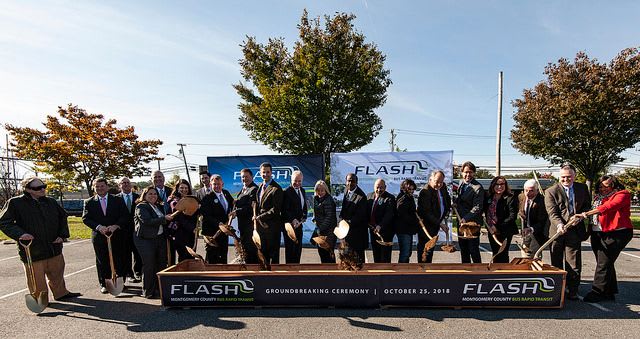
Officials at the groundbreaking ceremony for the Montgomery County bus rapid transit system included: Montgomery County Executive Ike Leggett; Senator Chris Van Hollen; County Council President Hans Riemer and Councilmembers Roger Berliner, Marc Elrich, Nancy Floreen, Tom Hucker and Nancy Navarro; Maryland Transportation Secretary Pete K. Rahn; Federal Transit Administration Deputy Regional Administrator Anthony Tarone; Howard County Executive Allan Kittleman, Corridor Advisory Committee Member Sanjida Rangwala and MCDOT Director Al Roshdieh. Photo: MCDOT

Officials at the groundbreaking ceremony for the Montgomery County bus rapid transit system included: Montgomery County Executive Ike Leggett; Senator Chris Van Hollen; County Council President Hans Riemer and Councilmembers Roger Berliner, Marc Elrich, Nancy Floreen, Tom Hucker and Nancy Navarro; Maryland Transportation Secretary Pete K. Rahn; Federal Transit Administration Deputy Regional Administrator Anthony Tarone; Howard County Executive Allan Kittleman, Corridor Advisory Committee Member Sanjida Rangwala and MCDOT Director Al Roshdieh. Photo: MCDOT
Montgomery County, Md., launched the start of construction for the FLASH, the County’s first bus rapid transit (BRT) line, which will operate along US 29 — the busiest transit corridor in the county.
Starting in 2020, the 14-mile, 11-station BRT will run between Burtonsville and downtown Silver Spring and is expected to serve about 20,000 riders per day.
Construction of the US 29 BRT will cost about $31 million, of which $10 million will be paid by the federal TIGER grant.
The FLASH will be a new, innovative transit option in Montgomery County that provides immediate, positive benefits to the diverse population living within the highly congested US 29 corridor, supports smart growth development, expands mobility options, and provides future connections to the Purple Line.
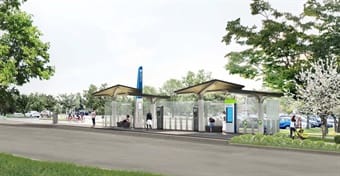
Starting in 2020, the 14-mile, 11-station FLASH bus rapid transit line will run between Burtonsville and downtown Silver Spring, Md. Rendering: MCDOT
The BRT buses, which will carry as many as 90 passengers, will use existing roadway pavement when possible to minimize the need for new infrastructure improvements. The new BRT service will link a continuous corridor of suburban centers, highway developments, shopping centers, federal offices, neighborhoods, a regional Park and Ride Lot, and job centers. Discussions with Howard County continue about making the US 29 FLASH a bi-county service.
The FLASH could cut commutes by an estimated 30% compared with current bus routes because of its added features that include all-door boarding, exclusive transit use of the shoulders along the northern section of US 29, and traffic signal priority. Other passenger amenities include WiFi and USB ports.
Stations along the route will feature weather protection, pre-payment kiosks, and real-time transit information. As part of the project, community-friendly design elements will be added that include improved pedestrian walkways and ADA-sidewalk upgrades, bike facilities and 10 new bike-share stations.
Montgomery County also is studying BRT lines along MD 355 and MD 586 (Veirs Mill Road).
More Bus

New York MTA Plans Largest Bus Fleet Upgrade in More Than a Decade
The agency is seeking manufacturers for 650 new CNG buses to replace aging vehicles, improve reliability, and advance its broader fleet modernization strategy.
Read More →
Building a Flexible Path to Transit Electrification
John Hroncich discusses BAE Systems’ modular and scalable approach, lessons learned from decades of real-world operations, and how agencies can identify electrification strategies that fit their fleets.
Read More →
Bus Tech Talk: Keeping Transit Technicians Ahead of the Technology Curve
LA Metro’s Obed Mejia discusses technician training, evolving maintenance technology, fleet replacement, and strategies for getting the most out of today’s transit fleets.
Read More →
Biz Briefs: RIPTA Unveils New Frontrunners, Clevland RTA Adds New Siemens, and More
In METRO's latest installment, we take a look at recent news from Siemens, Prevost, Dodge, and more partnerships making headlines across the transportation sector.
Read More →
People Movement: Holly Arnold Joins Transdev and More
In this edition, we also cover recent appointments and announcements at Pace, CamTran, MCI, and more, showcasing the individuals helping to shape the future of transportation.
Read More →
The High Cost of Transit Buses: Industry Leaders Look to Procurement Reform
Transit leaders and policymakers examine how standardized bus designs, streamlined procurement, and predictable funding could help agencies stretch budgets and deliver better service.
Read More →
The Business Voice Behind Public Transportation
As chair of APTA’s Business Members Board of Governors, Ray Melleady explains how more than 850 business members are partnering with transit agencies to advance funding, innovation, and industry-wide collaboration.
Read More →
From Surviving to Thriving: Building Stronger Transportation Organizations
Bus Business Consultants founder Brian Dickson shares lessons on leadership, organizational health, and creating options for long-term success in a changing transportation industry.
Read More →
Finding the ‘Happy Medium’: Optimizing Maintenance Without Sacrificing Reliability
The key to maintenance optimization isn’t doing less work—it’s doing the right work at the right time on the right assets.
Read More →
LA Metro, City of West Hollywood, and Partners Advance Smarter Bus Lane Enforcement
The award-winning partnership combines AI-powered detection with human oversight to improve bus reliability, accessibility, and enforcement efficiency.
Read More →