In conjunction with a service provider, Fort Bend County maintains a fleet of buses, 60 and growing, to serve the needs of the residents.
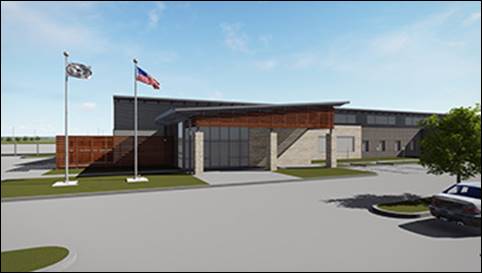
Rendering via LAN
2 min to read
In conjunction with a service provider, Fort Bend County maintains a fleet of buses, 60 and growing, to serve the needs of the residents.
Rendering via LAN
Texas’ Fort Bend County celebrated the groundbreaking of its new transit center.
The facility is designed to accommodate the County’s existing fleet of buses as well as future additions. It includes 18,600 square feet of office space, 28,400 square feet of maintenance bays, covered bus parking, and a 7,100-square-foot fuel and washing station. The facility also contains a break area, relaxation lounge, and kitchen spaces.
Ad Loading...
Engineering firm Lockwood, Andrews & Newnam Inc. (LAN) provided planning, engineering, and design services for the new transit center. SpawGlass is serving as the contractor. Other firms involved in the project include RdlR Architects as the architect, Asakura Robinson as the landscape architect, and HDR | Maintenance Design Group for specialty equipment and systems.
Fort Bend County is one of the fastest growing counties in Texas and the nation. Its rapid population and employment growth have increased traffic congestion considerably. To address this growth, in January 2011, the Fort Bend County Transit completed a long-range transit plan. The plan includes several proposals to improve its existing bus and van services, and expand its system for the next 25 years. The new transit center is a significant component of this plan.
In conjunction with a service provider, the County maintains a fleet of buses, 60 and growing, to serve the needs of the residents. Bus operations, including dispatching and maintenance, are provided by the private contractor while County staff provide reservation, scheduling, and administrative activities. Over the past several years, the County has performed these functions from four different facilities in the greater Houston area. The new facility will allow the County to combine its transportation functions into a single location for improved efficiency and service.
Construction of the $21 million project is scheduled to be completed in October 2019.
The Peninsula Corridor Joint Powers Board recently met for a budget workshop, during which staff outlined the significant service reductions Caltrain could be forced to make without new external funding.
In this edition, we cover recent appointments and announcements at Alstom, VIA Metropolitan Transit, Transdev US, and more, showcasing the individuals helping to shape the future of transportation.
Accessible transit isn’t a feature—it’s a responsibility. This whitepaper explores how the Low-Floor Frontrunner is redefining mobility with a breakthrough design that removes barriers, empowers riders, and delivers measurable operational advantages for agencies. Discover why this next generation minibus is setting a new standard for inclusive transportation.
With major events and increased travel expected across the state this summer, the Administration is focused on making sure people have a reliable, affordable alternative to driving so we can reduce congestion, support daily commuters, and keep Massachusetts moving.
As the American Bus Association marks its 100th year, a new ABA Foundation report highlights the Marketplace’s role as a key revenue engine for the bus and group travel industry.
As motorcoaches navigate increasingly congested urban corridors filled with pedestrians, cyclists, scooters, and distracted drivers, safety leaders across the industry are confronting a growing challenge: visibility.