



LA Metro breaks ground on $1.5B Gold Line rail extension
The historic ceremony held over the weekend marks the first Measure M-funded rail project to begin construction.

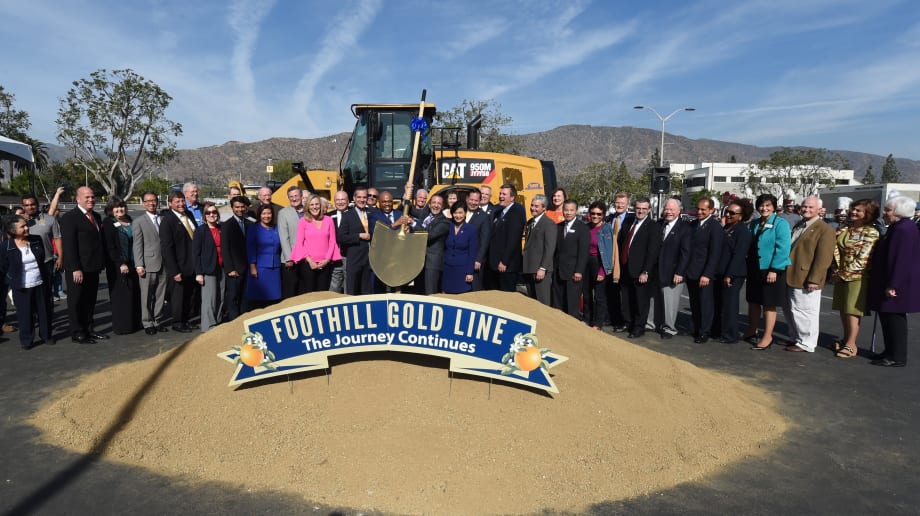
Dozens of elected officials join the Foothill Gold Line Construction Authority to break ground on the Foothill Gold Line light rail extension from Glendora to Montclair.
Dozens of elected officials join the Foothill Gold Line Construction Authority to break ground on the Foothill Gold Line light rail extension from Glendora to Montclair.
Los Angeles’ Foothill Gold Line Construction Authority (Construction Authority) held a groundbreaking ceremony for the $1.5 billion, six-station Foothill Gold Line light rail extension from Glendora to Montclair at Citrus College in Glendora. Attendance at the ceremony was large and diverse, with elected representatives from all levels of government, as well as transportation and higher education officials and hundreds of community stakeholders, joining the Construction Authority to celebrate the start of construction for the 12.3-mile extension. The historic ceremony marks the first Measure M-funded rail project to begin construction.
“When L.A County voters passed Measure M last year, they gave us an unprecedented mandate to create hundreds of thousands of jobs and build one of the most robust public transit systems in the world,” said Los Angeles Mayor Eric Garcetti, Chair of the Metro Board. “Now, it’s our turn to deliver, and that work starts today, with this promising new phase of the Metro Gold Line.”
“Funding the second phase of the Gold Line extension is the perfect example of what we’re trying to achieve through our agency’s comprehensive transportation plan,” said Metro CEO Phillip A. Washington. “As we make transit more available in new communities, we are changing the face of Southern California and creating an infrastructure inheritance for our children and grandchildren.”
The first three years of construction will be used to relocate strategic utilities, conduct pre-construction activities, hire a design-build contractor, and finalize the project design. Major construction will begin in 2020 and consist of two construction phases: (1) relocating/rebuilding the freight/Metrolink systems and (2) building the Gold Line light rail system. Substantial completion is anticipated in 2026.
“The Construction Authority’s team has been working tirelessly over the last few years to ready the Glendora to Montclair segment for construction,” stated Foothill Gold Line CEO Habib F. Balian. “Today is a celebration of that tremendous effort, as well as the partnership that the Construction Authority has with our corridor cities and Metro that allowed this project to be the first Measure M funded project to move forward. We are ready for the work ahead on this transformative project for the San Gabriel Valley.”
Construction alone is expected to generate $2.6 billion in economic output, 17,000 jobs, more than $1 billion in labor income, and nearly $40 million in tax revenues for Los Angeles County. Nearly $2 billion in private investments in transit-oriented developments have already been made or planned within a half-mile of the six future stations from Glendora to Montclair.
When completed, the Glendora to Montclair project will extend the Metro Gold Line light rail line from its eastern terminus in Azusa through the foothill communities in the San Gabriel Valley and into San Bernardino County, adding new light rail stations in Glendora, San Dimas, La Verne, Pomona, Claremont, and Montclair. Each will connect to the expanding rail network in Los Angeles County, as well as the Inland Empire, and provide opportunities for county residents, workers and visitors to connect to many regional and local points of interest along the corridor, including two dozen colleges, the Los Angeles County Fairplex, several outdoor recreation facilities, historical sites and museums, and retail and dining centers.
Funding for the project is coming from both Los Angeles and San Bernardino Counties. The portion of the project within Los Angeles County is being mostly funded by Metro's Measure M half-cent sales tax, as well as residual Measure R funds from the Pasadena to Azusa segment. The portion of the extension from Claremont to Montclair is being funded by San Bernardino County.
More Rail

New York MTA Advances Final Contract for Second Avenue Subway Expansion
Contract Four is the largest in the Second Avenue Subway Phase 2 project and includes construction of station infrastructure, tracks, and signals for the subway expansion, MTA officials said. Work on Contract Four will begin in 2027.
Read More →
San Diego MTS Breaks Monthly Trolley Ridership Record
Agency officials said July’s ridership indicates MTS’s continued recovery from the pandemic.
Read More →
Report Examines NJ TRANSIT Reliability, Funding Challenges
The Garden State Initiative analysis examines the roles of Amtrak infrastructure, fleet management, and agency operations while recommending a more performance-based approach to improving reliability.
Read More →
Stadler, CapMetro Sign Long-Term Rail Fleet Support Agreement
Beginning in 2027, Stadler will provide on-site technical expertise, spare parts support, training, and obsolescence management to help extend the reliability and longevity of CapMetro’s GTW fleet.
Read More →
Biz Briefs: Alstom Lands Canadian Contract, LYT to Supply California TSP, and More
In METRO's latest installment, we take a look at recent news from Complete Coach Works, Beep, FlixBus, and more partnerships making headlines across the transportation sector.
Read More →
CATS Gold Line Marks 5 Years of Service, 2.8M Passenger Trips
With a six-mile expansion planned, the Charlotte streetcar is positioned to connect more neighborhoods and major transit hubs across the region.
Read More →
Why Simulating Pedestrian Movement Has Become Essential for Modern Rail Stations
Pedestrian microsimulation is helping rail planners identify bottlenecks, test station designs, and prepare complex transit hubs for growing passenger volumes.
Read More →
Amtrak Begins Major Construction at New York’s Sunnyside Yard
The new maintenance facility will support Amtrak’s Airo trainsets while improving maintenance efficiency and turnaround times in New York.
Read More →
Chicago Leaders Unveil Plans for O’Hare Airport Express Train
The privately developed project would offer a 15-minute trip between downtown and O’Hare’s Terminal 2, with trains operating every 15 minutes on a dedicated track. The service would use battery-electric trains and three existing freight rail rights-of-way.
Read More →
OCTA Maps Out 30-Year Strategy to Protect Coastal Rail Corridor
The draft feasibility report identifies strategies to protect the coastal rail line for decades as the agency continues near-term stabilization and sand placement efforts.
Read More →