



SacRT launch Wi-Fi Bus to close digital divide
Testing for the 60-day proof of concept began Friday, with the first three Wi-Fi Buses going live Monday, to promote opportunities for distance learning, telework, and telehealth.

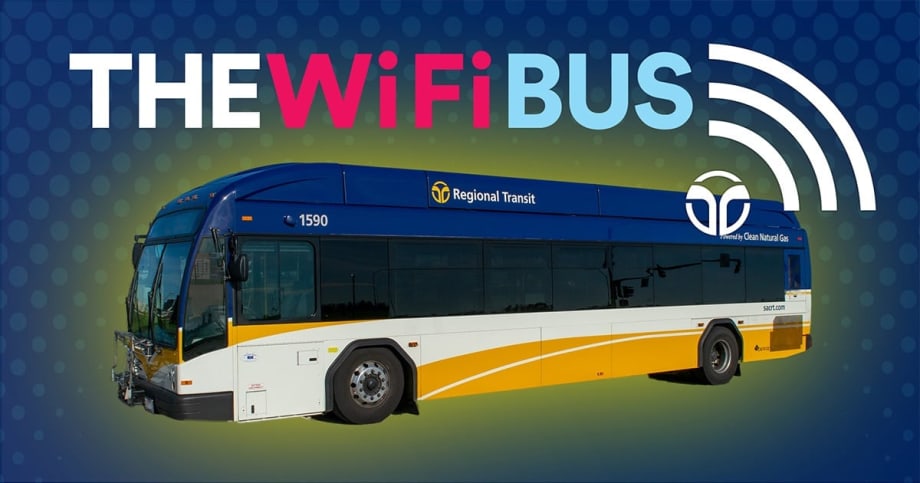
SacRT
The California State Transportation Agency, the City of Sacramento, and the Sacramento Regional Transit District (SacRT) are teaming up to turn buses into free wireless super hotspots in communities with limited high-speed internet access during the COVID-19 pandemic.
Testing for the 60-day proof of concept began Friday, with the first three Wi-Fi Buses going live Monday, to promote opportunities for distance learning, telework, and telehealth. Seven additional buses will be deployed to more “digital desert” communities across Sacramento beginning the week of Monday, May 11. Buses will provide 3½ hours of wireless broadband service at two locations each day, with updated schedules available at thewifibus.com.
The 10 repurposed Wi-Fi Buses are outfitted with combinations of equipment provided free of charge by proof of concept partners AT&T, Verizon Wireless, T-Mobile, Cradlepoint, Sierra Wireless, and Aruba, a Hewlett Packard Enterprise company, to offer high-speed connectivity with a range of up to 1,800 feet.
Hotspot locations and protocols will be determined in collaboration between the City of Sacramento, Valley Vision, Sacramento Public Library, SacRT, the California State Transportation Agency, and public health officials. High-need locations will be selected with input from local school districts, community organizations, and digital divide research, as well as the ability for users to maintain physical distancing and follow public health guidelines. The Sacramento Public Library will provide bus parking at its branches and robust online resources for students to access when connected to the Wi-Fi Bus network.
Gov. Gavin Newsom announced the project on April 20 as part of the state’s efforts to support distance learning and close the digital divide during the COVID-19 pandemic. Approximately one in five students in California lack high-speed internet access and nearly half of all low-income households in the state do not have broadband service at home.
More Technology

From Hardware to Digital Partner: Luminator Charts Its Next Chapter
CEO Magnus Friberg discusses Luminator’s shift toward becoming a digital partner, the growing importance of software and interoperability, and how AI can help agencies improve operations and passenger experience.
Read More →
Beyond the Checklist: A Structured Approach to Transit Maintenance
Reliability-Centered Maintenance helps transit agencies move beyond routine checklists to focus limited resources on the assets and failures that have the greatest impact on safety, reliability, and service.
Read More →
NJ TRANSIT Advances Bus Technology Upgrades Across Statewide Fleet
More than 1,500 buses now feature upgraded technology designed to improve arrival predictions and provide free Wi-Fi, with deployment expected to reach nearly 2,000 buses by the end of 2026.
Read More →

Building a Flexible Path to Transit Electrification
John Hroncich discusses BAE Systems’ modular and scalable approach, lessons learned from decades of real-world operations, and how agencies can identify electrification strategies that fit their fleets.
Read More →
Biz Briefs: Alstom Lands Canadian Contract, LYT to Supply California TSP, and More
In METRO's latest installment, we take a look at recent news from Complete Coach Works, Beep, FlixBus, and more partnerships making headlines across the transportation sector.
Read More →
From Legacy Silos to Conversational Intelligence
What if transit leaders could ask any operational question and get a trusted answer in seconds? Conversational AI is transforming how agencies use their data.
Read More →
USDOT Announces Rail Vehicle Replacement Grants, Chattanooga AV Shuttle Funding
More than $191 million in federal funding will help three transit agencies replace aging rail vehicles and support a new autonomous shuttle service in Chattanooga.
Read More →
Bus Tech Talk: Keeping Transit Technicians Ahead of the Technology Curve
LA Metro’s Obed Mejia discusses technician training, evolving maintenance technology, fleet replacement, and strategies for getting the most out of today’s transit fleets.
Read More →
Biz Briefs: RIPTA Unveils New Frontrunners, Clevland RTA Adds New Siemens, and More
In METRO's latest installment, we take a look at recent news from Siemens, Prevost, Dodge, and more partnerships making headlines across the transportation sector.
Read More →
Why Simulating Pedestrian Movement Has Become Essential for Modern Rail Stations
Pedestrian microsimulation is helping rail planners identify bottlenecks, test station designs, and prepare complex transit hubs for growing passenger volumes.
Read More →