




Tech Talk: Safe Fleet’s New System Aims to Clear Lanes, Improve Ridership
MCTS CONNECT Enters Final Construction Stage
The BRT line, called MCTS CONNECT, begins service on June 4, 2023.
April 24, 2023
The dedicated bus lanes, a collaboration between MCTS and the City of Milwaukee, are a component of the modernized transit route.
Photo: MCTS
3 min to read
Milwaukee County’s first Bus Rapid Transit (BRT) line enters the final construction stage with the painting of dedicated lane stripes, according to MCTS's news release.
The dedicated bus lanes, a collaboration between MCTS and the City of Milwaukee, are a component of the modernized transit route.
MCTS battery-electric buses will deliver service, with 10-minute headways at peak times along the route.
The BRT line, called MCTS CONNECT, begins service on June 4, 2023.
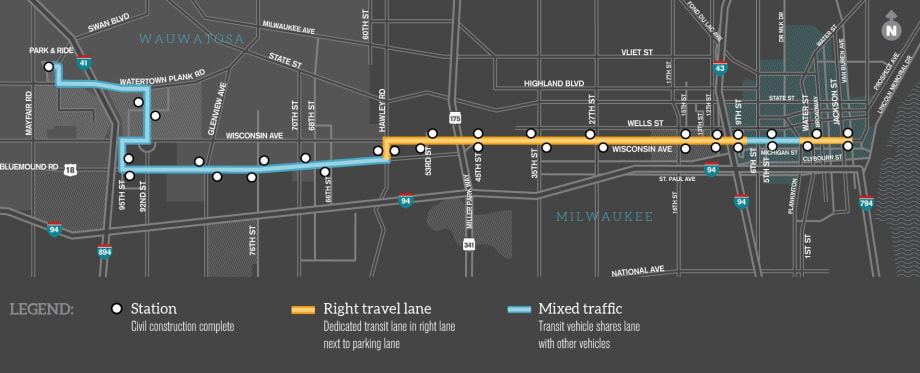
The CONNECT 1’s nine-mile route is nearly an even 50/50 split between dedicated lanes and mixed traffic from Downtown Milwaukee to the Milwaukee Regional Medical Complex in Wauwatosa.
The dedicated bus lanes are along the right travel lane of the eastern portion of the route, on Wisconsin Avenue from Hawley Road to 8th Street and Plankinton Avenue to Cass Street.
“Modernizing public transit through the BRT has taken nearly five years to achieve,” said Denise Wandke, MCTS president and interim managing director. “We’re excited to introduce Milwaukee County to this enhanced travel experience. Dedicated bus lanes are proven to increase safety for not only buses and cars but for pedestrians and cyclists, too.”
Lane installation begins this Tuesday, weather permitting, and will continue for three to four weeks.
The lanes will be designated using pavement markings and permanent signage. Access will be maintained to parallel parking and driveways. After yielding to buses, motorists will be permitted to enter the dedicated bus lane for right turns and parallel park in designated areas. Motorists are not allowed to travel in the dedicated bus lanes, but cyclists are.
How to Use Dedicated Bus Lanes
To keep traffic running smoothly, MCTS said motorists, cyclists, and pedestrians should follow these guidelines:
For motorists:
After yielding to the bus, motorists may access the dedicated bus lanes to access driveways and designated parallel parking.
After yielding to the bus and obeying pavement markings (dashed striping), motorists may access the dedicated bus lanes to make right turns at intersections.
When parking in designated parking areas, make sure your entire vehicle, including side mirrors, is inside the parking lane, and use caution when opening doors as buses, bikes, and vehicles could be approaching from behind you.
Never park your vehicle in the bus-only lane, even temporarily.
For pedestrians:
Only cross the dedicated bus lanes at designated crosswalks, wait for the appropriate signals, and look in all directions before crossing the dedicated bus lanes.
Never cross or run in front of an approaching bus and avoid entering the dedicated bus lane from between two parked vehicles.
Take a break from your electronic devices. Remove your headphones so you can hear traffic in the dedicated bus lane, and don’t walk and text when crossing the BRT route.
For cyclists:
Cyclists are allowed to travel in the dedicated bus lane.
Be aware of approaching vehicles.
Use hand signals to indicate turning.
More Bus

New York MTA Plans Largest Bus Fleet Upgrade in More Than a Decade
The agency is seeking manufacturers for 650 new CNG buses to replace aging vehicles, improve reliability, and advance its broader fleet modernization strategy.
Read More →
Building a Flexible Path to Transit Electrification
John Hroncich discusses BAE Systems’ modular and scalable approach, lessons learned from decades of real-world operations, and how agencies can identify electrification strategies that fit their fleets.
Read More →
Bus Tech Talk: Keeping Transit Technicians Ahead of the Technology Curve
LA Metro’s Obed Mejia discusses technician training, evolving maintenance technology, fleet replacement, and strategies for getting the most out of today’s transit fleets.
Read More →
Biz Briefs: RIPTA Unveils New Frontrunners, Clevland RTA Adds New Siemens, and More
In METRO's latest installment, we take a look at recent news from Siemens, Prevost, Dodge, and more partnerships making headlines across the transportation sector.
Read More →
People Movement: Holly Arnold Joins Transdev and More
In this edition, we also cover recent appointments and announcements at Pace, CamTran, MCI, and more, showcasing the individuals helping to shape the future of transportation.
Read More →
The High Cost of Transit Buses: Industry Leaders Look to Procurement Reform
Transit leaders and policymakers examine how standardized bus designs, streamlined procurement, and predictable funding could help agencies stretch budgets and deliver better service.
Read More →
The Business Voice Behind Public Transportation
As chair of APTA’s Business Members Board of Governors, Ray Melleady explains how more than 850 business members are partnering with transit agencies to advance funding, innovation, and industry-wide collaboration.
Read More →
From Surviving to Thriving: Building Stronger Transportation Organizations
Bus Business Consultants founder Brian Dickson shares lessons on leadership, organizational health, and creating options for long-term success in a changing transportation industry.
Read More →
Finding the ‘Happy Medium’: Optimizing Maintenance Without Sacrificing Reliability
The key to maintenance optimization isn’t doing less work—it’s doing the right work at the right time on the right assets.
Read More →
LA Metro, City of West Hollywood, and Partners Advance Smarter Bus Lane Enforcement
The award-winning partnership combines AI-powered detection with human oversight to improve bus reliability, accessibility, and enforcement efficiency.
Read More →