New York's MTA Completes Final 'Re-NEW-vation' of 2023
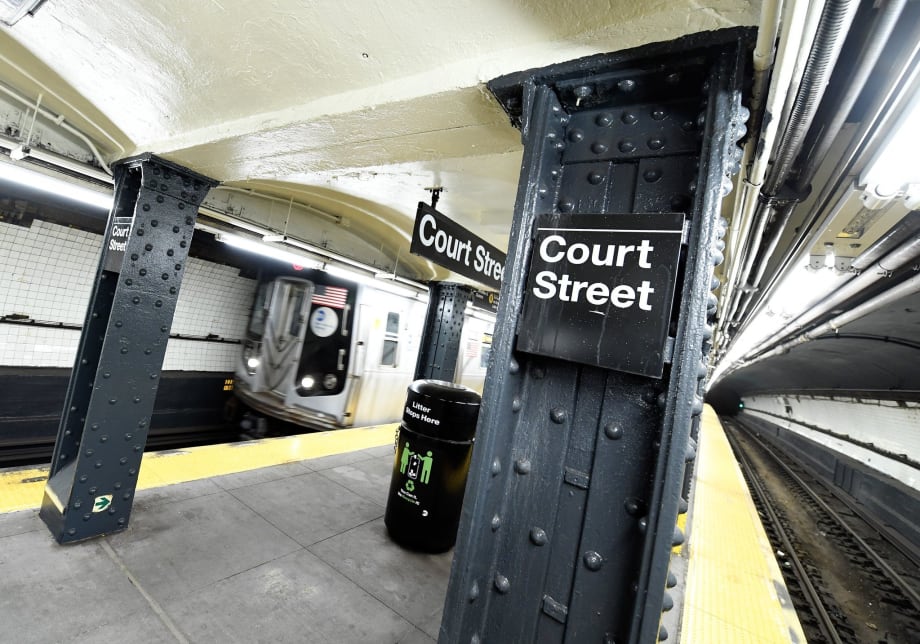
Court St Station marked the 53rd and final station to be re-NEW-vated in 2023, surpassing NYCT’s promised goal of upgrading, repairing, and deep cleaning 50 stations by the end of 2023.
Court St Station marked the 53rd and final station to be re-NEW-vated in 2023, surpassing NYCT’s promised goal of upgrading, repairing, and deep cleaning 50 stations by the end of 2023.
Photo: New York MTA
2 min to read
The New York MTA announced New York City Transit (NYCT) completed structural and aesthetic renovations at Court St R Station in Brooklyn.
The work is part of NYCT’s Re-NEW-vation Program, which utilizes planned service outages to perform station-wide repairs, enhancements, and deep cleaning providing customers with brighter and better station environments.
In October, NYCT announced it had delivered on its promised goal to complete re-NEW-vations at 50 subway stations by the end of 2023.
Photo: New York MTA
Court St Station “re-NEW-vation”
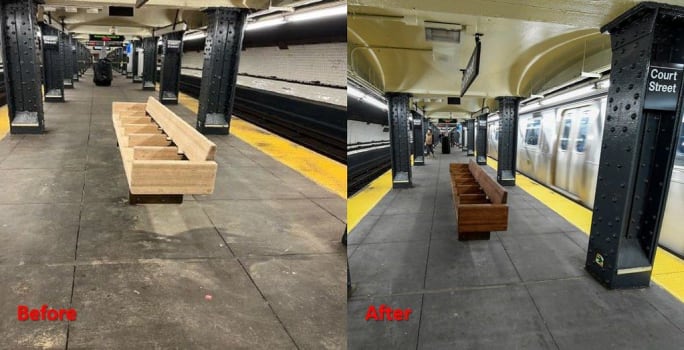
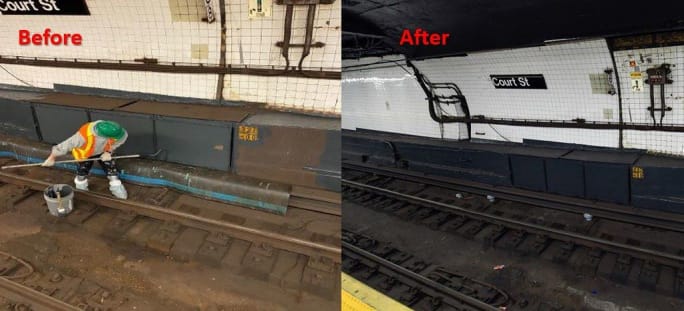
NYCT workers deep cleaned and replaced, where necessary, extensive sections of wall tiles throughout the station. Lighting fixtures were updated with LED lights, brightening darkened areas. Cracks in the concrete along the platforms and mezzanines were repaved and repaired, alleviating tripping hazards.
Outdated signage was taken down and new and clearer signs were posted where needed. The iconic subway globes located at entrances were scrubbed clean. Drains were inspected and cleared to prevent possible backups during future rain events.
Workers also scrapped, primed, and repainted the entire stations. Employee facilities, including the breakroom and bathrooms, also received a refresh with new lighting and repainted surfaces.
“I’m proud of all the hard work NYCT employees put in to bring the Re-NEW-vation Program to 53 stations across the system in 2023,” said New York City Transit President Richard Davey. “That’s 53 stations whose customers are experiencing cleaner, brighter, and better stations, which is part of our ongoing mission for faster, cleaner, safer service.”
Ad Loading...
NYCT workers deep cleaned and replaced, where necessary, extensive sections of wall tiles throughout the station.
Photo: New York MTA
Moving Ahead with “Re-NEW-vations”
In October, NYCT announced it had delivered on its promised goal to complete re-NEW-vations at 50 subway stations by the end of 2023.
The Re-NEW-vation Program is a permanent part of the NYCT Department of Subways, with at least 50 more stations to receive repairs, upgrades, and deep cleanings each year.
The funding marks the first phase of a planned $250 million investment over five years to modernize stations, overhaul vehicles, and improve system reliability and passenger safety.
John Moon, Associate Director, Product Strategy at STraffic, discusses the company's growth in North America, its efforts to reduce fare evasion, and more.
An economic impact study finds the agency supports approximately 17,500 jobs, delivers $1.6 billion in annual community and mobility benefits, and generates $2.42 in economic value for every dollar invested.
The former Rochester transit chief and TransPro founder, who has also contributed to METRO Magazine, brings decades of industry experience and a focus on performance, accountability, and financial sustainability to the nomination.
COO Jake Sion discusses Transit’s growth, the success of its Transit Royale program, and how technology is helping agencies improve the rider experience.
The 2.1-mile extension will connect Fort Worth’s Medical District and Near Southside to downtown, surrounding communities, and Dallas-Fort Worth International Airport.
Austin Transit Partnership CEO Greg Canally discusses the city's nearly 10-mile light rail project, its collaborative approach to project delivery, the importance of community engagement, and the milestones ahead as construction approaches in 2027.
The Systemwide Network Plan identifies infrastructure needs and potential investments to expand all-day, bidirectional rail service across the Chicago region.
The CRISI Grant Program funding will support rail infrastructure improvements, safety upgrades, and projects aimed at improving freight and passenger rail service across 45 states and Washington, D.C.