



Alstom, Siemens Shortlisted to Supply California High-Speed Trains
The identification of the shortlisted teams is a crucial step toward the release of the Request for Proposals and procurement of state-of-the-art electrified high-speed trainsets capable of operating at speeds up to 220 mph.

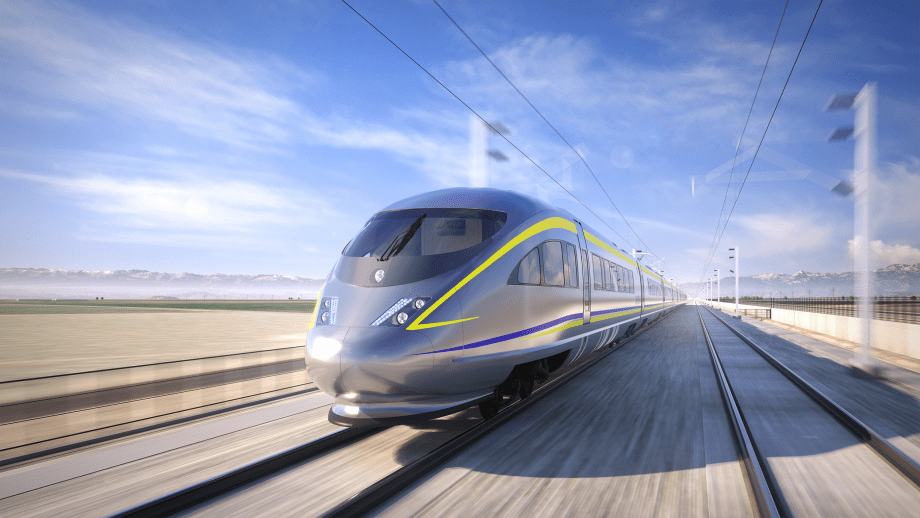
The Trainset and Related Services contract will be funded in part by the Federal-State Partnership for Intercity Passenger Rail (Fed-State National) Program grant the authority received in December 2023.
Photo: California High-Speed Rail Authority
On the heels of the nearly $3.1 billion historic federal investment for California’s high-speed rail project, which includes funding for new electric trains, the California High-Speed Rail Authority announced Alstom Transportation Inc. and Siemens Mobility Inc. are on its shortlist of qualified bidders for the authority’s high-speed trainsets.
The identification of the shortlisted teams is a crucial step toward the release of the Request for Proposals and procurement of state-of-the-art electrified high-speed trainsets capable of operating at speeds up to 220 mph.
“These world-class vendors ensure that we are procuring the latest generation of high-speed trains,” said Authority CEO Brian Kelly. “With this recent federal grant, we are able to move forward with this major step on the project, purchasing trains capable of speeds of more than 220 mph to move passengers here in California in a way that transforms the passenger rail experience.”
The Road to Today
In August, the authority’s board approved the release of a Request for Qualifications for the trainsets and related services contract. The contract will comply with the Buy America Act, and the procurement will result in a supply-maintain contract for the provision of trainsets, a driving simulator, and related services.
The authority anticipates releasing the Request for Proposals in the coming months, followed by award of a contract later this year.
Funding and Contract Scope
The Trainset and Related Services contract will be funded in part by the Federal-State Partnership for Intercity Passenger Rail (Fed-State National) Program grant the authority received in December 2023. The scope of work for the contract is anticipated to include:
The design, manufacture, storage (prior to conditional acceptance), integration, testing, and commissioning of the trainsets.
Maintenance of each trainset for 30 years and provision of all spares (i.e., interchangeable parts of a trainset) for such trainsets.
The provision, testing, commissioning, maintenance, and update of the driving simulator.
Development and provision of design criteria to inform interfaces with the facilities, track, systems, and stations.
Participating in the testing and commissioning of the facilities, track, systems, and stations.
The development and provision of information as required to support the certification and subsequent commissioning of the trainsets.
The operation and maintenance of the trainset maintenance-related equipment installed in the Heavy Maintenance Facility, Light Maintenance Facility, and Trainset Certification Facility (to be built by others).
California High-Speed Rail Progress
Since the start of construction, the authority has created more than 12,000 construction jobs, a majority going to residents from the Central Valley. On average, nearly 1,500 workers are dispatched to a high-speed rail construction site daily.
The authority has begun work to extend the 119 miles under construction to 171 miles of future electrified high-speed rail from Merced to Bakersfield.
There are more than 25 active construction sites in California’s Central Valley, with the authority having also environmentally cleared 422 miles of the high-speed rail program from the Bay Area to the Los Angeles Basin.
More Rail

New York MTA Advances Final Contract for Second Avenue Subway Expansion
Contract Four is the largest in the Second Avenue Subway Phase 2 project and includes construction of station infrastructure, tracks, and signals for the subway expansion, MTA officials said. Work on Contract Four will begin in 2027.
Read More →
San Diego MTS Breaks Monthly Trolley Ridership Record
Agency officials said July’s ridership indicates MTS’s continued recovery from the pandemic.
Read More →
Report Examines NJ TRANSIT Reliability, Funding Challenges
The Garden State Initiative analysis examines the roles of Amtrak infrastructure, fleet management, and agency operations while recommending a more performance-based approach to improving reliability.
Read More →
Stadler, CapMetro Sign Long-Term Rail Fleet Support Agreement
Beginning in 2027, Stadler will provide on-site technical expertise, spare parts support, training, and obsolescence management to help extend the reliability and longevity of CapMetro’s GTW fleet.
Read More →
Biz Briefs: Alstom Lands Canadian Contract, LYT to Supply California TSP, and More
In METRO's latest installment, we take a look at recent news from Complete Coach Works, Beep, FlixBus, and more partnerships making headlines across the transportation sector.
Read More →
CATS Gold Line Marks 5 Years of Service, 2.8M Passenger Trips
With a six-mile expansion planned, the Charlotte streetcar is positioned to connect more neighborhoods and major transit hubs across the region.
Read More →
Why Simulating Pedestrian Movement Has Become Essential for Modern Rail Stations
Pedestrian microsimulation is helping rail planners identify bottlenecks, test station designs, and prepare complex transit hubs for growing passenger volumes.
Read More →
Amtrak Begins Major Construction at New York’s Sunnyside Yard
The new maintenance facility will support Amtrak’s Airo trainsets while improving maintenance efficiency and turnaround times in New York.
Read More →
Chicago Leaders Unveil Plans for O’Hare Airport Express Train
The privately developed project would offer a 15-minute trip between downtown and O’Hare’s Terminal 2, with trains operating every 15 minutes on a dedicated track. The service would use battery-electric trains and three existing freight rail rights-of-way.
Read More →
OCTA Maps Out 30-Year Strategy to Protect Coastal Rail Corridor
The draft feasibility report identifies strategies to protect the coastal rail line for decades as the agency continues near-term stabilization and sand placement efforts.
Read More →