LA Metro Completes 5 Years of Tunneling on D Line Subway Extension
The major construction milestone was accomplished safely in one of the densest and most geologically challenging urban corridors in the L.A. region and nation.
Contractors utilized the latest Tunnel Boring Machine technology to excavate approximately 40 to 60 feet per day to help complete tunneling for the project.
The major construction milestone was accomplished safely in one of the densest and most geologically challenging urban corridors in the L.A. region and nation.
Ad Loading...
D Line Tunnel Boring
With the completion of tunneling, Metro will continue to work with its two contractors as a part of a joint venture with Skanska-Traylor-Shea and Tutor-Perini/O&G to complete seven new underground stations in Section 1 between Wilshire/Western and Wilshire/La Cienega, Section 2 between Wilshire/La Cienega and Century City, and Section 3 between Century City and Westwood.
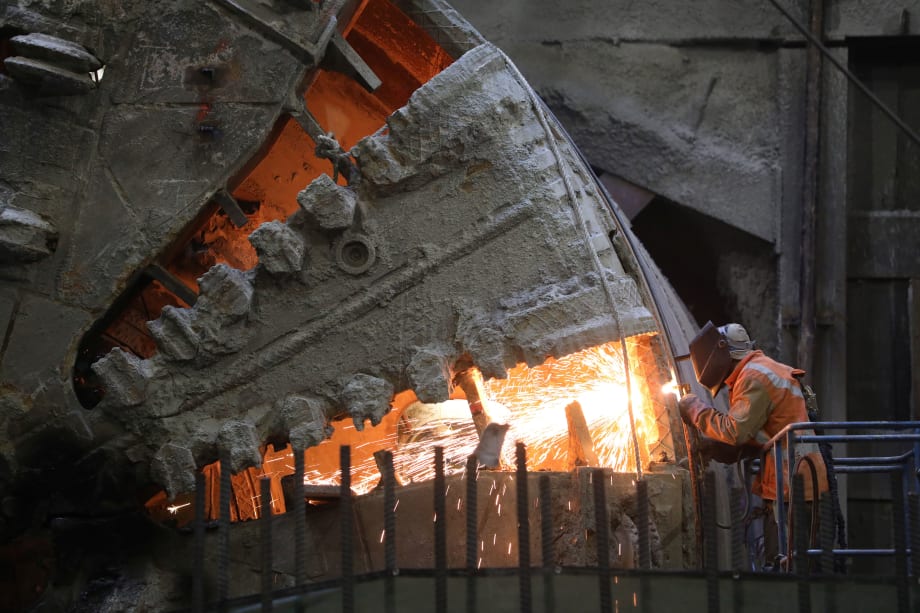
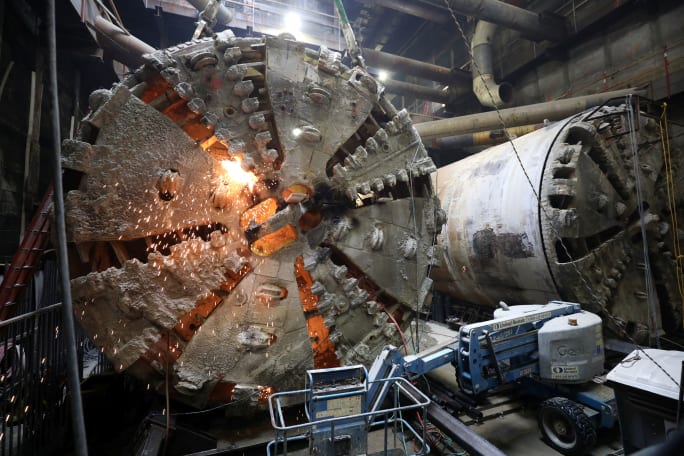
Contractors utilized the latest Tunnel Boring Machine (TBM) technology to excavate approximately 40 to 60 feet per day to help complete tunneling for the project. The 400 foot-long, 21 foot-diameter earth digging machines utilized closed face, pressurized TBM technology that minimizes ground settlement during excavation.
The machines also lined the tunnel itself with precast concrete segments that were bolted together to form secure rings making them water- and gas-tight, preventing water and gas-related risks. The same TBM technology was successfully employed on Metro’s 2009 Eastside Extension Project.
The 400 foot-long, 21 foot-diameter earth digging machines utilized closed face, pressurized TBM technology that minimizes ground settlement during excavation.
Photo: LA Metro
Making It to The Historic Milestone
During its five years of tunneling, Metro faced and successfully overcame many technical challenges like gassy ground, tar sands, and abandoned oil wells. Near the La Brea Tarpits, for example, Metro’s advanced TBMs made their way through tar sands, and used horizontal directional drillings to probe the earth so contractors could identify and remove potential objects before any TBM damage occurred.
Metro also safely used the same methods to identify and avoid unmapped and abandoned oil wells underneath Beverly Hills High School.
Ad Loading...
"The end of tunneling work on this project is a triumph of engineering, planning and execution. Our construction team undertook a painstaking process that helped us keep everyone in these communities safe and deliver a better project for the people of L.A. County," said Stephanie Wiggins, Metro CEO. "We have proven yet again our capability to safely tunnel underneath a range of different structures as well as sensitive and historic sites."
Forecasted openings are 2025 for Section 1, 2026 for Section 2, and 2027 for Section 3 of the project.
Metro secured local funding to build the project via the 2008 Measure R and 2016 Measure M voter-approved transportation sales tax measures. These local funding sources were then matched by federal funding, which ultimately amounted to approximately half of the project’s overall cost.
Contract Four is the largest in the Second Avenue Subway Phase 2 project and includes construction of station infrastructure, tracks, and signals for the subway expansion, MTA officials said. Work on Contract Four will begin in 2027.
The Garden State Initiative analysis examines the roles of Amtrak infrastructure, fleet management, and agency operations while recommending a more performance-based approach to improving reliability.
Beginning in 2027, Stadler will provide on-site technical expertise, spare parts support, training, and obsolescence management to help extend the reliability and longevity of CapMetro’s GTW fleet.
In METRO's latest installment, we take a look at recent news from Complete Coach Works, Beep, FlixBus, and more partnerships making headlines across the transportation sector.
Pedestrian microsimulation is helping rail planners identify bottlenecks, test station designs, and prepare complex transit hubs for growing passenger volumes.
The privately developed project would offer a 15-minute trip between downtown and O’Hare’s Terminal 2, with trains operating every 15 minutes on a dedicated track. The service would use battery-electric trains and three existing freight rail rights-of-way.
The draft feasibility report identifies strategies to protect the coastal rail line for decades as the agency continues near-term stabilization and sand placement efforts.