



Scott Sauer Named Interim GM in Philadelphia
SEPTA Board Chair Kenneth E. Lawrence Jr. announced Sauer would serve as interim GM while the board considers a permanent successor to former GM Leslie S. Richards, who stepped down at the end of November.

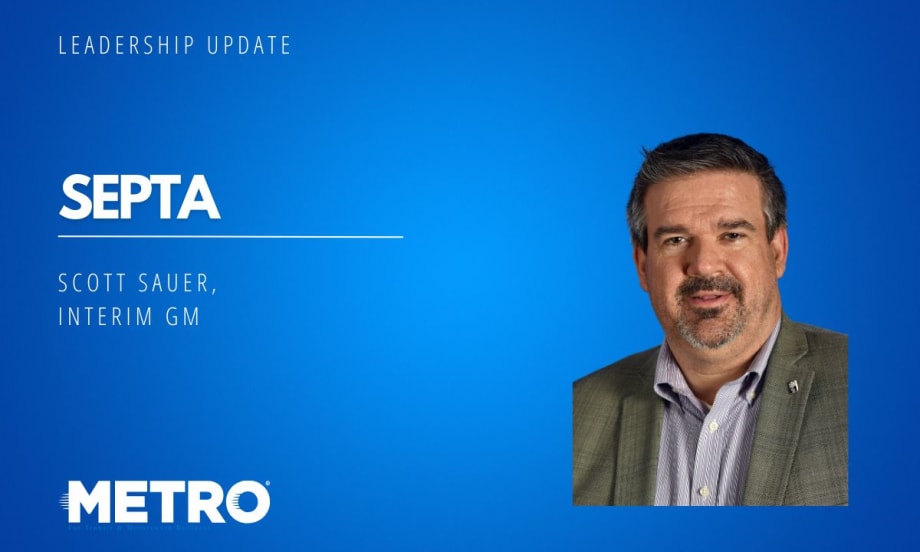
A second-generation transit professional, Scott Sauer follows in the footsteps of his late father, Robert, who served the Philadelphia Transportation Co. and SEPTA for 30 years.
Photo: SEPTA
Long-time Philadelphia SEPTA veteran Scott Sauer took on a new role as the authority’s interim GM.
Sauer had most recently been the COO.
Filling the Void
SEPTA Board Chair Kenneth E. Lawrence Jr. announced Sauer would serve as interim GM while the board considers a permanent successor to former GM Leslie S. Richards, who stepped down at the end of November.
Sauer started his career with SEPTA in 1990 as a surface train operator. A second-generation transit professional, he follows in the footsteps of his late father, Robert, who served the Philadelphia Transportation Co. and SEPTA for 30 years.
“I am honored to be entrusted with the stewardship of a transit system that is absolutely essential to the region’s success,” said Sauer. “My priority will be to commit this organization to a back-to-basics philosophy emphasizing the fundamentals that keep Greater Philadelphia moving each day: safety, customer service, and reliability.”
Sauer’s Tenure at SEPTA
Over the years, Sauer progressed through roles as a subway/elevated train operator, transportation manager, and safety officer.
In 2013, he was appointed asst. GM, system safety, where he developed and implemented critical safety initiatives.
In 2017, Sauer was promoted to asst. GM, operations, overseeing all operational aspects of SEPTA, including transportation, control center, vehicle maintenance, and station cleaning.
In 2022, Sauer was named COO, expanding his oversight to include the engineering, maintenance, and construction division; transit police; and capital programs.
His leadership has guided the organization through significant challenges, including the COVID-19 pandemic, cybersecurity incidents, civil unrest, and budgetary constraints.
Sauer also manages a $2.5 billion annual budget, focusing on transformative projects such as rail fleet replacements, station upgrades to achieve full accessibility by 2035, and infrastructure improvements to enhance SEPTA’s reliability and state of good repair.
Industry Involvement
Sauer is a nationally recognized transit safety and operations expert, serving on multiple industry boards and committees, including two terms with the Federal Transit Administration’s Transit Advisory Committee for Safety (TRACS), where he served as chairman; the Transportation Research Board (TRB) Committee on Transit Safety and Security; the Northeast Corridor Safety and Security Committee; and the board of directors for Operation Lifesaver Inc., a national rail safety organization.
Since 2011, Sauer has also been a faculty member in the USDOT TSI Associate Staff Program, teaching Transit Rail Incident Investigation and mentoring future transit professionals.
More Management

METRO Opens Submissions for 2026 Motorcoach Awards
Nominations are now being accepted for METRO Magazine’s Operator of the Year and Innovative Operator of the Year awards.
Read More →
New York MTA Advances Final Contract for Second Avenue Subway Expansion
Contract Four is the largest in the Second Avenue Subway Phase 2 project and includes construction of station infrastructure, tracks, and signals for the subway expansion, MTA officials said. Work on Contract Four will begin in 2027.
Read More →
Transit Agencies Highlight Safety Gains at National Summit
Leaders from 15 major transit systems shared crime-reduction results and safety initiatives while discussing the role of continued federal support.
Read More →

NITA Names New Leadership, Expands Reduced-Fare Program at First Board Meeting
The new regional transit authority appointed its first board chair and interim executive director while extending reduced fares across CTA, Metra, and Pace for eligible riders.
Read More →
Beyond the Checklist: A Structured Approach to Transit Maintenance
Reliability-Centered Maintenance helps transit agencies move beyond routine checklists to focus limited resources on the assets and failures that have the greatest impact on safety, reliability, and service.
Read More →
APTA 2026 Nominating Committee Selects Leadership Slate, Names Chair and Vice Chair Nominees
Leadership changes will help shape the association’s priorities and its representation of the transportation industry during the 2026–2027 term.
Read More →
DART Launches Major Security, Fare Enforcement Initiative
The 90-day demonstration will deploy coordinated security teams at five light rail stations while testing controlled access and gathering data to guide future investments.
Read More →
Advancing Fare Collection Through Technology and Innovation
Learn about delivering 1300 gates at 91 stations while managing fare evasion. Explore the large scale deployment, solution customization and real-world results that affect the region. Prepare for deployment in your region now.
Read More →
Game Day in Motion: Moving Millions During the 2026 World Cup
Between packed transit stations and team motorcoaches, see how agencies and operators across North America tackled the transportation demands of the 2026 FIFA World Cup.
Read More →
Surface Transportation Extension Averts Shutdown, Leaves Transit Funding Gap
The stopgap keeps federal transportation programs moving, but missing advance funding could complicate the transit and rail projects agencies are planning next.
Read More →