



2024 Ridership on LA Metro Hits 311M
The total marks an 8% increase over 2023 annual ridership numbers and the first time the agency has reached this level of ridership since before the COVID-19 pandemic.


Throughout the year, Metro improved the reliability and frequency of bus service to improve customers’ travel experience on multiple routes and to better meet the needs of today’s riders.
Photo: LA Metro
The Los Angeles County Transportation Authority (Metro) saw more than 311 million boardings (311,261,332) in 2024 — an 8% increase over 2023 annual ridership numbers and the first time the agency has reached this level of ridership since before the COVID-19 pandemic.
In 2024, Metro surpassed one million average weekday boardings in September and October. Weekend ridership has surpassed pre-pandemic ridership levels for the past 25 months. Overall weekday ridership on Metro grew 8.7% year over year, while weekend ridership grew 5.8%.
“For more than two years, transit ridership has been growing in L.A. County said Stephanie Wiggins, CEO of Metro,” “ To me, that speaks to the fact that our efforts are making positive differences. We’re excited to welcome more riders in 2025, as we expand our system to LAX Airport, the San Gabriel Foothills, and the Wilshire Boulevard Corridor.”
How LA Metro Ridership is Growing
Several factors have played a part in Metro’s growing ridership.
Improved Service
Throughout the year, Metro improved the reliability and frequency of bus service to improve customers’ travel experience on multiple routes and to better meet the needs of today’s riders.
Bus service changes included more trips on some lines to provide added capacity, the transfer of two lines to Pasadena Transit as the new service provider, and the reconfiguring of some of the bus lines to improve regional connectivity to Metro rail. Bus ridership in 2024 increased 8.8% over 2023.
Improvements were also seen on Metro Rail.
The reconfigured A and E Lines marked their first full year of operation in June and combined saw a 33.4% ridership increase in December 2024 over December 2023.
Metro’s Aviation/Century Station, which opened last year, is now the transfer point for those on the C Line to transfer to the K Line providing service to the west side line stations including Mariposa, El Segundo and Douglas, and Redondo Beach Station. These stations are now serviced exclusively by the K Line.
Overall rail ridership grew 5.4% in 2024 over 2023.
Increased Leisure Ridership
Reflecting the evolution of ridership patterns, Metro’s weekend ridership continues to lead overall ridership growth.
Leisure riders are using the service for weekend events and throughout the year activities, such as the Hard Summer Music Festival, college football and Rams and Chargers games, Dodgers games, and the celebratory championship parade, plus holiday celebrations like Grand Park’s NYELA Countdown to 2025 and Christmas Eve and Christmas Day celebrations.
For many of these special events the agency provided additional late-night service and shuttle buses. This year Metro provided extended free service on Christmas Eve and New Year’s Eve.
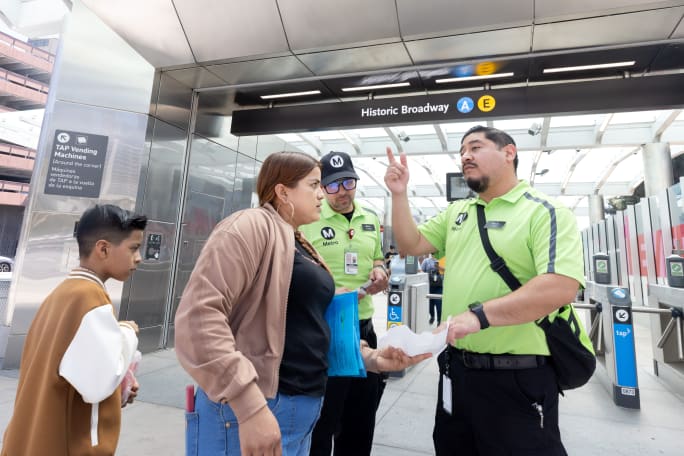
Metro’s law enforcement partners, Metro Transit Security Officers, private security, Metro Ambassadors, and care teams collaborate closely to provide a more visible presence on the system, address and prevent crime, provide enhanced customer experience, and connect people to the appropriate services.
Photo: LA Metro
Increased Safety
In 2024, Metro made significant progress in its efforts to provide a safer, cleaner, and more comfortable rider experience by focusing on its three-pronged public safety strategy:
Working to ensure an engaged and visible presence of uniformed personnel on Metro buses and trains, including law enforcement, Metro Transit Security, and Metro Ambassadors.
Enhancing access control by stepping up TAP inspections and trespasser checks and ensuring, to the greatest extent possible, that its system is only used for its intended purpose: transportation.
Strengthening partnerships to address societal issues that affect Metro, like homelessness, untreated mental illness, and addiction.
Metro’s law enforcement partners, Metro Transit Security Officers, private security, Metro Ambassadors, and care teams collaborate closely to provide a more visible presence on the system, address and prevent crime, provide enhanced customer experience, and connect people to the appropriate services.
The Metro Ambassador program has been so successful and popular with Metro riders that Metro is bringing the currently contracted program in-house as full-time Metro employees.
In June 2024, the Metro Board authorized the agency to launch a new in-house law enforcement agency, the Transit Community Public Safety Department (TCPSD).
The TCPSD will be staffed by more than 600 sworn police officers, homeless and crisis intervention specialists, and others to deliver a safe transit system for our customers and employees. The TCPSD will feature transit-specific training, allowing Metro to enforce consistent policy and rule implementation across the system.
Ensuring the Metro system is being used for the purpose of transit contributes to a safer transit system, and one new enforcement strategy deployed in 2024 was the TAP-to-Exit program that confirmed everyone paid their fare. Fare gates were locked at both ends of the journey so if passengers did not pay when they entered the system, fare was deducted from their TAP card when they exited.
The program is currently implemented at the North Hollywood Station on the B Line, the Downtown Santa Monica Station on the E Line and the A Line end-of-line rail stations, Azusa Pacific University (APU)/Citrus College and Downtown Long Beach.
Since TAP-to-Exit was implemented less than one year ago at North Hollywood, the program has captured nearly 120,000 unpaid passenger exits, translating to over $130,000 in fares recuperated. More stations are expected to be added to this successful program in 2025, beginning with Union Station this month.
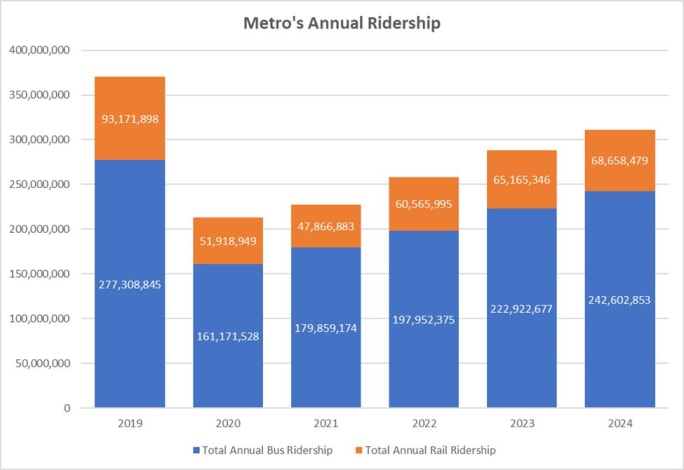
LA Metro's bus and rail ridership from 2019 through 2024.
Photo: LA Metro
A More Affordable Metro
Metro has several programs that support making it more affordable for all riders. Reduced-price transit passes, such as the student GoPass, which offers free transit passes to K-12 and community college students, and the LIFE program, which provides free rides and reduced fares to low-income customers, are increasingly helping these qualified riders.
In 2024, the GoPass Program saw 19,665,051 total boardings versus 17,720,181 in 2023, an 11% increase. The LIFE Program observed a 27% increase in ridership in 2024 with 20,873,250 boardings over 16,411,583 boardings in 2023.
Metro continues to offer a fare capping program under which riders who pay with a TAP card pay no more $5 a day or $18 over seven days. Once they’ve reached those limits, they ride free for the remainder of the day or seven-day period.
And Metro’s Mobility Wallet Pilot Program gives in-need Angelenos the freedom to choose the mode that best suits their needs by providing a debit card with $150 per month to spend on transportation. The card can be used to take the bus, ride the train, use bike share, take Metro-Micro, and more.
More Management

Beyond the Checklist: A Structured Approach to Transit Maintenance
Reliability-Centered Maintenance helps transit agencies move beyond routine checklists to focus limited resources on the assets and failures that have the greatest impact on safety, reliability, and service.
Read More →
APTA 2026 Nominating Committee Selects Leadership Slate, Names Chair and Vice Chair Nominees
Leadership changes will help shape the association’s priorities and its representation of the transportation industry during the 2026–2027 term.
Read More →
DART Launches Major Security, Fare Enforcement Initiative
The 90-day demonstration will deploy coordinated security teams at five light rail stations while testing controlled access and gathering data to guide future investments.
Read More →

Advancing Fare Collection Through Technology and Innovation
Learn about delivering 1300 gates at 91 stations while managing fare evasion. Explore the large scale deployment, solution customization and real-world results that affect the region. Prepare for deployment in your region now.
Read More →
Game Day in Motion: Moving Millions During the 2026 World Cup
Between packed transit stations and team motorcoaches, see how agencies and operators across North America tackled the transportation demands of the 2026 FIFA World Cup.
Read More →
Surface Transportation Extension Averts Shutdown, Leaves Transit Funding Gap
The stopgap keeps federal transportation programs moving, but missing advance funding could complicate the transit and rail projects agencies are planning next.
Read More →
Bus Tech Talk: Keeping Transit Technicians Ahead of the Technology Curve
LA Metro’s Obed Mejia discusses technician training, evolving maintenance technology, fleet replacement, and strategies for getting the most out of today’s transit fleets.
Read More →
Why Simulating Pedestrian Movement Has Become Essential for Modern Rail Stations
Pedestrian microsimulation is helping rail planners identify bottlenecks, test station designs, and prepare complex transit hubs for growing passenger volumes.
Read More →
People Movement: Holly Arnold Joins Transdev and More
In this edition, we also cover recent appointments and announcements at Pace, CamTran, MCI, and more, showcasing the individuals helping to shape the future of transportation.
Read More →
NITA Launches New Era of Regional Transit in Chicago
The new authority replaces the RTA and brings CTA, Metra, and Pace under a strengthened regional framework for funding, planning, fares, safety, and service coordination.
Read More →