




Miss This? King County Metro To Install Operator Safety Partitions Fleetwide
King County and City of Seattle Plan Bus Stop Upgrades for Safer, Faster Service
Planned improvements along First Avenue South aim to ease bus merging delays, enhance safety, and keep buses moving in traffic lanes.
July 14, 2025

King County Metro buses on First Avenue South near South Lander and Hanford streets often face safety risks and delays when merging back into traffic.
Photo: King County Metro
2 min to read
King County Metro is working alongside the Seattle Department of Transportation (SDOT) to make bus stop improvements for routes 21 and 50 in Seattle neighborhoods. Improving the bus services at three locations along First Avenue South in the SODO area could provide more reliability and safety to the bus service.
According to agency analysis and transit operator feedback, buses face safety challenges and travel time delays when merging back into traffic from bus stops near South Lander and Hanford streets.
From July 11 through August 8, the agency will inform nearby businesses and property owners about early concept designs that will provide improved or relocated bus shelters, improved lighting, and wider sidewalks that will allow buses to stay in-lane while riders board and exit.
Design Concept Improvements
King County Metro and SDOT will work together on the design and construction phases for each proposed location of this project. Preliminarily, design work and public outreach are planned for 2025, construction in 2026, and project completion in 2027.
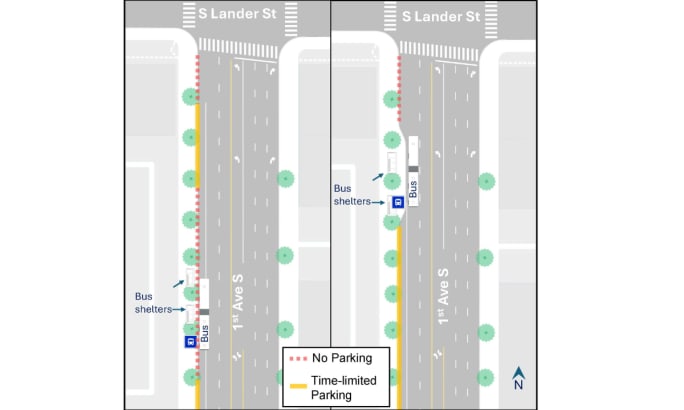
This map shows the current bus stop on the west side of First Avenue South located south of South Lander Street. This proposed stop location will be relocated closer to South Lander Street.
Photo: King County Metro
First Avenue South and South Lander Street changes include:
The sidewalk on the west side of First Avenue South will be widened to allow buses to stay in the traffic lane while riders board and exit the bus.
The bus stop will be relocated closer to the crosswalk.
The existing shelters will be replaced by a new shelter.
SDOT may create additional time-limited parking and/or load zones.
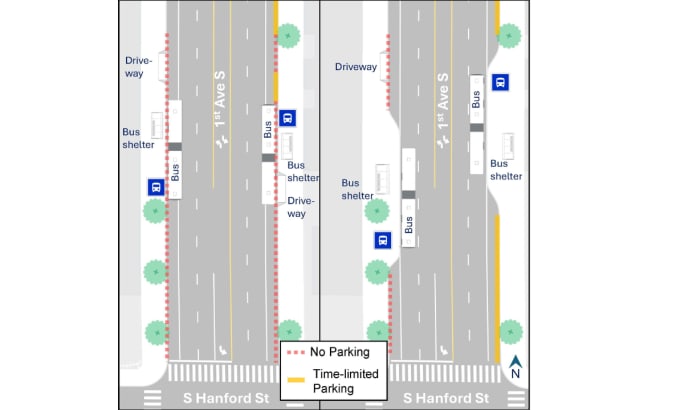
This map shows the current bus stops on First Avenue South located north of South Hanford Street. The proposed stop locations would move about a half of a bus length in each direction, farther south on the west side of First Avenue South and farther north on the east side of the same street.
Photo: King County Metro
First Avenue South and South Hanford Street changes include:
Sidewalks on both sides of First Avenue South will be widened to allow buses to stay in the traffic lane while riders board the bus. The left lane will remain open for other vehicles to pass a bus serving the stop.
SDOT may adjust time-limited parking and passenger load zones.
The driveway on the east side of First Avenue South near the bus zone will be removed and become part of the sidewalk that will be widened.
The passenger load zone on the west side of First Avenue South, north of South Hanford Street near the bus stop, will be removed.
More Bus
Indian River Transit’s Community-Focused Approach Earns National Recognition
Named APTA’s 2026 Outstanding Public Transportation System in its size category, Florida’s Indian River County transit system continues to grow ridership through fare-free service and a focus on evolving community needs.
Read More →
ENC Lands MATA Contract and More in Biz Briefs
In this edition of Biz Briefs, we spotlight the latest developments shaping the future of mobility.
Read More →
From Surviving to Thriving: Building Stronger Transportation Organizations
Bus Business Consultants founder Brian Dickson shares lessons on leadership, organizational health, and creating options for long-term success in a changing transportation industry.
Read More →
Everett Transit, Community Transit Outline Consolidation Agreement
The proposed agreement calls for a 50% increase in bus service in Everett, a new microtransit zone, continued paratransit service, and the transfer of Everett Transit operations to Community Transit.
Read More →
SEPTA Details Accelerate Vision for Transit System
The plan outlines investments in trolley modernization, new Metro and Regional Rail vehicles, accessible stations, and more frequent bus and rail service.
Read More →
Report: Transit Bus Manufacturing Supports 34,100 Jobs, $5.1B in GDP
The “Buses Mean Business” report examines the transit bus manufacturing industry’s economic footprint, supply chain, and rising demand for vehicle replacements.
Read More →
Biz Briefs: New Flyer Delivers in Columbus, Houston, Beep and Freebee Merge, and More
In this edition of Biz Briefs, we spotlight the latest developments shaping the future of mobility.
Read More →
People Movement: Dan Dipert Coaches Adds Third-Generation Leader, Keolis Names New Valley Metro VP/GM, and More
In this edition, we also cover recent appointments and announcements at the Wabtec, SilverRide, HNTB, and more, showcasing the individuals helping to shape the future of transportation.
Read More →
New York MTA Plans Largest Bus Fleet Upgrade in More Than a Decade
The agency is seeking manufacturers for 650 new CNG buses to replace aging vehicles, improve reliability, and advance its broader fleet modernization strategy.
Read More →
Building a Flexible Path to Transit Electrification
John Hroncich discusses BAE Systems’ modular and scalable approach, lessons learned from decades of real-world operations, and how agencies can identify electrification strategies that fit their fleets.
Read More →