



Improving Transit Accessibility by Offering Assistive Listening
Did you know that there are literally tens of millions of people worldwide with hearing loss, many of whom will use some form of public transit at some point?

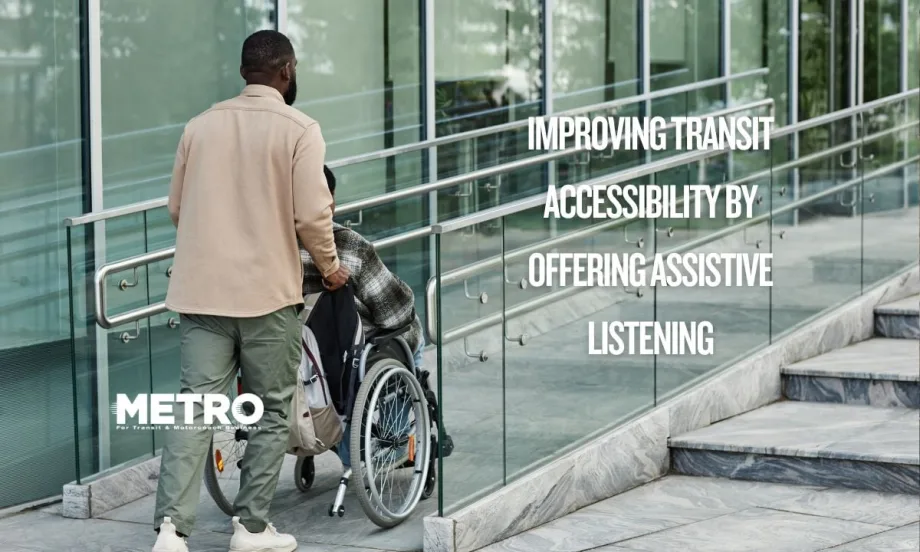
When the Americans with Disabilities Act was signed into law in 1990, hearing loss was recognized on a federal level as a disability.
Photo: METRO
- Tens of millions of people globally experience hearing loss.
- Many individuals with hearing impairments utilize public transit.
- Offering assistive listening on public transit can improve accessibility.
*Summarized by AI
When we think of accessibility, most people think of addressing the needs of those with physical disabilities. There are wheelchair lifts and ramps, priority seating, properly placed handrails, wider doors, and kneeling systems to reduce the gap between the bus and the curb.
But what is being done for passengers and travelers with hearing loss? In many cases, very little.
Did you know that there are literally tens of millions of people worldwide with hearing loss, many of whom will use public transit at some point? According to the CDC, the reported number of Americans with mobility-related disabilities is around 41 million, or about 12% of the country.
Meanwhile, the number of Americans living with hearing loss is estimated at 50-73 million, according to data from the Hearing Loss Association of America and the Center for Hearing Access, respectively.
When the Americans with Disabilities Act was signed into law in 1990, hearing loss was recognized on a federal level as a disability. To this day, 35 years later, hearing loss is still often overlooked when planning for accessibility needs, despite the massive number of people dealing with hearing loss or a decrease in the quality of their hearing.
Challenges for Individuals with Hearing Loss
The three most significant challenges for individuals with hearing loss are the effectiveness of hearing aids and their internal microphones, the quality of the sound source, and the presence of background noise and interference.
Firstly, hearing aids are most effective when the sound source is at a distance of three to six feet away. Beyond that, the hearing aid doesn’t receive sound in a high-quality enough state to work with and improve. In the case of announcements, whether on a bus, train, or otherwise, the PA system speakers are often further away than this ideal range.
The second factor is the quality of the sound source.
There is a perceived quality of sound and the actual quality of the sound. What this means is that for those without hearing loss, something may sound great. However, once a person has hearing loss, they realize that previously satisfactory sound quality is no longer acceptable.
Additionally, the sound quality from the PA speakers can vary significantly, as can the severity of the person’s hearing loss.
For example, a person can visit five different fast-food or bank drive-through lanes and will likely have five different experiences based on the quality of the sound equipment. Those of a certain age will remember the saying, “garbage in, garbage out.” If the sound system is not producing good sound, the hearing aid will also not deliver good sound to the wearer.
The third factor is background noise and interference.
Background noise can be electrical, such as a buzz or hum, or organic, including road and traffic noise and conversations from other passengers. In quiet environments, there is no clear-cut fight between good and evil — just spoken word versus background noise.
However, once a person enters public, the battle ensues. A person with hearing loss needs the ratio of intended sound (speech) versus background noise to be excellent.
A good example is when a 21-year-old goes to a nightclub; they can carry on a conversation despite the noise and music. Try that at 40 or 50. It is much more challenging as hearing loss sets in — the noise must be far lower in volume than the conversation.
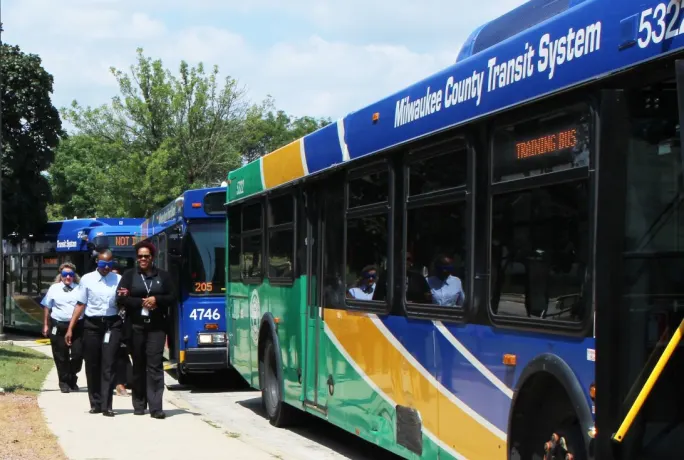
There is one way to improve the quality and listening experience in the transport sector — with assistive listening systems.
Photo: MCTS
What Can Improve the Experience?
There is one way to improve the quality and listening experience in the transport sector — through assistive listening systems (ALS). Assistive listening systems are exactly what they sound like; they allow the intended sound to be transmitted and heard in a way that eliminates or mitigates the three issues above. They can work on buses, trains, boats, and cars.
There are various versions of ALS, but there are only a few suited for transit use.
Hearing Loops, or Induction Loops, are the primary way. This technology transmits sound directly from the sound source into a passenger’s T-coil-equipped hearing aid or cochlear implant. This allows the passenger to take advantage of their personal, prescriptive corrections in the programming of their hearing aids to achieve clear, concise sound. It also eliminates or reduces background noise interference. These allow passengers to have the best chance of hearing and understanding an announcement.
This technology is being implemented worldwide in buses and taxis as we speak. It is required in the UK on all public buses by October 2026. The U.S. and Canada don’t yet have this requirement, but perhaps they will one day. But public transit is not the only one implementing it.
Similarly, private fleets operate tour businesses. For them, improving accessibility increases customer satisfaction, which can translate to increased revenue from repeat business.
The second, and potentially a solution for the future, is Auracast by Bluetooth. This new and developing technology will eventually allow passengers to receive sound, similar to that of a hearing loop user, in their hearing aids.
However, currently, there are very few users with Auracast-enabled hearing aids. So, for now, this would require a device to receive the sound. This could be a dedicated Auracast receiver, an Auracast-enabled headset, or similarly equipped earbuds.
Another way to improve accessibility for travelers is to provide window intercom systems at points of sale and interaction where there is glass between staff and visitors. Try talking through a thick pane of glass while covering your ears with your hands. This is what it is like for a person with hearing loss to communicate at a ticket window.
Companies such as Contacta Inc. make accessibility possible through hardware that enables passengers with hearing loss to communicate. This equipment is R10-compliant and designed to withstand the challenges of vehicle-installed hardware, including electromagnetic compatibility and vibration.
Additionally, their window intercom systems provide not only speakers and microphones for staff and travelers alike, but also hearing loops.
By installing a hearing loop on public or private transport, passengers with hearing loss will have the opportunity to hear announcements and tour information clearly and equally, as well as other passengers without hearing loss. And in the end, that is the goal — to provide equal access to all.
Quick Answers
Assistive listening devices make announcements and other auditory information more accessible to individuals with hearing loss, allowing them to navigate transit systems more effectively and independently.
*Summarized by AI
More Blog Posts
35 Years of the ADA, Making Travel Easier for Seniors
Thirty-five years after the passage of the Americans with Disabilities Act of 1990 (ADA), the impact of this landmark piece of civil rights legislation cannot be overstated.
Read More →
Driving Performance with Purpose: How I Lead One of Greyhound’s Top Teams
Safety, on-time performance, and customer experience are critical elements in intercity bus operations. But getting them right doesn’t come down to plans or protocols alone. It comes down to execution. How well your team performs on the ground, in real time, is what defines success.
Read More →
Navigating Emerging Privacy Laws: A Call to Action for Service Providers in Mass Transit
With Data Privacy Day Jan. 28, I want to spotlight a critical challenge faced by service providers in the mass transit sector: managing personal information responsibly in an era of rapidly evolving privacy regulations.
Read More →
Human Trafficking Awareness: What Public Transportation Can Do?
January is National Slavery and Human Trafficking Prevention Month in the U.S., and January 11 is National Human Trafficking Awareness Day.
Read More →
Want to Improve Transit Safety and Operations? Break Down the Silos
Retrieving and reviewing data and video can be a cumbersome process for fleet managers. Each system or tool provides a piece of the puzzle, but seeing the complete picture requires tedious manual synchronization.
Read More →
Ensuring Public Transit Cybersecurity Through Robust Protective Measures
In today’s highly connected world, cybersecurity is of utmost importance, particularly for transportation agencies overseeing transit bus systems that rely increasingly on sophisticated technologies, including the use of data analytics in traffic signal networks, to manage and operate their systems.
Read More →
How Advances in Thermal Management Revolutionize Urban Mobility
In the daily hustle and bustle of city life, transit buses serve as the backbone of urban transportation, allowing millions of city dwellers to get from point A to point B each day reliably.
Read More →
The Evolution of Bus Design
Thirty years ago, drivers not only had to drive the bus and navigate heavy traffic, but they were also responsible for tasks like supervising passenger loading and unloading, selling tickets, and providing passengers with various kinds of information, all while sitting in an often ill-fitting workstation.
Read More →
What 'Transit Safety 101' Really Means
Safety, Safety, Safety. This word is used repeatedly, and in many contexts, without most people understanding what it actually means.
Read More →
5 Ways AI Will Impact the Bus and Motorcoach Sector
The old joke that you wait ages for one bus and suddenly three come along at once may be consigned to the history bin thanks to developments in artificial intelligence (AI).
Read More →