



Guidelines for Assisting, Securing Passengers with Disabilities in Transit Vehicles
Not making assumptions about your customer’s intellectual or physical capabilities is one of the key guidelines to follow.
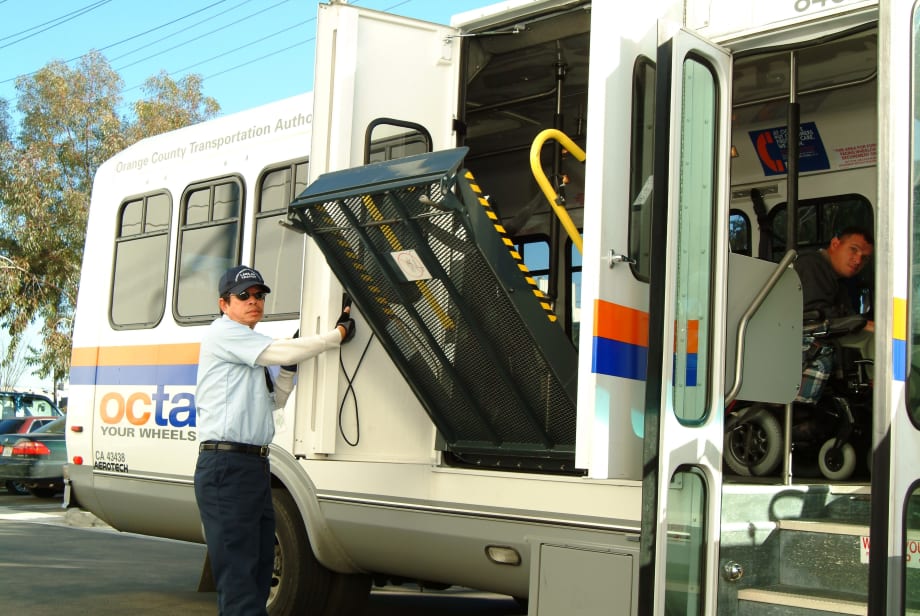
Photo courtesy OCTA
Photo courtesy OCTA
Passengers with physical disabilities may need assistance getting in and out of a vehicle. Passengers who are blind or who have a visual impairment and passengers who are deaf or hard of hearing may request assistance with directions or communication. A passenger who has a cognitive disability may become confused or agitated about time of pick-up or departure locations and may need additional assistance through repeated or written information. No matter the mobility level or type of disability, all passengers should be treated in an equitable and friendly manner.
Easter Seals Project ACTION shares a few basic tips on assistance, securement, communication, and preparation that will provide your company with a strong foundation for serving customers with disabilities.
Assistance
Ask the customer if they need assistance before you act. Never make assumptions about your customer’s intellectual or physical capabilities.
Do not lean on or touch a person’s mobility device or wheelchair without asking permission.
Be patient and allow the customer to take their time. Respond to them in a calm, professional manner.
When speaking with someone who is blind, identify yourself and others who may be assisting you. When you offer to assist, allow the person to take your arm. Be specific when providing directions and identify architectural elements or barriers the person should consider when approaching or leaving the vehicle.
Operators must allow all service animals on board and may not ask for proof of their certification.
Operators may not require a passenger traveling with a service animal to sit in a particular seat on the vehicle.
Passengers with service animals are responsible for knowing the best way to position the animal on the vehicle, and the service animal may not block aisles or exits.
Communication
Use person-first language. For example, say “a customer with a disability” or “a passenger who uses a wheelchair” instead of “disabled customer” or “wheelchair user.”
Speak directly to the customer rather than to their companion.
When speaking with a customer who is deaf or hard of hearing, face the person and do not let objects obstruct their view. Do not raise your voice unless asked.
Keep a pad of paper and pen on hand in case you or the passenger need to write during the conversation.
Securement
ADA regulations allow transportation providers liberty to make rules concerning operations and safety. If your operation has an established policy requiring mobility device securement, a passenger must allow you to secure their device.
Vehicle operators are responsible for knowing how to secure mobility devices, so that they can do so if requested or required by their company’s policy. Operators must assist passengers with disabilities with the use of ramps, lifts and securement systems.
Operators should not lift passengers or provide physical assistance other than through the use of vehicle accessibility equipment.
The shuttle operator cannot refuse a passenger a ride if there is a legitimate reason the device cannot be secured (e.g., vehicle securement equipment is inoperable or not compatible with a passenger’s mobility device).
The size and weight of customers’ mobility devices vary, so it is important that vehicle operators know the maximum size and weight capacities of the vehicle’s lift equipment.
A vehicle operator is not permitted to require people who use mobility devices to use seat belts and shoulder harnesses unless the operator requires all customers to use them.
Complete regular pre-trip vehicle safety inspections to make sure that securement systems and accessibility equipment are in good working order.
For more information, visit www.projectaction.org, email projectaction@easterseals.com or call (800) 659-6428.
Rachel Beyerle - Easter Seals Project ACTION resources & publications manager
More Paratransit

Biz Briefs: RIPTA Unveils New Frontrunners, Clevland RTA Adds New Siemens, and More
In METRO's latest installment, we take a look at recent news from Siemens, Prevost, Dodge, and more partnerships making headlines across the transportation sector.
Read More →
King County Metro Makes ADA Paratransit Easier to Navigate
METRO's Innovative Solutions Award winner replaces complex service-area descriptions with an accessible, interactive map that puts paratransit information directly in customers’ hands.
Read More →
Jacksonville’s NAVI Project Charts a New Course for Autonomous Public Transportation
Through its NAVI program, JTA is showing how autonomous vehicles, intelligent infrastructure, and coordinated operations can work together to deliver everyday public transportation.
Read More →
Driving Smarter Paratransit
John Hanlon shares how AlphaRoute is leveraging AI-powered technology to help paratransit providers optimize operations, support frontline staff, and enhance the rider experience.
Read More →
METRO Magazine Announces 2026 Innovative Solutions Awards Winners
Projects Recognized for Advancing Mobility Through Technology, Accessibility, Workforce Innovation, and Operational Excellence
Read More →
Biz Briefs: STV teams with Amtrak, Motorcoach Operators Boost Fleet and Land Contracts, and More
From manufacturers and suppliers to transit agencies and motorcoach operators, these updates offer a snapshot of the projects, partnerships and business moves driving the industry forward.
Read More →
Biz Briefs: Masabi Teams with St. Louis Metro and More
In METRO's latest installment, we take a look at recent news from Transdev, Hitachi, and more partnerships making headlines across the transportation sector.
Read More →
New York MTA Leverages Zoning Program to Advance Station Accessibility
Accessibility enhancements at Nevins St Station will be financed through a development agreement tied to the MTA's Zoning for Accessibility initiative.
Read More →
Reinventing Fleet Maintenance with Real-time Visibility and AI
Transit leaders need to know what needs fixing, where to look, who is responsible, when work is completed, and what it costs without having to chase information across disconnected systems.
Read More →
SamTrans Sets Priorities for Potential Connect Bay Area Revenue
The board-approved framework allocates future funding to maintaining service, rider improvements, equity initiatives, and infrastructure repairs.
Read More →