



2013 BRT Survey: Coordination, Construction Top Challenges
While many operators cited receiving plenty of political and community support, they reported contending with difficulties in coordination with other jurisdictions, Departments of Transportation, transit agencies and city staff.

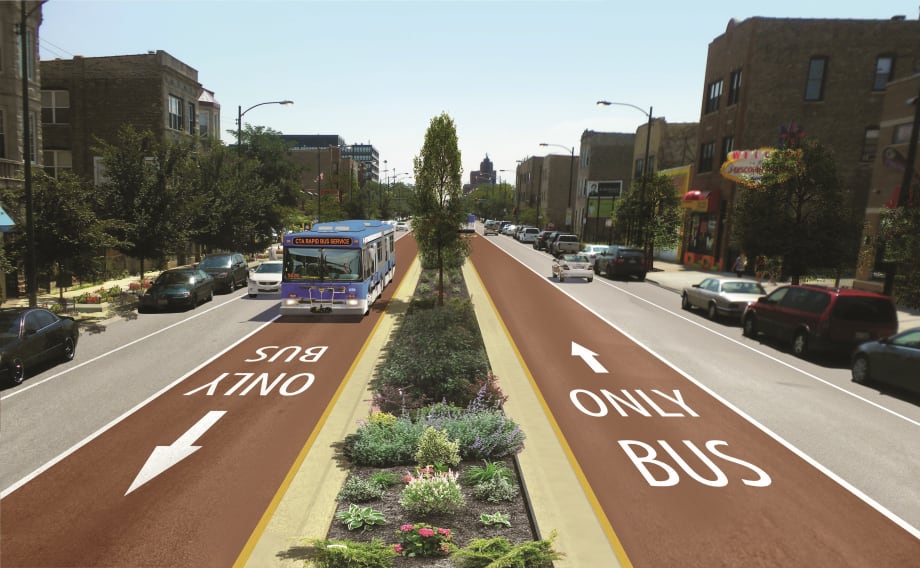
Chicago Transit Authority is planning to open a second BRT route next year. Rendering shown.
Chicago Transit Authority is planning to open a second BRT route next year. Rendering shown.
METRO’s bus rapid transit survey results for 2013 include 64 projects, 61 of which are located in the U.S., with three in Canada.
Since we checked in on various projects last year, Chicago; Las Vegas; Stockton, Calif.; Seattle (RapidRide C and D Lines); and San Antonio (Prímo) began operating new routes. This year, Aspen, Colo.-based Roaring Fork Transportation Authority (RFTA), Monterey Salinas Transit, and two San Diego and Seattle lines will launch new routes, for a total of six, the same number as last year. The projects slated farthest in the future are Minneapolis-based Metro Transit’s Orange Line and San Francisco Municipal Transportation Agency’s Geary Corridor BRT.
Last summer, RFTA won a “White House Champion of Change” award as a transit innovator for its VelociRFTA route. Meanwhile, construction on the project will be done this fall, Dawn Chase, marketing, communications & design manager, says.
Additionally, San Bernardino, Calif.-based Omnitrans received six of the vehicles for its E Street Corridor sbx BRT project from New Flyer over the past four months. The remaining eight are in production and due by April.
The region producing the highest number of BRT projects was, as usual, the West Coast, with 30. The majority of them are located in California (63%). Projects in this region combined for a total of $1.8 billion, on par with last year’s $1.7 billion total.
The project that reported the highest number of vehicles is OC Transpo’s Transitway, with 500 buses.
Nearly all respondents (91%) are using or plan to use low-floor style vehicles. Three-quarters selected enhanced aesthetics, slightly more than last year, and two-thirds selected passenger amenities — another bump from last year — and articulated vehicles.
Exactly one-half of operators plan to use hybrid-electric propulsion for their buses, about the same as last year. Nearly one-third selected CNG, up slightly from last year’s 28%, with clean diesel down by about one-third from last year, at 21%. Only 3% of operators plan to use trolleys.
Federal funding, including FTA’s Very Small Starts, Small Starts, and Congestion Mitigation and Air Quality, comprised 81% of the funding for projects. More than two-thirds of projects received local support, and state funds were awarded to nearly half of all projects.
However, this year’s project roundup showed less local funding — 69% compared with last year’s 80% — but that could be because more projects were submitted this year.
Top challenges cited were construction as well as coordination with other jurisdictions, streetcar lines, Departments of Transportation, other transit agencies and city staff. The most common project benefits reported were travel time savings and shorter dwell time; connections to major employers and transfer points, airport and rail; improved job and housing access; and faster boarding due to pre-boarding tickets. Additionally, one project created or sustained the equivalent of 900 full-time jobs: Regional Transportation Commission of Southern Nevada’s Sahara Express. [PAGEBREAK]
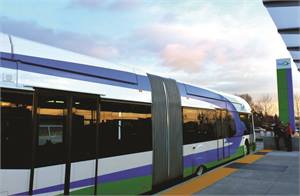
Everett, Wash.-based Community Transit’s SWIFT is one of many projects that receives a high level of community and political support. However, coordination has been a challenge.
For fare collection, more than two-thirds chose cash/coin, more than half chose on-board and off-board payment, about half chose smart card payments and slightly more than one-third chose magnetic strip. Three of the projects submitted, those run by Orlando, Fla.’s Central Florida Regional Transportation Authority (LYNX), are fare-free.
Among running way features, survey respondents overwhelmingly chose mixed-flow arterials, at 92%, with dedicated arterials at half that rate (46%). Selection of station characteristics broke down as designated stations (81%), enhanced stops (63%), pedestrian-friendly areas (79%) and intermodal terminals (48%). Other features included enhanced lighting (15%, nearly half of which is solar-powered), real-time message signs and fare vending machines (14%), and bicycle accessibility (5%).
Nearly all respondents chose passenger information when asked about ITS features. More than three-quarters selected signal manipulation (89%), vehicle tracking (83%) and voice annunciation (78%). Nearly half are using ITS for security and almost 10% are offering Wi-Fi. Other uses included telephone system for stops and a passenger counting system, cited by Ottawa’s Transitway.
For more, click here and here.
More Bus

New York MTA Plans Largest Bus Fleet Upgrade in More Than a Decade
The agency is seeking manufacturers for 650 new CNG buses to replace aging vehicles, improve reliability, and advance its broader fleet modernization strategy.
Read More →
Building a Flexible Path to Transit Electrification
John Hroncich discusses BAE Systems’ modular and scalable approach, lessons learned from decades of real-world operations, and how agencies can identify electrification strategies that fit their fleets.
Read More →
Bus Tech Talk: Keeping Transit Technicians Ahead of the Technology Curve
LA Metro’s Obed Mejia discusses technician training, evolving maintenance technology, fleet replacement, and strategies for getting the most out of today’s transit fleets.
Read More →
Biz Briefs: RIPTA Unveils New Frontrunners, Clevland RTA Adds New Siemens, and More
In METRO's latest installment, we take a look at recent news from Siemens, Prevost, Dodge, and more partnerships making headlines across the transportation sector.
Read More →
People Movement: Holly Arnold Joins Transdev and More
In this edition, we also cover recent appointments and announcements at Pace, CamTran, MCI, and more, showcasing the individuals helping to shape the future of transportation.
Read More →
The High Cost of Transit Buses: Industry Leaders Look to Procurement Reform
Transit leaders and policymakers examine how standardized bus designs, streamlined procurement, and predictable funding could help agencies stretch budgets and deliver better service.
Read More →
The Business Voice Behind Public Transportation
As chair of APTA’s Business Members Board of Governors, Ray Melleady explains how more than 850 business members are partnering with transit agencies to advance funding, innovation, and industry-wide collaboration.
Read More →
From Surviving to Thriving: Building Stronger Transportation Organizations
Bus Business Consultants founder Brian Dickson shares lessons on leadership, organizational health, and creating options for long-term success in a changing transportation industry.
Read More →
Finding the ‘Happy Medium’: Optimizing Maintenance Without Sacrificing Reliability
The key to maintenance optimization isn’t doing less work—it’s doing the right work at the right time on the right assets.
Read More →
LA Metro, City of West Hollywood, and Partners Advance Smarter Bus Lane Enforcement
The award-winning partnership combines AI-powered detection with human oversight to improve bus reliability, accessibility, and enforcement efficiency.
Read More →