



2013 Women In Transportation: Virginia Miller
Despite dreams of growing up to be an astronaut, an archeologist, a dancer, and at one time, an Olympic gold medalist for swimming the backstroke, Virginia Miller decided she wanted to be a social studies teacher, with a stretch goal to be a Congresswoman.
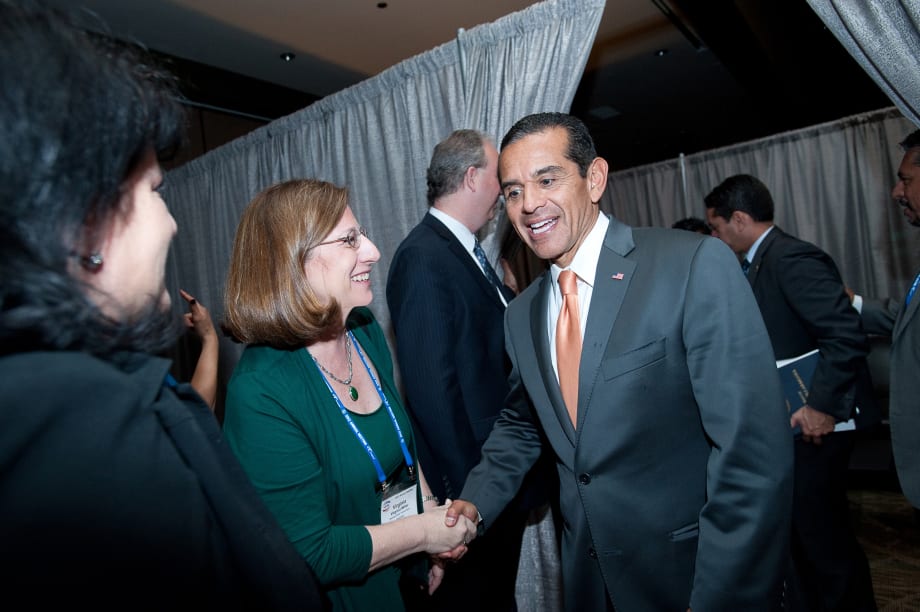
Miller shown with then-Los Angeles Mayor Antonio Villaraigosa at APTA’s 2012 Annual Awards ceremony, says she is proud of her work managing the annual event.
Miller shown with then-Los Angeles Mayor Antonio Villaraigosa at APTA’s 2012 Annual Awards ceremony, says she is proud of her work managing the annual event.
Virginia Miller
Director, Media Relations, American Public Transportation Association,
Washington, D.C.
Despite dreams of growing up to be an astronaut, an archeologist, a dancer, and at one time, an Olympic gold medalist for swimming the backstroke, Virginia Miller decided she wanted to be a social studies teacher, with a stretch goal to be a Congresswoman. She pursued her goal to be a teacher as a government major at Smith College before switching to a comparative religion major, to help her “figure out what life is.”
In her mid-twenties she got a position working for WGBH-TV, the top PBS station in the country at the time, known for producing such shows as NOVA and Julia Child’s cooking specials. It was here she was introduced to the communications industry, developing voiceover scripts, clips and other duties helping with show promotions.
Next she moved to New Hampshire, and in her first foray in the transportation industry, was hired as the public affairs manager for AAA New Hampshire. She was also the registered lobbyist for the association, representing 100,000 people. Having won every political battle that she fought, including a highway safety mandate restricting twin trailer access, Miller’s boss told her that she should work on campaigns.
Less than a decade later, she was hired as a paid staffer working on then-Gov. Bill Clinton’s New Hampshire primary campaign. She was charged with canvassing Nashua, the second-biggest city in the state, developing the campaign routes and finding volunteers. Her ingenuity shone through with the development of voter information packets, something the campaign hadn’t used before, as well as its first literature piece. She describes her time on the campaign as an amazing experience. Although exciting, it was grueling work.
“It really tests you and what you are made of and what your commitment is,” she says.
Her work on the campaign led to political appointment positions in the Department of Commerce, as public affairs director for a presidential public-private initiative that developed hybrid and fuel cell technologies — groundbreaking at the time — with the domestic automakers. In the fall of ’97, Miller moved to the Federal Highway Administration, where she sometimes worked as a traveling press secretary for Secretary of Transportation Rodney Slater. She was charged with handling the press during Boston’s Big Dig scandal.
“This was one of the most challenging press assignments in my life,” Miller says.
In her current position as director of media relations for American Public Transportation Association (APTA), she is the lead person working with the media, where she not only responds to requests for information or interviews, she also pitches story ideas to the media. Miller works closely with all the media relation professionals at the transit systems. Another part of her job includes managing the APTA Awards, which honors top public transit individuals and organizations in North America as well as organizing the national Dump the Pump campaign, which she started. Miller is quite proud of her work on both of these projects and remembers fondly when an attendee once said the APTA Awards were like being at the “Oscars.”
Faced with numerous deadlines on a daily basis, Miller says her job is a juggling act at times. Despite these challenges, she finds it rewarding.
“I know that my work in placing national media stories has made a difference in advancing public transportation,” she says.
She is proud of her work building the media relations community within the transit industry, which was nonexistent when she first began at APTA. Reaching out to people one at a time, she started building relationships and connecting them with each other. “Now we have a great community of people who are helpful to each other, and knowing that I was instrumental in making this happen is especially rewarding.”
Outside of work, Miller enjoys traveling to ancient sites around the world.
“I was in Egypt a month before the revolution and saw the pyramids, the Sphinx and the Temple of Isis.”
More Management

METRO Opens Submissions for 2026 Motorcoach Awards
Nominations are now being accepted for METRO Magazine’s Operator of the Year and Innovative Operator of the Year awards.
Read More →
New York MTA Advances Final Contract for Second Avenue Subway Expansion
Contract Four is the largest in the Second Avenue Subway Phase 2 project and includes construction of station infrastructure, tracks, and signals for the subway expansion, MTA officials said. Work on Contract Four will begin in 2027.
Read More →
Transit Agencies Highlight Safety Gains at National Summit
Leaders from 15 major transit systems shared crime-reduction results and safety initiatives while discussing the role of continued federal support.
Read More →

NITA Names New Leadership, Expands Reduced-Fare Program at First Board Meeting
The new regional transit authority appointed its first board chair and interim executive director while extending reduced fares across CTA, Metra, and Pace for eligible riders.
Read More →
Beyond the Checklist: A Structured Approach to Transit Maintenance
Reliability-Centered Maintenance helps transit agencies move beyond routine checklists to focus limited resources on the assets and failures that have the greatest impact on safety, reliability, and service.
Read More →
APTA 2026 Nominating Committee Selects Leadership Slate, Names Chair and Vice Chair Nominees
Leadership changes will help shape the association’s priorities and its representation of the transportation industry during the 2026–2027 term.
Read More →
DART Launches Major Security, Fare Enforcement Initiative
The 90-day demonstration will deploy coordinated security teams at five light rail stations while testing controlled access and gathering data to guide future investments.
Read More →
Advancing Fare Collection Through Technology and Innovation
Learn about delivering 1300 gates at 91 stations while managing fare evasion. Explore the large scale deployment, solution customization and real-world results that affect the region. Prepare for deployment in your region now.
Read More →
Game Day in Motion: Moving Millions During the 2026 World Cup
Between packed transit stations and team motorcoaches, see how agencies and operators across North America tackled the transportation demands of the 2026 FIFA World Cup.
Read More →
Surface Transportation Extension Averts Shutdown, Leaves Transit Funding Gap
The stopgap keeps federal transportation programs moving, but missing advance funding could complicate the transit and rail projects agencies are planning next.
Read More →