



2016 Women in Transportation: Susan Dreier
Sue Dreier began her transit career on the ground floor as a part-time bus operator for Lane Transit District (LTD) in 1990 in Eugene, Ore., as she went back to school to earn her BA in public administration while also raising her two daughters.
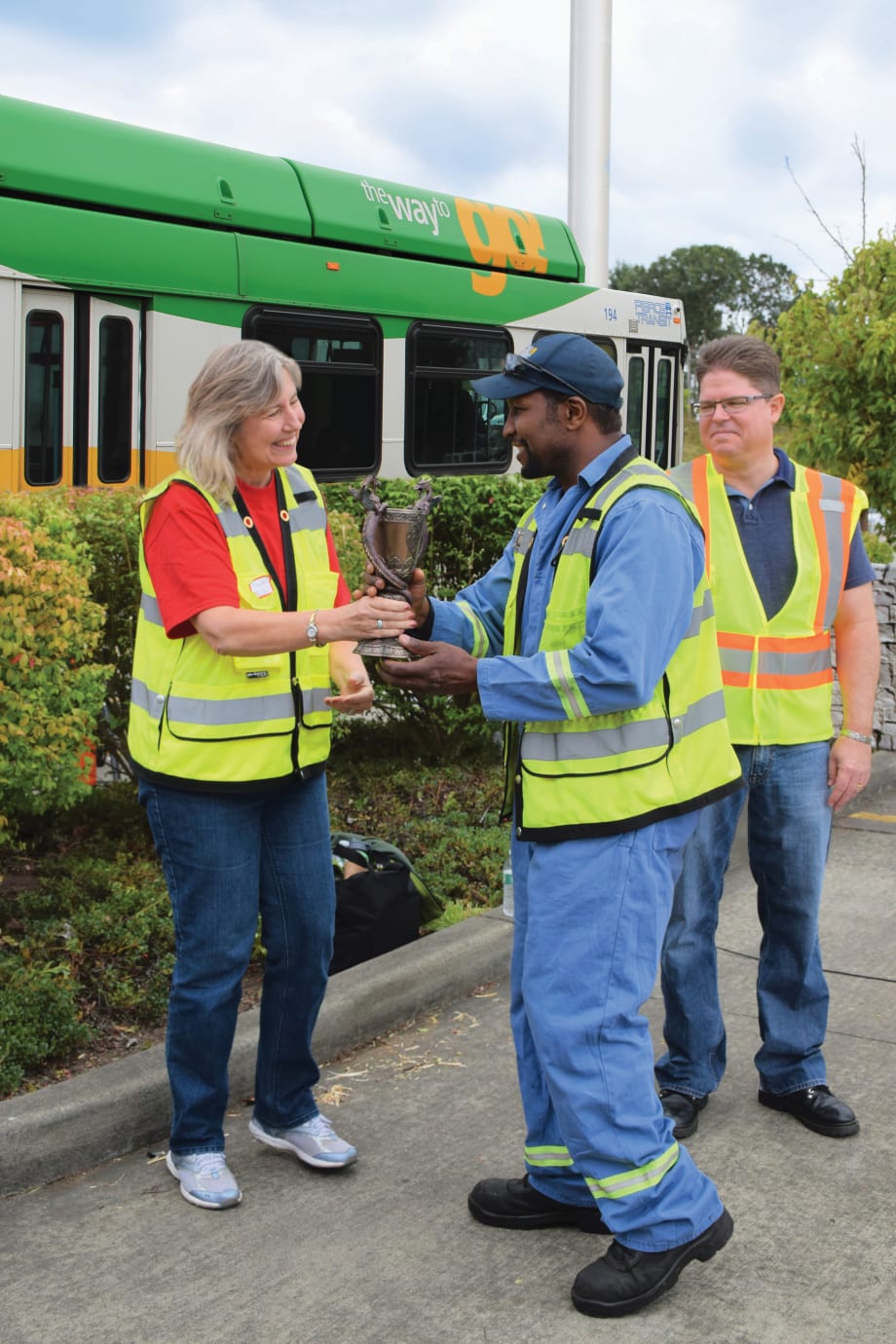
As not only the leader of Pierce Transit, but as a transit advocate to the community, Dreier feels it’s an important part of her role to the move the agency forward.
As not only the leader of Pierce Transit, but as a transit advocate to the community, Dreier feels it’s an important part of her role to the move the agency forward.
Sue Dreier began her transit career on the ground floor as a part-time bus operator for Lane Transit District (LTD) in 1990 in Eugene, Ore., as she went back to school to earn her BA in public administration while also raising her two daughters. It was here she was able to see firsthand, and for the first time, the kind of positive effect transit can have on the public.
And now, after 25 years in the industry, she sits as the CEO for Pierce Transit in Lakewood, Wash., where she has been for just over a year, and is a recent nominee to APTA’s board of directors.
Transit wasn’t Dreier’s original career path. She spent seven years working in the cosmetology industry, helping Supercuts, a then-regional hair salon franchise around the entire west coast, including Hawaii. It was working as a district manager there where she learned how to implement, execute, and provide proper management as she traveled from city to city helping open individual salons.
After moving to Oregon from Northern California with her husband, she worked as a bus operator for 10 years. “Growing up in such a small town [in Northern California], I was not regularly exposed to public transit,” Dreier explains. “In Eugene, I was able to see the connection that transit creates for people. There is such value in providing people with mobility options and the opportunity to get to employment, school, the grocery store or wherever they need to go.”
From her position behind the wheel, Dreier worked her way up through the operations of LTD, first as a supervisor, then as manager, operations. After that, she spent five years as the COO of Ore.’s Salem-Keizer Transit until she was awarded the CEO position at Pierce Transit.

In her first 15 months with her new agency, Dreier has been anything but idle. As not only the leader of the organization, but as a transit advocate to the community, she feels it’s an important part of her role to move the agency forward in a big way. During the recession, Pierce Transit had to cut one-third of its service, including reducing its operations and administrative staff. Now, as the sales tax that predominantly funds the agency is almost back up to a healthy number, Dreier has helped the organization restore those service levels. Dreier’s team added 30,000 service hours in the last year, with an even bigger boost planned for the next 18 months.
Additionally, Pierce Transit has completed and adopted its first-ever, long-range strategic plan to guide the agency into the future. And the organization, in partnership with its insurance provider, the Washington State Transit Insurance Pool, has implemented Mobileye technology in seven of its buses to alert operators to nearby pedestrians.
The agency is also being recognized in big ways for the work it’s doing and the services it wants to roll out. Pierce Transit received $15 million in state funding to develop high-capacity transit along the busiest corridor in the county. “We consider this our seed money to help us with future funding for this exciting project,” she says.
Pierce Transit was also one of 20 agencies nationwide to receive an FTA Low or No Emission Grant to help it set up an infrastructure to move entirely to electric buses.
Dreier has big plans for the future of her agency and she prides her team on being with her on the path to restoring Pierce Transit to what it was and giving the county the transit it deserves.
When she’s not at work, she can be found exploring her new community within the South Puget Sound area; bird watching; day hiking; gardening; and spending time with her husband, daughters and grandkids.
More Management

METRO Opens Submissions for 2026 Motorcoach Awards
Nominations are now being accepted for METRO Magazine’s Operator of the Year and Innovative Operator of the Year awards.
Read More →
New York MTA Advances Final Contract for Second Avenue Subway Expansion
Contract Four is the largest in the Second Avenue Subway Phase 2 project and includes construction of station infrastructure, tracks, and signals for the subway expansion, MTA officials said. Work on Contract Four will begin in 2027.
Read More →
Transit Agencies Highlight Safety Gains at National Summit
Leaders from 15 major transit systems shared crime-reduction results and safety initiatives while discussing the role of continued federal support.
Read More →

NITA Names New Leadership, Expands Reduced-Fare Program at First Board Meeting
The new regional transit authority appointed its first board chair and interim executive director while extending reduced fares across CTA, Metra, and Pace for eligible riders.
Read More →
Beyond the Checklist: A Structured Approach to Transit Maintenance
Reliability-Centered Maintenance helps transit agencies move beyond routine checklists to focus limited resources on the assets and failures that have the greatest impact on safety, reliability, and service.
Read More →
APTA 2026 Nominating Committee Selects Leadership Slate, Names Chair and Vice Chair Nominees
Leadership changes will help shape the association’s priorities and its representation of the transportation industry during the 2026–2027 term.
Read More →
DART Launches Major Security, Fare Enforcement Initiative
The 90-day demonstration will deploy coordinated security teams at five light rail stations while testing controlled access and gathering data to guide future investments.
Read More →
Advancing Fare Collection Through Technology and Innovation
Learn about delivering 1300 gates at 91 stations while managing fare evasion. Explore the large scale deployment, solution customization and real-world results that affect the region. Prepare for deployment in your region now.
Read More →
Game Day in Motion: Moving Millions During the 2026 World Cup
Between packed transit stations and team motorcoaches, see how agencies and operators across North America tackled the transportation demands of the 2026 FIFA World Cup.
Read More →
Surface Transportation Extension Averts Shutdown, Leaves Transit Funding Gap
The stopgap keeps federal transportation programs moving, but missing advance funding could complicate the transit and rail projects agencies are planning next.
Read More →