



METRO Magazine Logo
MenuMENU
SearchSEARCH

4 Transit Technologies to Improve the Passenger Experience

The impact of the pandemic has not only created an urgent need to regain ridership, it has also presented a new opportunity: to rethink the passenger experience and the role of mass transit in promoting the health and well-being of our communities.

by Werner Malcherek
July 5, 2021
4 Transit Technologies to Improve the Passenger Experience


Credit:

Luminator

4 min to read


The impact of the pandemic has created an urgent need to regain ridership. It compounded an already downward trend in ridership, as identified in a 2018 report published by American Public Transportation Association (APTA), and has created a challenge for transit agencies weathering the pandemic. But this challenge also presents a new opportunity: to rethink the passenger experience and the role of mass transit in promoting the health and well-being of our communities.

Prior to the pandemic, innovation in the transit technology space did not directly focus on public health issues or present solutions to marry public transit and public health. In the COVID era, this began to shift, with transit operators seeking more efficient ways to prevent the transmission of viruses in place of expensive, time-consuming, and sometimes damaging manual-disinfecting. A variety of technologies have been tested and piloted — including UV lamps, upgraded HVAC and air filtration systems, and manual foggers or handheld sprays — but few offer high enough rates of efficacy to inspire confidence by transit agencies, who continue to gauge the health needs of returning riders.

Ad Loading...

The new focus on health does not detract from transit’s previous focus of digital transformation. Rather, if done right, health and safety innovations can further enhance those digital technologies and make the entire passenger experience safer, healthier, and more accessible for riders as they navigate returning to work and school and adjust to future phases of pandemic response.

Rebuilding confidence

By implementing these innovative health technologies, transit agencies have the chance to rebuild confidence in public spaces and contribute to COVID mitigation efforts. These innovations can help both return ridership to pre-pandemic levels and improve the passenger experience in the future. Here are four examples of how technology can benefit passengers and improve ridership today:

1. Air Treatment: In 2020, air treatment systems emerged as potential replacements for expensive and time-consuming manual disinfecting procedures. Rather than spend time and money on staff and cleaning materials needed to routinely sanitize every surface inside a transit vehicle, transit agencies have been exploring how to combat the virus in the air before it can land on a surface or infect passengers. Many solutions have emerged, including those that use advanced HVAC systems, UV filters, and even foggers or sprayers, but the most effective solution has proven to be continuous antimicrobial air treatment, which quickly envelopes and inactivates 98% of virus particles in the air. As we continue to fight the COVID-19 virus, its variants and other viruses and gear up for the next flu season, continuous air treatment can provide much-needed protection for riders and provide a more virus-resilient method of transportation.

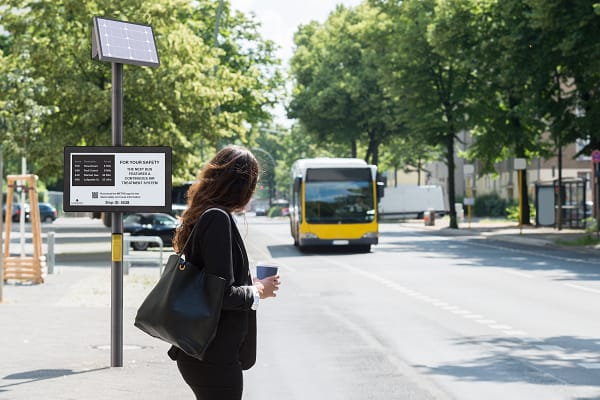
2. Accessible technology: The COVID-19 pandemic has raised awareness of the essential service that public transit provides and the community reliance on safe and accessible public transit. Transit agencies can leverage a variety of ADA-compliant transit technologies to improve the accessibility of transit stations and vehicles throughout the entire transit journey. ADA-compliant E-paper displays repurpose technology previously seen in e-readers and applies it to transit applications for bus stops and transit stations. The ultra-low-power LED screens minimize power usage while also maximizing accessibility for hearing-impaired and vision-impaired passengers. An optional solar-power addition allows for displays to be installed in remote areas, thereby expanding the rider information in rural locations without major infrastructure projects and capital expenses.

3. Infotainment and PSAs:On-board passenger information systems have been a critical communication path during the pandemic to provide passengers with up-to-date information about COVID protocols, safety guidelines, and route updates. By combining PSAs with more traditional travel information, the passenger experience has been transformed to better meet passenger needs during the pandemic and further support an enjoyable rider experience.

Ad Loading...

4. Video Surveillance: Existing technologies can be repurposed for new efforts to help promote a safe and enjoyable rider experience. With advanced software tools, video footage can be easily leveraged for ongoing training of operators. Video clips of incidents where riders do not follow safety protocols, for example, can be used to train operators on how to better enforce those guidelines and deescalate heated situations. Triggers can be monitored and reported for sudden stops, accidents, or avoidance of collisions. By identifying and capturing these events, agencies can continually and proactively improve safety. Some agencies have taken the technology transformation to another level, catching the good deeds of operators on camera to create advertising campaigns that promote the use and safety of public transit. These campaigns have gone viral in many instances and have promoted continued Good Samaritan-behaviors of operators while also improving employee retention and job satisfaction of operators.

As these examples show, both new and existing technologies can be used to help improve the passenger experience and increase safety during and after the pandemic. As riders return, some of them warily, to their usual commutes, transit agencies have an opportunity to leverage transit technology to create safer, healthier, accessible, and more future proof experiences for riders. 

Werner Malcherek is chief technology officer for Luminator Technology Group.

Connectpoint

Connectpoint’s industry leading Digital Bus Stop® is an ePaper signage solution that provides riders with accessible real-time passenger information 24/7, at bus stops, rail platforms, and transit centers. The solar or A/C powered signage is available with 10-, 13-, 22-, 32-, and 42-inch displays. Combined with solar lighting and a text-to-speech button, Connectpoint offers a complete solution for any stop. Connecptoint’s content management system, CPAM®, allows agencies to manage the displays remotely 24/7.

www.connectpointdigital.com

LG

The LG LSCA Signage Series is designed for public installations with a viewing distance of 15 feet or more – such as displays that provide arrival/departure times, menu options, wayfinding, health protocols and more. It comes equipped with LG’s webOS Signage smart platform to provide smooth content playback and can be easily controlled using a TV-style remote. The model’s optional 90-degree corner design feature can also minimize discontinuity of content displayed around corners.

www.lg.com

Peerless-AV

Peerless-AV’s SEAMLESS Kitted Series Mounting Systems are designed exclusively for leading direct view LED display manufacturers. These slim, space saving mounts come equipped with easy-hang hardware, a lightweight aluminum frame, and integrated cable management. The unique, modular designs allow for unlimited video wall display configurations, as well as height and depth adjustments. To ensure easy installation and high-quality customer support, Peerless-AV also offers start to finish support through the SEAMLESS dvLED Video Wall Integration Program.

www.peerless-av.com

Urban Solar

The PV Stop Max delivers security lighting and real-time bus arrival information to unsheltered bus stops. The result: enhanced safety at bus stops, reduced pass-bys, and increased choice ridership. Since the system is completely standalone, significant costs associated with trenching and cabling are eliminated. The PV Stop Max is ideal for northern locations with limited solar energy available during winter months and can power 13-inch and 23-inch e-paper real-time information signs and illuminate a large (~200 ft2) area surrounding a bus stop pole. 

www.urbansolarcorp.com

Safe Fleet

Safe Fleet Infotainment and Public Display Monitors enhance on-board safety and the passenger experience by:
1. Displaying video from security cameras inside the bus to discourage unwanted behavior. 
2. Keeping passengers informed with updates relevant to them.
3. Presenting customers with advertising based on the route/bus line they are on. Agencies also gain an additional revenue generation source. 

www.safefleet.net/infotainment

Sharp/NEC

ActiveScene™ transforms existing glass walls and windows to create dynamic, on-demand digital signage using Sharp/NEC projection technology and Avery Dennison’s Vela™ Dynamic System. ActiveScene is adaptable to any dimension, transforming transparent windows and walls into display screens to feature announcements or advertising in an unobtrusive way. Controlled electronically, the film becomes opaque upon command to create a dynamic canvas to project videos and messages, then returns to transparent when not in use.

www.sharpnecdisplays.us/activescene

Luminator Technology Group

Luminator Technology Group’s (Luminator) suite of technology covers the entire range of passenger information systems. Depending on your information needs and requirements you can create a custom solution using a variety of display technologies best suited for each location in your network. This can include a wide range of display sizes, resolutions, and formats. LED, LCD, and E-paper are available with a modular design that can be expanded with text-to-speech, speakers, lighting, and other features.

www.luminator.com


Subscribe to Our Newsletter

More Technology

An ABQ RIDE bus going through a Westmatic wash system.
Technologyby Staff and News ReportsMarch 16, 2026

Biz Briefs: Westmatic in Albuquerque, New Fare Payment Systems, and More

In METRO's latest installment, we take a look at the latest news from suppliers including Alstom, Modeshift, and more.

Read More →
Photo of a traffic signal
TechnologyMarch 16, 2026

AI Bus Lane Enforcement Boosts Safety, Reliability in West Hollywood

Traditionally, bus lane enforcement has relied on manual processes carried out by transit police or parking enforcement officers. While it may be effective in certain municipalities, this approach is resource-intensive and very difficult to sustain.

Read More →
A Coach USA vehicle wrapped for Newark International Airport service.
TechnologyMarch 11, 2026

Scaling Smart: How Fleet Operations Can Cut Downtime and Drive Growth

A phased approach to technology, in-house capabilities, and workforce investment is helping transportation leaders break the reactive cycle and build more resilient, revenue-focused operations.

Read More →
Ad Loading...
A Sound Transit Link light rail vehicle in a station
Technologyby Staff and News ReportsMarch 10, 2026

INIT Introduces Open Payments for Seattle’s ORCA Fare System

The landmark event empowers riders across six agencies in the Puget Sound region to tap-and-ride transit using a contactless credit or debit card or a mobile wallet.

Read More →
An MBTA paratransit vehicle.
Technologyby Staff and News ReportsMarch 9, 2026

METRO Opens Submissions for 2026 Innovative Solutions Awards

Now in its latest edition, the awards recognize forward-thinking solutions that improve safety, operational efficiency, sustainability, rider experience, and overall system performance.

Read More →
Cover photo for Biz Briefs dated March 6, 2026
Technologyby Staff and News ReportsMarch 6, 2026

Biz Briefs: Tolar Manufacturing Supports PSTA Spark Service and More

Stay informed with these quick takes on the projects and companies driving progress across the transportation landscape.

Read More →
Ad Loading...
Cover Photo for METROspectives with Timothy Menard
TechnologyMarch 5, 2026

How AI and Innovation Are Powering the Future with LYT’s Timothy Menard

Menard discusses how data-driven signal prioritization is improving efficiency, reliability, and ridership, while offering insight into the innovations driving the next generation of smart mobility. Together, they explore how technology and collaboration are paving the way for a more connected, sustainable future in transit.

Read More →
An NJ TRANSIT bus
Technologyby StaffMarch 4, 2026

NJ Transit Pilots AI-Powered Digital Bus Stop Signs

The pilot program showcases two companies’ technology at eight bus stops. The companies submitted their ideas through the Transit Tech Lab, which is backed by the Partnership Fund for New York City and provides an accelerated pathway for early to growth-stage companies to solve public transportation challenges for the largest transit agencies in North America.

Read More →
Cover photo for Biz Briefs
Technologyby Staff and News ReportsFebruary 26, 2026

Biz Briefs: Hitachi Rail in Philadelphia, Keolis in Nantucket, and More

Stay informed with these quick takes on the projects and companies driving progress across the transportation landscape.

Read More →
Ad Loading...
MBTA passengers at rail station
Technologyby StaffFebruary 24, 2026

Boston's MBTA Advancing Major Signal Modernization to Improve Red Line Reliability

To accomplish this work, the MBTA announced that four phases of temporary evening service changes will begin on February 28 and continue through April.

Read More →







