



Alstom, OC Transpo foresee growth for public-private partnerships
During EXPO, Managing Editor Alex Roman sat down with Guillaume Mehlman (shown far right), managing director, Alstom Transportation Inc., North America, and Alain Mercier, president of OC Transpo, for a brief conversation.
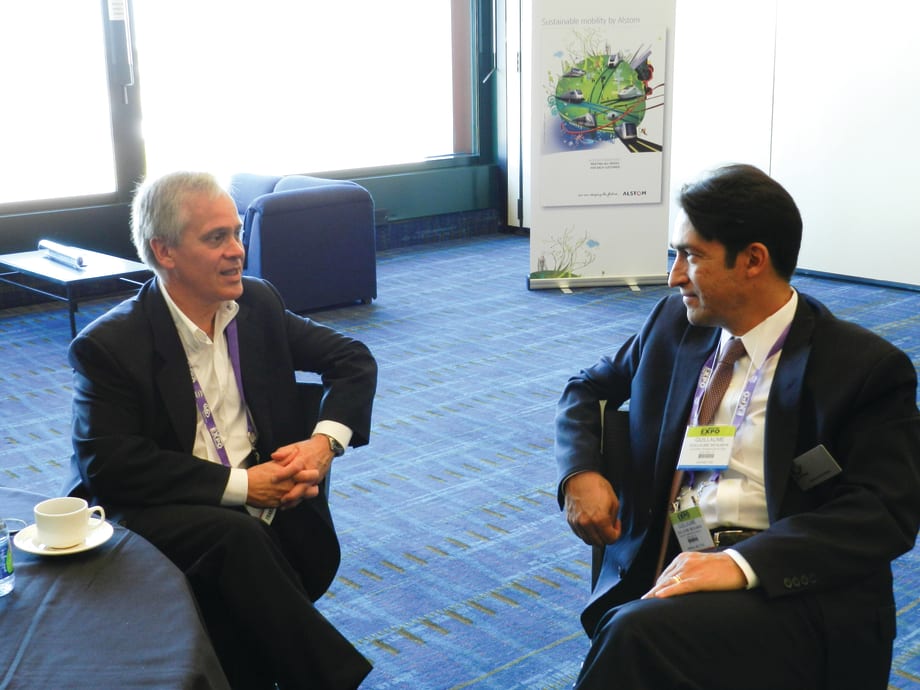
Alain Mercier and Guillaume Mehlman at 2011's APTA EXPO.
Alain Mercier and Guillaume Mehlman at 2011's APTA EXPO.
In September, Alstom Transport won an approximately $34.8 million contract to supply six new diesel multi-unit (DMU) trainsets to Ottawa-based OC Transpo. The order is part of OC Transpo's plan to continuously upgrade O-Train rolling stock and infrastructure and continue providing quality service to the agency's passengers. The new Coradia Lint Alstom DMUs will be delivered in May 2013.
During EXPO, Managing Editor Alex Roman sat down with Guillaume Mehlman (shown far right), managing director, Alstom Transportation Inc., North America, and Alain Mercier, president of OC Transpo, for a brief conversation.
What's going on at Alstom and this new contract in Ottawa?
G.M.: We're very excited about the fact that we see a very buoyant market despite the public funding situation. We see opportunities for mid-size cities to expand with light rail systems, as an answer to the crunch on the funding, and we can bridge that with some of the new procurement schemes that are coming out from Canada. People in Toronto and Ottawa are doing very innovative and creative things to deliver projects in a new way, so we're very excited about that. [Public-private partnerships] (PPP) have really been an answer for the industry, the market and the agencies in the last 18 months. And, we have the DMU market, which is also booming for quite a few commuters in the U.S. and Canada.
PPPs have been so successful all over the world, why do you think there is a reticence here in the U.S.?
G.M.: Some of the transit agencies were uncomfortable departing from the sort of standard that was set, because it is viewed as a risk. We find a lot of benefit in taking a stake in the form of equity, providing an optimized system, more value for the investment and making a long-term commitment over the full lifecycle. Why hasn't it been possible in the past in North America? I think, really, the agencies were a little reluctant to depart from known solutions.
A.M.: We did a major transaction where we sold back almost half our fleet of buses to a manufacturer and bought new. I don't think that's ever been done in the bus industry, but we presented a problem to the manufacturer about obsolescence of engines and all these things, so we worked out a solution. We actually proposed a quarter of a billion dollar bus procurement deal, and it took 60 days to go from idea to approval by our city council to raise $200 million debt level to buy a new fleet of buses. Our customers got a more comfortable vehicle, and we eliminated all the obsolescence and supply chain problems. We built a partnership with the builder for the longer-term for the life of those buses and cured all our other issues. Partnerships are the only approach [to do something like this], you can't do it any other way.
How far off do you think we are from it taking hold in North America?
G.M.: I think we're going to see significant awards in the next two or three years, whether it's on light rail or commuter systems. We are going to see that shift.
A.M.: It always takes something in the industry to force a change, and I think this insecurity that's out there will be a factor. We are seeing tremendous demand for services and the realities that governments can no longer manage that funding model.
G.M.: So, there's the value. Typically, we're going to be seeing funding cuts of roughly 20, 30, 40, 50 percent in the next few years, but the value is there to be extracted if you do things differently, so there's a way of sustaining the market and meeting the demand and getting across those funding issues.
More Rail

New York MTA Advances Final Contract for Second Avenue Subway Expansion
Contract Four is the largest in the Second Avenue Subway Phase 2 project and includes construction of station infrastructure, tracks, and signals for the subway expansion, MTA officials said. Work on Contract Four will begin in 2027.
Read More →
San Diego MTS Breaks Monthly Trolley Ridership Record
Agency officials said July’s ridership indicates MTS’s continued recovery from the pandemic.
Read More →
Report Examines NJ TRANSIT Reliability, Funding Challenges
The Garden State Initiative analysis examines the roles of Amtrak infrastructure, fleet management, and agency operations while recommending a more performance-based approach to improving reliability.
Read More →
Stadler, CapMetro Sign Long-Term Rail Fleet Support Agreement
Beginning in 2027, Stadler will provide on-site technical expertise, spare parts support, training, and obsolescence management to help extend the reliability and longevity of CapMetro’s GTW fleet.
Read More →
Biz Briefs: Alstom Lands Canadian Contract, LYT to Supply California TSP, and More
In METRO's latest installment, we take a look at recent news from Complete Coach Works, Beep, FlixBus, and more partnerships making headlines across the transportation sector.
Read More →
CATS Gold Line Marks 5 Years of Service, 2.8M Passenger Trips
With a six-mile expansion planned, the Charlotte streetcar is positioned to connect more neighborhoods and major transit hubs across the region.
Read More →
Why Simulating Pedestrian Movement Has Become Essential for Modern Rail Stations
Pedestrian microsimulation is helping rail planners identify bottlenecks, test station designs, and prepare complex transit hubs for growing passenger volumes.
Read More →
Amtrak Begins Major Construction at New York’s Sunnyside Yard
The new maintenance facility will support Amtrak’s Airo trainsets while improving maintenance efficiency and turnaround times in New York.
Read More →
Chicago Leaders Unveil Plans for O’Hare Airport Express Train
The privately developed project would offer a 15-minute trip between downtown and O’Hare’s Terminal 2, with trains operating every 15 minutes on a dedicated track. The service would use battery-electric trains and three existing freight rail rights-of-way.
Read More →
OCTA Maps Out 30-Year Strategy to Protect Coastal Rail Corridor
The draft feasibility report identifies strategies to protect the coastal rail line for decades as the agency continues near-term stabilization and sand placement efforts.
Read More →