



Alstom Tram Technology Provides Ease of Integration
When planning a transportation system, integration into its surroundings is key. ALSTOM Transport’s Citadis tram technology was developed to mesh easily with various environments. Its multiple propulsion options, low-noise factor and modular design allow the vehicle to fit in just about anywhere.
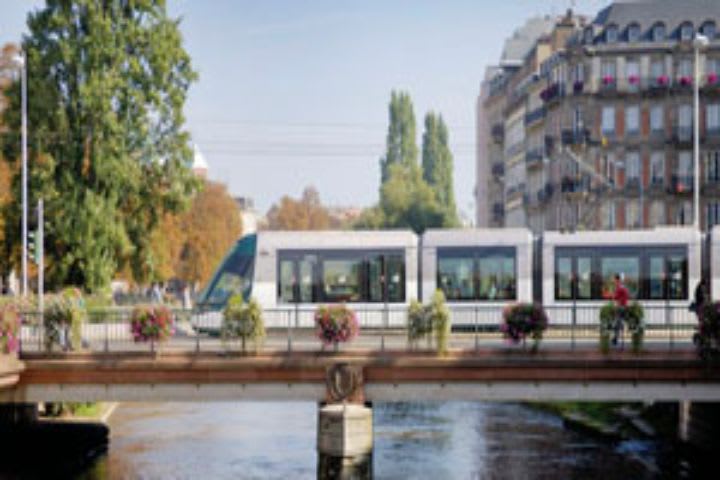
When planning a transportation system, integration into its surroundings is key. ALSTOM Transport’sCitadis tram technology was developed to mesh easily with various environments. Its multiple propulsion options, low-noise factor and modular design allow the vehicle to fit in just about anywhere.
Strasbourg system
The city of Strasbourg is located in the Northeastern portion of France near the border of Germany. Known for its architecture, the city’s skyline features a towering gothic cathedral, as well as other medieval structures. While the city elicits an Old World aesthetic, it boasts one of the most well-connected transportation networks. One element of this network is the city’s tram system. Operated by the Compagnie des Transports Strasbourgeois (CTS), the nearly 34-mile tram system has five lines and features 70 stations. Although the city’s modernized tram system was launched in 1994, Citadis trams were added in 2005 to meet growing service demands. In addition, the system will go international in 2010 when it is extended to Germany.
The Citadis tram fleet, comprised of 41 trainsets, was adapted to the specific requirements of the Strasbourg environment. The low-floor vehicles were fitted with a small bogie at either end in order to follow the network’s curves more smoothly and provide harmonious movement. Featuring a nearly eight-foot width, the trams can carry 288 passengers.
Modular design
In addition to Strasbourg, numerous cities across the globe from Algiers to Valenciennes, France, have implemented Citadis tram technology. By combining standardization of components with customization of interior and exterior designs, the technology adapts to the requirements of each city in terms of aesthetics, comfort and accessibility.
“The whole concept was based on modularity and flexibility,” says Roelof van Ark, president, ALSTOM Transportation Inc. and SVP, North America Region, ALSTOM Transport. Eighty percent of Citadis components are standardized. “Customers can choose the length of the tram, as well as decide on the nose or the cab section of the car and its styling,” van Ark says. “Finally, you can choose your own colors or corporate patterns and designs.”
Other options include video surveillance systems, as well as media displays. “You could show the news and you could also advertise,” says van Ark. “You could offer passengers information updates about train delays, and other information that applies to the passenger.”
When reviewing the portfolio of Citadis projects, several European systems stand out due to their progressive designs and use of color. “European designs have developed much further because the market is that much larger,” says van Ark. “Therefore, you have many more options coming out of the European market.” That’s one of the reasons that the Citadis range has been a success, he adds. “The core business is important because that’s where you develop your product.”
Some progressive tram designs are on display in the French cities of Toulouse and Reims. To acknowledge its distinction as the “European hub of the aeronautics industry,” the city of Toulouse designed the nose of each of its trams to reflect the shape of an Airbus airplane. For the latter system based in Reims — the capital of the Champagne region — the tram design was inspired by a champagne glass.
Environmental Considerations
Because they use clean energy and can transport the same number of people as three buses or 50 cars, trams are considered an ultra-modern solution against pollution and congestion in cities, according to Alstom. In addition, the company is committed to integrating other environmental considerations in its tram design “to limit and reduce their impact on the environment throughout their life cycle, from construction to recycling.”
“When the Citadis tram line was originally developed, the concept of recyclability was a significant factor,” says van Ark. (There is a minimum recyclability rate of 85 percent.) “We spend a lot of energy and time in designing the cars to ensure that they can be recycled, says van Ark. “And we continue to do so.” The company makes a point to integrate reusable materials into the tram design, including steel, aluminum and copper. In addition, the use of “biomaterials from renewable sources, such as wood and hemp” is also being researched.
It’s also important that a big portion of other synthetics being used can be recycled, van Ark says. “There’s a lot of effort made to use recyclable materials in the inner cladding, the seating materials and the synthetic materials, mainly inside these cars.”
The company also uses composite materials, and has improved the Citadis’ traction system’s efficiency to help reduce energy consumption levels by 10 percent.
In addition, Alstom has also lessened its impact on the environment through the reduction of noise emissions. With the use of insulation materials and acoustic dampeners, the system emits 5 dBAs less than automotive traffic. “That is four times less noise than you would have on a roadway with traffic on it,” van Ark says.
Propulsion options
In keeping with its concept of integrating seamlessly into the environment, the company offers an array of propulsion solutions. In addition to the standard overhead catenary system, other power options include APS (ground-level power supply), battery power and two newer technologies in final development, the inertia flywheel and super capacitors.
The ground-level power supply system — or wireless APS (Alimentation Par le Sol) system as it is known — uses a third rail embedded in the tracks to supply power to the tram. “You can decide on the different propulsion technologies that you require,” van Ark says, adding that catenary systems might not always be appropriate for some settings. “It’s important not to bring catenary systems into cities with historic sites.”
The city of Bordeaux, France, incorporated 9 miles of its 27-mile system with the APS-powered propulsion— the first in the world to install the technology, according to Alstom.
Battery power, another wireless option, can be utilized for small distances just over a half-mile. To help “preserve” the historical nature of the city’s Place Masséna and Place Garibaldi squares, the French city of Nice employed battery power for its Citadis tram.
Still under development, the inertia flywheel system powers the tram through “recovering the energy released during braking.”
A mixture of propulsion options can also be used to fulfill the system’s needs. “You can use a standard catenary supply along with an APS, or the catenary system with the battery, or the battery system with the APS or the new propulsion systems,” van Ark says. “It’s very modular.”
Tram-train concept
Another tram offering based on the Citadis platform is Alstom’s Dualis model. This version employs the capabilities of both a tram and a train. Vehicles can operate on a tram network, as well as on a regional rail network.
This configuration makes it a highly versatile means of transport: its tram build enabling it to run through the city, while its performance as a train allows it to transport passengers at over 60 mph once on the outskirts of cities, without the need to change the means of transport.
The tram-train concept was initially developed in Germany, where Alstom has put into service its Regio Citadis model, in Kassel. Developed at Alstom’s Valenciennes facility in France, the first Citadis Dualis trainsets should enter service in January 2010 on the Nantes network and, in March 2010, on the Lyons network.
Latest contracts
Looking to the future, Alstom’s Citadis technology continues to expand its global reach with new projects on the horizon. Along with its partners, the company recently received two contracts from the Algerian public transport company EMA (Entreprise du Métro d’Alger) to supply “turnkey” tramway systems for the cities of Oran and Constantine. The contract for the city of Oran calls for an 11-mile line, serving 32 stations. Its value is worth $550 million, of which $229 million is allocated for Alstom. The TRAMNOUR consortium is made up of Alstom Transport and the Spanish group Isolux CORSAN. Alstom will supply 30 Citadis tramways, which will be manufactured at the group’s factory in Barcelona, Spain. Alstom will also supply the operating system (signaling and telecommunications), as well as the depot equipment and the substations. The first trainsets will enter commercial service 26 months after the contract takes effect.
The Constantine contract, a 5-mile line serving 11 stations, is worth $475 million, with Alstom’s portion totaling $276 million. Alstom will supply 27 Citadis tramways, the track, electrical power supply, operating system (signaling and telecommunications) and the depot equipment. The first trainsets will enter commercial service 27 months after the contract takes effect.
More Rail

ENC Lands MATA Contract and More in Biz Briefs
In this edition of Biz Briefs, we spotlight the latest developments shaping the future of mobility.
Read More →
Strada360’s Steve Lassey on Turning Transit Data Into Better Decisions
From breaking down data silos to preparing for AI, Strada360 CEO Steve Lassey discusses how transit agencies can use technology to improve operations, customer information, and long-term decision-making.
Read More →
SEPTA Details Accelerate Vision for Transit System
The plan outlines investments in trolley modernization, new Metro and Regional Rail vehicles, accessible stations, and more frequent bus and rail service.
Read More →
FTA Ends Direct Oversight of MBTA Safety Actions
The federal agency closed its remaining special directive to the Massachusetts Department of Public Utilities following a safety review that began in 2022.
Read More →
Amtrak, CN Reach Agreements to Strengthen Passenger Rail Service, Safety
The agreement resolves a more than decade-long proceeding before the Surface Transportation Board concerning the terms and conditions for Amtrak services, such as the City of New Orleans, Illini/Saluki, and Wolverine.
Read More →
New York MTA Advances Final Contract for Second Avenue Subway Expansion
Contract Four is the largest in the Second Avenue Subway Phase 2 project and includes construction of station infrastructure, tracks, and signals for the subway expansion, MTA officials said. Work on Contract Four will begin in 2027.
Read More →
San Diego MTS Breaks Monthly Trolley Ridership Record
Agency officials said July’s ridership indicates MTS’s continued recovery from the pandemic.
Read More →
Report Examines NJ TRANSIT Reliability, Funding Challenges
The Garden State Initiative analysis examines the roles of Amtrak infrastructure, fleet management, and agency operations while recommending a more performance-based approach to improving reliability.
Read More →
Stadler, CapMetro Sign Long-Term Rail Fleet Support Agreement
Beginning in 2027, Stadler will provide on-site technical expertise, spare parts support, training, and obsolescence management to help extend the reliability and longevity of CapMetro’s GTW fleet.
Read More →
Biz Briefs: Alstom Lands Canadian Contract, LYT to Supply California TSP, and More
In METRO's latest installment, we take a look at recent news from Complete Coach Works, Beep, FlixBus, and more partnerships making headlines across the transportation sector.
Read More →