



Lane Transit District, EmX: Eugene, Ore.
BRT Project Focus: Oregon and Nevada
A look at two unique and interesting BRT projects; Lane Transit District's EmX line and RTC Washoe County's RAPID.
by Janna Starcic, Executive Editor
April 4, 2016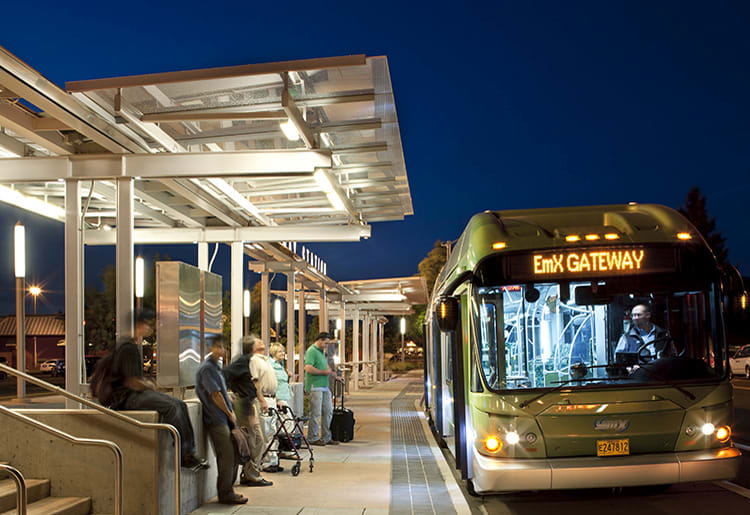
LTD’s first BRT corridor, the Franklin line launched in 2007, and it’s second line, the Gateway (shown), launched in 2011.
8 min to read
LTD’s first BRT corridor, the Franklin line launched in 2007, and it’s second line, the Gateway (shown), launched in 2011.
The Emerald Express, known as EmX, is Lane Transit District’s (LTD) bus rapid transit (BRT) system. The system is currently operating two lines — Franklin and Gateway, which were launched in 2007 and 2011, respectively — and is mid-way through construction on the third, the West Eugene, slated to open in 2017.
The four-mile Franklin line had a little over 1.4 million boardings the first year in operation. And, as of 2015, the line totaled an estimated 2.7 million boardings.
“We need the kind of infrastructure that BRT provides, which allows us to operate more efficiently in those corridors,” explains Tom Schwetz, LTD’s planning and development manager.
Once built, the West Eugene line will extend the service nine miles and have 26 stations. It will use seven articulated New Flyer diesel-electric hybrid Xcelsior buses — the same vehicles in use on the existing EmX corridors. The 60-foot BRT vehicles feature at-grade boarding, incorporating innovative ramps on both sides, and use five doors for enhanced accessibility. Vehicles will also feature automatic vehicle location and automatic passenger counting systems.
The West Eugene service will utilize transit signal priority technology and operate on 10-minute frequencies. Stations will feature off-board fare payment and most will be equipped with real-time arrival information displays. Security personnel will do random checks for fare payment.
The EmX system is “basically a paper system,” says Meg Kester LTD’s marketing manager, adding that the agency has a flash pass for their large population of student riders as well as group pass for their significant employer program.
Flexibility
“BRT is incredibly flexible, so we can operate in mixed traffic, which we do in certain areas, and we can also have exclusive curb lanes that we have running in front of the university and in other parts of the corridor,” Schwetz says.
The most prevalent form of exclusivity for the new corridor is the use of a BAT lane (business and access transit lanes), which allows vehicle access to businesses, driveways and intersections. “It’s not intended to be a through-lane for cars, but our buses can operate in that lane,” Schwetz says. “It’s essentially an extended-queue jump lane.”
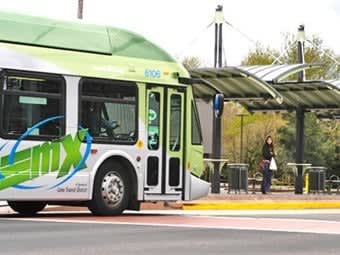
Once built, the West Eugene service will utilize transit signal priority technology and operate on 10-minute frequencies.
Primary objectives
The primary objective of the newest EmX corridor is to be an extension of the system. “So, regional connectivity is a big part of it,” Schwetz says. Other objectives include supporting the city’s vision for growth and making the community more livable.
Although a good bike system runs through the corridor, there aren’t very direct connections into activity centers in the downtown and other key areas, which the project aims to alleviate. LTD forecasts that half of the residents in the region will be able to access two-thirds of the employment centers via the EmX system once the West Eugene project is completed.
There’s already been some early redevelopment along this new corridor, Kester says. “We are seeing some pretty solid evidence that business is thriving and business is attracted to corridors that have multimodal frequent service,” she says of LTD’s earlier corridors.
Lessons learned
Looking back at LTD’s first BRT project experience, Schwetz says in some portions of the Franklin line it wasn’t feasible to have a lane for both directions of traffic. To solve this, they implemented shared lanes, which use block signaling to ensure that only one direction is in the shared lane at a time.
“What we found is that as general traffic volumes have increased, we’re having to wait longer for that shared lane to clear one direction before the other,” Schwetz says. “We haven’t done that anyplace else.”
Another lesson learned for the LTD was its challenge obtaining exclusivity for the Franklin line on the state-owned corridor.
“The state didn’t understand the concept of transit having exclusive lanes on its facilities,” says Schwetz, who adds that a “very supportive traffic engineer,” was able to talk to the state DOT engineers about the issue. “That was certainly something we realized early, that we needed that partnership to make the full package happen for BRT,” he explains.
Lane exclusivity also became an issue on the current West Eugene project. While the property impact of acquiring exclusive lanes was pretty straightforward due to large stretches of landscaped medians that already existed in the first two corridors, the West 11th Street, where the new corridor runs, is a very mature neighborhood and the density of small businesses is much higher. “We had to work more with property owners to acquire what we needed to build the line,” explains Schwetz.
“We realized with the West Eugene line, it would’ve been beneficial to have the city [of Eugene] partnering with us to do this,” Kester says. LTD, which now has a strong partnership with the City of Eugene, is working with them on multiple corridors and looking at land use in a holistic way to incorporate biking and pedestrian systems, as well as transit.
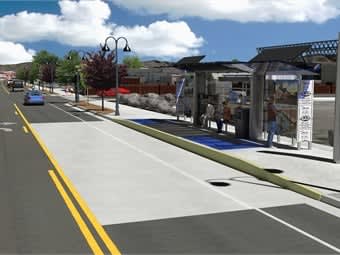
The planned 4th Street/Prater Way RAPID line will run in the second-busiest transit corridor in the system.
Wood Rodgers/RTC of Washoe County
The Regional Transportation Commission of Washoe County (RTC), Nevada is an integrated transportation agency serving as the metropolitan planning organization, public transit operator, and street and highway agency for the citizens of the Reno-Sparks metropolitan area and unincorporated Washoe County. When it came time to plan its second BRT project, the 4th Street/Prater Way corridor, the RTC was able to leverage its multi-hyphenate status. “Being both the MPO and the service delivery agency, we can really fast-track project delivery to get the improvements out on the street that the public demands,” says the RTC’s CEO Lee Gibson.
The project, which connects downtown Reno to downtown Sparks, is the second-busiest transit corridor in the system and is the most heavily utilized multimodal corridor in the Reno-Sparks metropolitan area. Pedestrians, bikes and transit run on the corridor, while most of the auto traffic runs on the parallel interstate highway.
“We actually want to slow down this corridor for safety and make it a better place to walk, bike. We’ll [also] have faster transit service as well, with improved headways,” says Amy McAbee Cummings, RTC’s director of planning.
The 3.1-mile project, which received TIGER and Small Starts funding, is currently in final design, and RTC expects to be in construction in late fall. It will incorporate complete streets design elements, including sidewalk upgrades following ADA standards, road reconstruction, bike lanes and the addition of street trees. The agency recently won a U.S. DOT transportation planning excellence award for 2015.
“The unique thing is we are just bringing all of our funding sources, from local sales and fuel tax, CMAQ, STBG and Small Starts to TIGER, all to bear and trying to deal with a multimodal project all in one single contract,” Gibson says.
RTC plans on ordering four 40-foot all-electric buses, manufactured by Proterra, sometime in late spring. The agency will also install a fast-charge station at Centennial Plaza, one of two transit centers linked by the corridor.
System features will include off-vehicle fare collection, with ticket kiosks located at stations with level boarding. The eight planned stations will have rooftop solar panels to light the stations at night and canopies to provide shade. Station design will also incorporate a solid backing to provide wind protection.
Other BRT service features will include transit signal preference and real-time bus arrival info at stations, as well as an app so customers can track buses.
Tapping history for design
The 4th Street/Prater Way BRT alignment follows the route of the Lincoln Highway — one of the oldest parts of the community. Several businesses, business owners and residents have been in the corridor for decades, according to McAbee Cummings. Knowing this, RTC built in resources to do additional research and focus design and contextual elements of the project, drawing from the rich history of the corridor. RTC worked with a local historian who interviewed about 30 local residents and researched the corridor. This information and audio clips were made available on a special website and historical app.
This history will also be integrated into the station design in the form of glass panel backings etched with historical photographs and interpretative materials, such as timelines, which talk about the development of the corridor. RTC identified themes for each of the stations that are tied to events or the cultural history that’s unique to each station area, McAbee Cummings says. One station’s theme follows the historic 1910 boxing match, Johnson vs. Jeffries — the first interracial fight, which took place nearby.
“The historical aspect of the project design was a big component of engaging with the community and building pride for the BRT project,” says Michael Moreno, RTC public affairs administrator. Additionally, RTC recently completed a media campaign asking the public to suggest names for the corridor. “We received 230-plus suggestions,” he adds. “We’ll review them and announce sometime in the spring.”
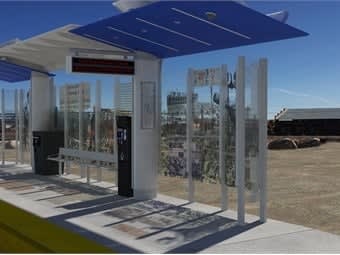
RTC’s stations, featuring solar panels and real-time information displays, will integrate glass panels etched with historical photographs relevant to local cultural history.
Wood Rodgers/RTC of Washoe County
Revitalization, job growth
Although the BRT line isn’t in place yet, the corridor itself is seeing signs of revitalization, with the emergence of an industrial arts group. There has also been an influx of restaurants and breweries that are installing themselves in buildings that have been empty for years. “With the improved mobility and accessibility that will come from both transit, pedestrians and bicycles, we’re only going to make the corridor that much more attractive to those types of creative businesses,” Gibson says.
The corridor is also heavily residential for low-income families, says McAbee Cummings. “Through connections to our two transit centers, a lot of these [local residents] will have access to job training they otherwise did not have,” she says of the corridor’s benefits.
Subscribe to Our Newsletter
More Bus

New York MTA Plans Largest Bus Fleet Upgrade in More Than a Decade
The agency is seeking manufacturers for 650 new CNG buses to replace aging vehicles, improve reliability, and advance its broader fleet modernization strategy.
Read More →
Building a Flexible Path to Transit Electrification
John Hroncich discusses BAE Systems’ modular and scalable approach, lessons learned from decades of real-world operations, and how agencies can identify electrification strategies that fit their fleets.
Read More →
Bus Tech Talk: Keeping Transit Technicians Ahead of the Technology Curve
LA Metro’s Obed Mejia discusses technician training, evolving maintenance technology, fleet replacement, and strategies for getting the most out of today’s transit fleets.
Read More →
Biz Briefs: RIPTA Unveils New Frontrunners, Clevland RTA Adds New Siemens, and More
In METRO's latest installment, we take a look at recent news from Siemens, Prevost, Dodge, and more partnerships making headlines across the transportation sector.
Read More →
People Movement: Holly Arnold Joins Transdev and More
In this edition, we also cover recent appointments and announcements at Pace, CamTran, MCI, and more, showcasing the individuals helping to shape the future of transportation.
Read More →
The High Cost of Transit Buses: Industry Leaders Look to Procurement Reform
Transit leaders and policymakers examine how standardized bus designs, streamlined procurement, and predictable funding could help agencies stretch budgets and deliver better service.
Read More →
The Business Voice Behind Public Transportation
As chair of APTA’s Business Members Board of Governors, Ray Melleady explains how more than 850 business members are partnering with transit agencies to advance funding, innovation, and industry-wide collaboration.
Read More →
From Surviving to Thriving: Building Stronger Transportation Organizations
Bus Business Consultants founder Brian Dickson shares lessons on leadership, organizational health, and creating options for long-term success in a changing transportation industry.
Read More →
Finding the ‘Happy Medium’: Optimizing Maintenance Without Sacrificing Reliability
The key to maintenance optimization isn’t doing less work—it’s doing the right work at the right time on the right assets.
Read More →
LA Metro, City of West Hollywood, and Partners Advance Smarter Bus Lane Enforcement
The award-winning partnership combines AI-powered detection with human oversight to improve bus reliability, accessibility, and enforcement efficiency.
Read More →