



Calif.'s High-Speed Rail Charges Up as Expertise, Leadership Look Ahead
By 2033, the first high-speed rail system in the U.S. will whisk passengers from San Francisco to Los Angeles in under three hours at speeds above 200 mph.
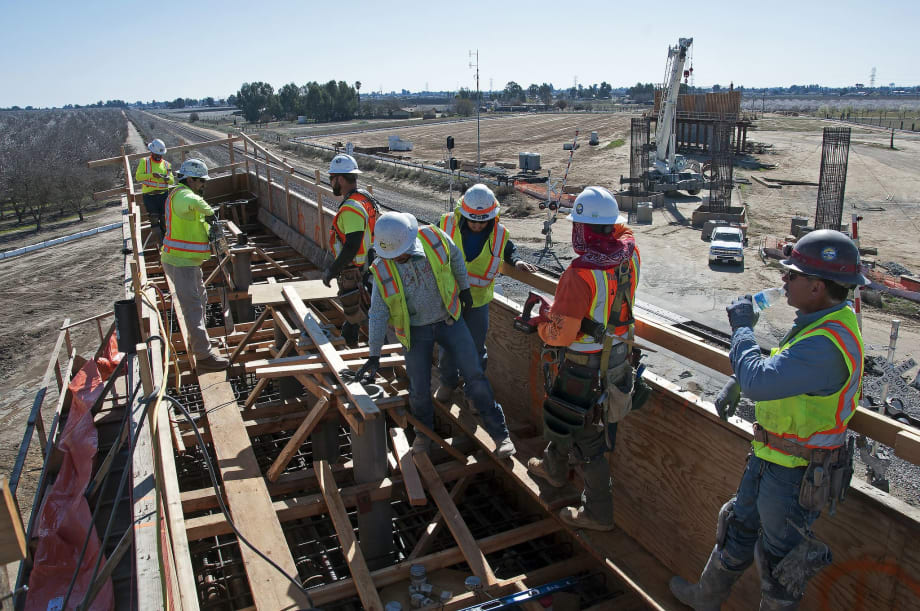
Photos courtesy CHSRA
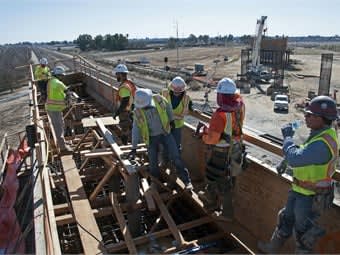
Photos courtesy CHSRA
By 2033, the first high-speed rail system in the U.S. will whisk passengers from San Francisco to Los Angeles in under three hours at speeds above 200 mph. The system will eventually extend to Sacramento and San Diego, covering 800 miles and having up to 24 stations. The vision doesn’t stop there. The California High-Speed Rail Authority (CHSRA) is working with regional transportation providers to implement a statewide rail modernization plan that includes local and regional rail lines to meet 21st century transportation needs.
Building the first U.S. and California high-speed rail system is a step-by-step process. The CHSRA initially released three construction packages that encompass construction on the initial operating sections of the high-speed rail program.
Construction package 4 (CP 4) is the third and covers about 22 miles that stretch from one mile north of the Kern County/Tulare County line to Poplar Avenue south of Wasco. It is valued at $444 million of the estimated $77 billion plan to complete the full project.
The project requires almost innumerable functions and areas of expertise. It is made up of nine, Type 1 structures in which high-speed trains will travel on and over local roads or waterways and two, Type 2 structures where the local road will go up and over high-speed trains. It also takes in BNSF bridges at State Route 43, Poso Avenue, and J Street in Wasco. There are also 60 box culverts for wildlife crossings and drainage facilities, multiple retaining walls, and hundreds of utility conflicts to manage.
HNTB serves as program and construction manager, providing oversight for design, construction, quality management, third parties, payments, schedules, and other contractor-related operations.
Vision supports being first
“This project is transformational,” says Joseph Hedges, chief operating officer for the CHSRA. “It shifts the idea of mobility for future generations. As we realized with the connectivity the internet creates, it is important for us to be able to move around with regards to cost and environment. With high-speed rail, there’s no reason one can’t live in Fresno and work in San Jose.”
Staying focused on the end goal helps keep work on diverse areas of the project headed in the right direction. Utilities, rights-of-way, environmental management, and endangered species are but a few examples.
“In fact, each utility represents a project in itself,” says Michael Barbour, HNTB design-build oversight manager. “When dealing with right-of-way, we have to manage each component, whether the land it is private or public, or property owned by the authority. We negotiate those agreements. All require significant effort.”
Right-of-way acquisition is an aspect that has created pause, though the team is making progress. Jeffrey Payne, HNTB quality oversight manager and verification and validation manager, said the team has conducted preliminary work as right-of-way is acquired.
“We overcame delayed right-of-way acquisition by obtaining ‘Permission to Enter’ status,” Payne says. “This lets us complete environmental studies and carry out the geotechnical exploration that goes into the design. We can now hit the ground running once the right-of-way is granted. We’ve succeeded in acquiring 122 of the 168 properties we need. This allows for immediate progress.”
“Ensuring the protection of endangered species is a priority,” he adds. “For most, we were able to get ahead of things and implement the necessary precautions to keep them out of work areas. We continue to work with California Department of Fish and Wildlife to make sure others are protected.”
Quality control, vision delivery
Verification and validation (V&V) is a procedure new to construction in the U.S. Payne noted that it is a series of checks and balances that validate requirements were met in the final design and constructed product so that it meets operational needs. In other words, V&V demonstrates, with objective evidence, that a task, service, or job meets contractual requirements for its intended purpose. V&V are important parts of the ISO 9001-2015 system. The master plan for the authority requires that these key quality management principles be included throughout the system. The seven principles include:
• Customer focus
• Leadership
• Engaging all people involved in the project
• Process management approach
• Continuous improvement
• Evidence-based decision making
• Relationship management
Laura Uden, president of NSI Engineering in San Jose, Calif., serves as quality engineer for the project. Her company is a woman-owned, disadvantaged, and disabled veteran business, and one of more than 400 small businesses working on the program.
“The role of quality management is to ensure requirements are met by establishing procedures for quality control (QC) and quality assurance (QA),” Uden says. “We train the team members in these procedures and audit to ensure they’re being followed. QC is controlling quality by various checking methods. For design, it involves the review of design deliverables by people who are equally qualified to those creating the original design. In construction, it involves inspection and testing.”
“Our job as QA is to help. We write procedures for the PCM team, train personnel in the procedures, and audit against them,” she adds. “In our role as QA oversight, we also approve the contract’s management plans and audit the implementation of their procedures. If needed, we write corrective action requests and NCRs. If we find something that might lead to non-compliance, we implement actions designed to prevent it. ISO 9001-2015 has recently required the integration of risk management into QA to inform the audit schedule, and assessing severity of findings based on risk.”
Independent assurance is one part of the quality team’s role. They have hired an independent materials testing lab to take samples and process them to ensure materials testing processes of the contractor and the independent site engineer are producing accurate results.
These V&V requirements are managed in an RM DOORS database. The design-builder is responsible for putting project requirements into the authority provided database. Once they’re compiled, the design-builder must also:
• Break down requirements to subcomponents that apply to the work.
• Assign them to design and construction segments of work.
• Document interactions between requirements.
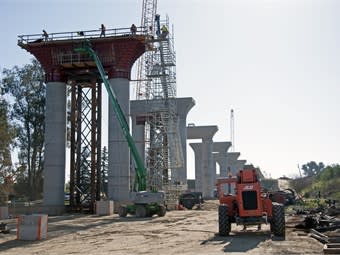
Construction package 4 covers about 22 miles that stretch from one mile north of the Kern County/Tulare County line to Poplar Avenue south of Wasco.
“We ensure these steps are all completed by auditing and reviewing V&V reports,” Uden says. “The advanced thinking the authority is applying to quality management is setting the tone for projects that follow. Having strong oversight ensures quality, which is critical for the complexities of a system that supports a high-speed train traveling faster than 200 mph.”
Uden adds the project adheres to the Federal Transit Administration’s 2012 Quality Management System Guidelines, which state that design-build projects should have stronger oversight than traditional design-bid-build projects. In addition, Caltrans has more stringent construction and quality requirements than most areas of the country.
HNTB’s Payne concurs and notes the importance of QC on this project.
“The U.S. is behind some countries when it comes to high-speed rail,” he says. “Japan, China, Spain, and others have had high-speed rail systems since the 1960s. With this being the first in the U.S., it sets the foundation for future HSR projects here. That’s why we believe we have only one opportunity to do things right.”
Once operational, ongoing monitoring will ensure the most problem-free operation possible. Instruments and gauges throughout the system will alert maintenance teams to stabilize systems or maintain grades.
A connected future
Each of these processes support what the CHSRA’s Hedges sees as essential components of a remarkable program.
“If you look beyond the scope of CP 4, we have approximately 120 miles of alignment construction going on within a year. We have more than 2,000 laborers working in the field. This adds prosperity to the Central Valley and to California,” he says. “These tax dollars keep getting regenerated in the communities, in schools, in medical facilities and programs that improve residents’ lives. It is an investment that will pay dividends for at least 100 years.”
Rick Purnell is a freelance writer based in Palm Springs, Calif.
More Rail

New York MTA Advances Final Contract for Second Avenue Subway Expansion
Contract Four is the largest in the Second Avenue Subway Phase 2 project and includes construction of station infrastructure, tracks, and signals for the subway expansion, MTA officials said. Work on Contract Four will begin in 2027.
Read More →
San Diego MTS Breaks Monthly Trolley Ridership Record
Agency officials said July’s ridership indicates MTS’s continued recovery from the pandemic.
Read More →
Report Examines NJ TRANSIT Reliability, Funding Challenges
The Garden State Initiative analysis examines the roles of Amtrak infrastructure, fleet management, and agency operations while recommending a more performance-based approach to improving reliability.
Read More →
Stadler, CapMetro Sign Long-Term Rail Fleet Support Agreement
Beginning in 2027, Stadler will provide on-site technical expertise, spare parts support, training, and obsolescence management to help extend the reliability and longevity of CapMetro’s GTW fleet.
Read More →
Biz Briefs: Alstom Lands Canadian Contract, LYT to Supply California TSP, and More
In METRO's latest installment, we take a look at recent news from Complete Coach Works, Beep, FlixBus, and more partnerships making headlines across the transportation sector.
Read More →
CATS Gold Line Marks 5 Years of Service, 2.8M Passenger Trips
With a six-mile expansion planned, the Charlotte streetcar is positioned to connect more neighborhoods and major transit hubs across the region.
Read More →
Why Simulating Pedestrian Movement Has Become Essential for Modern Rail Stations
Pedestrian microsimulation is helping rail planners identify bottlenecks, test station designs, and prepare complex transit hubs for growing passenger volumes.
Read More →
Amtrak Begins Major Construction at New York’s Sunnyside Yard
The new maintenance facility will support Amtrak’s Airo trainsets while improving maintenance efficiency and turnaround times in New York.
Read More →
Chicago Leaders Unveil Plans for O’Hare Airport Express Train
The privately developed project would offer a 15-minute trip between downtown and O’Hare’s Terminal 2, with trains operating every 15 minutes on a dedicated track. The service would use battery-electric trains and three existing freight rail rights-of-way.
Read More →
OCTA Maps Out 30-Year Strategy to Protect Coastal Rail Corridor
The draft feasibility report identifies strategies to protect the coastal rail line for decades as the agency continues near-term stabilization and sand placement efforts.
Read More →