



COTA focuses on providing greater mobilty to Columbus region
President/CEO Joanna Pinkerton discusses the agency's biggest challenges as well as how it plans to evolve to better fit riders' needs.
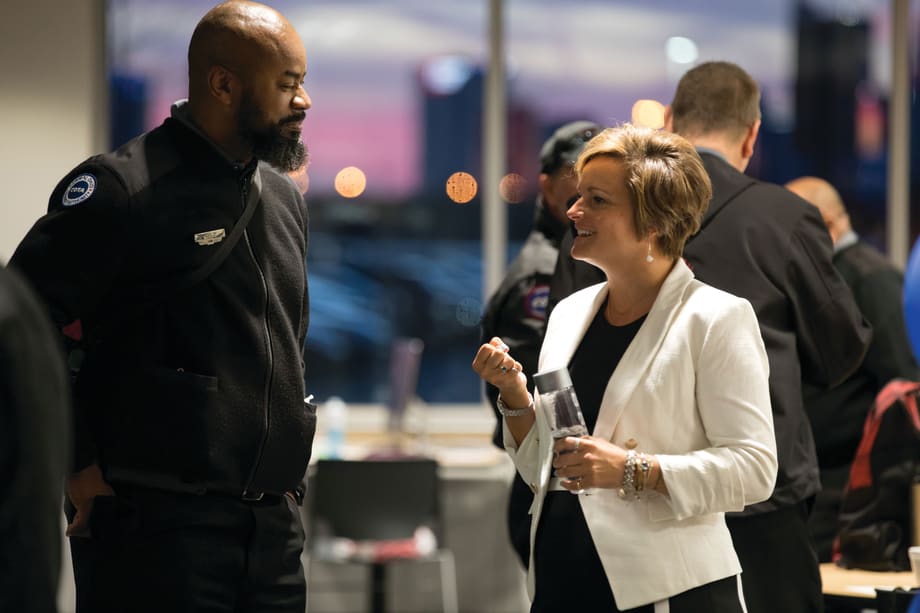
COTA is headquartered in Columbus, Ohio the nation’s first U.S Department of Transportation Smart City Challenge grant recipient.
COTA
COTA is headquartered in Columbus, Ohio the nation’s first U.S Department of Transportation Smart City Challenge grant recipient.
COTA
A licensed professional engineer with a history of implementing solutions to capitalize on Ohio’s rich legacy of transportation, manufacturing and technical resources, Joanna Pinkerton joined COTA as president/CEO in April 2018.
What experience do you bring from working on the private and public side of the industry to your current role?
My experience and background in highly technical and productive organizations —both public and private — has helped me develop the skills needed to convene these groups. Of the many demands placed on the president/CEO role — the ability to bring various entities and teams together to deliver is essential. The bold steps we are taking to improve the customer experience, increase ridership, serve the business community and expand mobility options in Central Ohio requires an understanding of the importance of partnership; not just public-private, but between public, private, academic, and non-profit as well.
A prime example of that is our new Downtown C-pass Program. We are focused on reducing downtown Columbus traffic congestion, preserving mobility capacity for future economic growth, and committed to pollution reduction by providing more efficient access to downtown jobs through this employer-funded transit pass program. COTA combined financial, intellectual and marketing resources with the Mid-Ohio Regional Planning Commission, the Capital Crossroads Special Improvement District and local private business and government agencies to provide unlimited transit passes for downtown employees. Nearly 15,000 have signed up in just a seven-month span, taking advantage of this employer-sponsored benefit.
It is important to develop multi-faceted public-private and public-public relationships for mobility to advance for everyone in a community. Multiple parties need to buy into and become invested in that mission of prioritizing mobility access as a fundamental issue which supports economic growth and the social determinates of a healthy community. It takes a lot of work to serve as a convener, and I believe transit leaders are perfectly situated to identify needs of varying partners and bring them together to reach that common goal.

Pinkerton
What agency initiatives do you feel helped contribute to winning the APTA award last year?
There are multiple initiatives that led to our receiving the award. Most certainly COTA’s system redesign in mid-2017 was one of them. We were one of the first in the nation to perform a complete overhaul of the entire system — our first redesign in 40 years. The focus on neighborhoods and employment centers placed our high frequency routes within walking distance to 89 percent more residents and 71 percent more jobs.
We made customer-focused decisions, putting free Wi-Fi on our entire fleet of 320-plus buses. Our customers can commute to work or access much-needed community services with the comfort and convenience of riding while surfing the internet. Our vehicles are also equipped with GPS and CAD-AVL systems, providing real-time trip planning for our customers through online resources and new displays embedded in our bus stops along our highest capacity corridors.
COTA also launched our first Bus Rapid Transit service — CMAX, which travels from downtown Columbus to Westerville, a heavily-populated suburban city. This was a strategic investment on our part, coordinated with public, private and academic entities. The service provides access to more than 200,000 jobs along the corridor, three post-secondary institutions, and two health care institutions and the investments are paying off — demonstrating a 17 percent increase in ridership in the first year alone. We are also seeing month-to-month increases on CMAX so far in 2019.
We are also focused on helping our community and our business model by contributing to the education and development of the next generation of skilled trade workers. Last year we launched the first year of COTA’s Vehicle Maintenance Internship Program. It is now in its second year. Our team works with high school educators and administrators to recruit high school seniors to work alongside skilled trades professionals during their senior year. This is a paid internship and students learn invaluable skills which they can utilize after graduation with job offers from COTA or other employers in our community.
COTA is also continuing our commitment to environmental sustainability. We will eliminate diesel buses within five years. More than 50 percent of our fleet is compressed natural gas (CNG) already, and as we continue to remove diesel from our fleet, we are committed to deploying electric vehicles in addition to our CNG fleet.
What is the agency’s current challenge that you’re focused on solving?
The entire mobility industry — transit, automotive, infrastructure alike — is experiencing an incredible period of disruption which I see as unlimited opportunity. Having worked in government and academic and non-profits for a while now, I know how challenging it can be to structure agencies which are accustomed to regulation. All of us in the industry must be nimble enough to adapt to customer needs — particularly us in the public mobility business — where we are uniquely situated to ensure equitable mobility services for all people.
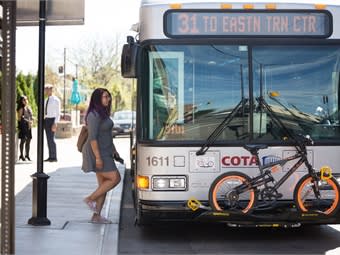
Just last month, COTA’s Board of Trustees approved the implementation process for the first of nine mobility hubs in the region.
COTA
How is COTA working to integrate itself with the new mobility paradigm?
COTA is headquartered in Columbus, Ohio the nation’s first U.S Department of Transportation Smart City Challenge grant recipient. During the development of the program, we have developed a strong partnership with the city and the private partners deploying pilot projects throughout the community to serve residents better through the application of technology.
COTA is currently working with the Smart Columbus Team on several projects including: a common payment system, multimodal trip planning applications, and centralized mobility hubs where multiple modes of personal transport can be accessed. Just last month, COTA’s Board of Trustees approved the implementation process for the first of nine mobility hubs in the region. These locations will put rideshare services, scooters, vehicle sharing and microtransit companies at COTA Park and Rides and terminals to ensure customers have first-last mile solutions as part of their mass transit trip.
What was one of your most memorable experiences riding public transportation?
Last Dec. 29, The Columbus Foundation, our community’s leading philanthropic organization hosted a city-wide celebration event called "The Big Explore." The date celebrated the 75th anniversary of the community choosing to invest in others through philanthropy. As part of “The Big Explore,” the Foundation covered costs to ensure free museum admission to six of our community’s cultural institutions such as the nationally number one ranked COSI (Center for Science and Industry), the new congressionally-designated National Veterans Memorial and Museum, the Columbus Museum of Art and many others.
I rode the bus with the CEO of The Columbus Foundation to some of the venues and met so many great people who were trying COTA service for the first time. We met a retired couple from one of the suburbs whom has traveled the world, and used transit in foreign countries, but they admitted they never used the bus system in their own hometown! They did not realize how easy it was with one of our main lines running through their neighborhood, nor how often the bus came by their home (every 10-15 minutes). I could see their eyes opening to another opportunity to explore Columbus in a different way from that day forward.
More New Mobility

From Hardware to Digital Partner: Luminator Charts Its Next Chapter
CEO Magnus Friberg discusses Luminator’s shift toward becoming a digital partner, the growing importance of software and interoperability, and how AI can help agencies improve operations and passenger experience.
Read More →
Biz Briefs: Alstom Lands Canadian Contract, LYT to Supply California TSP, and More
In METRO's latest installment, we take a look at recent news from Complete Coach Works, Beep, FlixBus, and more partnerships making headlines across the transportation sector.
Read More →
CharterUP’s Armir Harris on Technology, AI, and the Future of Group Mobility
In a recent episode of METROspectives, CharterUP Founder/CEO Armir Harris discussed the company’s evolution from an online charter bus marketplace into a technology platform supporting public- and private-sector mobility and much more.
Read More →
Jacksonville’s NAVI Project Charts a New Course for Autonomous Public Transportation
Through its NAVI program, JTA is showing how autonomous vehicles, intelligent infrastructure, and coordinated operations can work together to deliver everyday public transportation.
Read More →
Biz Briefs: Luminator Marks Milestone and More
From manufacturers and suppliers to transit agencies and motorcoach operators, these updates offer a snapshot of the projects, partnerships and business moves driving the industry forward.
Read More →
New Tricks for Old Bureaucracies: Joshua Schank on Making Transit Innovation Stick
Former LA Metro Chief Innovation Officer Joshua Schank discusses why good ideas aren't enough, how transit agencies can overcome resistance to change, and why today's challenges demand more innovation.
Read More →
How DART's GoPass Is Redefining Regional Mobility
Serving 14 transit agencies, GoPass simplifies multimodal travel by allowing riders to plan, pay for, and manage an entire trip through one app.
Read More →
Biz Briefs: OCTA Taps Clean Energy for Hydrogen Station, Stadler to Supply Via Rail Vehicles, and More
From manufacturers and suppliers to transit agencies and motorcoach operators, these updates offer a snapshot of the projects, partnerships and business moves driving the industry forward.
Read More →CharterUP Expands Into New Mobility and Autonomous Transportation
Vice President of New Mobility Stephen Joos discusses how CharterUP is leveraging its nationwide transportation network, technology platform, and autonomous vehicle partnerships to expand into workforce mobility, campus shuttles, and transit solutions.
Read More →
METRO Magazine Announces 2026 Innovative Solutions Awards Winners
Projects Recognized for Advancing Mobility Through Technology, Accessibility, Workforce Innovation, and Operational Excellence
Read More →