



Enhancing Paratransit Operator Customer Service Skills
Providing good customer service in a paratransit environment is about understanding and respecting people with disabilities as people and customers first. Bringing in the customer’s perspective by including customers with disabilities on panels or advisory boards is a recommended practice.

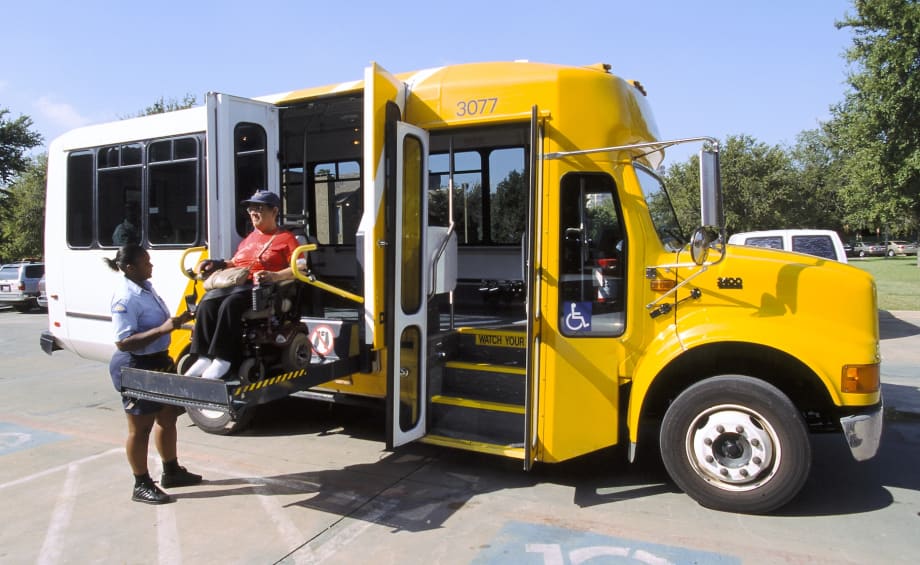
One of the main underlying themes for providing good customer service in a paratransit environment is understanding and respecting people with disabilities as people and customers first. In addition to being trained on operating equipment like lifts or ramps, and how to appropriately use securement equipment for wheelchairs and other mobility devices being secured on vehicles, paratransit operators must acquire “soft service” skills, or customer service type training.
“Quite a few of our drivers are retired postal workers and truck drivers. They carried freight, they didn’t carry people,” says Pat Hansen, director for the Valley City, N.D.-based South Central Adult Services.
“They are excellent drivers, they just didn’t have the knowledge of how to deal with people with disabilities,” she explains of the training classes required by her agency for operators.
There are many resources for paratransit providers with regard to training operators. Washington, D.C.-based Easter Seals Project ACTION (ESPA) is one such resource. This federally funded training and technical assistance center, serving people with disabilities and the transportation and service provider communities, offers training programs, tools and materials, and technical assistance.
“Customer service training is taught more as a philosophy rather than doing A, B and C, because it’s about people,” says Donna Smith, director of training, ESPA.
Customer service training for paratransit operators is about engaging the person and asking what kind of help is needed, she says.
“Just because you see someone moving slowly or who’s using a different technique and reaching out and touching the vehicle to figure out where to step in doesn’t necessarily mean that they need help,” she says, “It just means they are doing it a different way.”
The organization recommends that drivers be trained to ask customers if they need assistance and then proceed based on the person’s request. Although you may have people with similar disabilities, they can have very different ways or skill levels of coping, she adds.
“It’s really about reaching out to that person directly and respecting the fact that they know what they need best and maybe they don’t need help at all,” Smith says.
Service techniques
When communicating with a customer who is deaf, first find out what the person’s level of communication is and develop alternatives.
“Not all people who are deaf can read lips, some people can. Not all people who are deaf can speak,” Smith says.
She recommends that operators always have a pad of paper and pencil handy so they can write down information or offer it to the customer to write down a question.
For people that are visually impaired, it is recommended that operators be as verbal as possible.
“You don’t want to be pointing out directions, or shaking your head, which also doesn’t work in terms of communicating,” Smith says.
If customers have cognitive or intellectual disabilities, operators should provide their information, and if the person still does not seem to understand or ask additional questions, then perhaps break it down into smaller steps or simpler language until you reach a point where they do.
If customers have difficulty with verbal communication, they can speak, but they speak slowly or sometimes slur their language and are difficult to understand, it is recommended to listen to them and hear what they are trying to say, rather than guess.
“If you get part of what they are saying, but not the rest, repeat the portion back to them that you understand and give them the opportunity to work on the part you didn’t,” Smith says.
Another critical aspect of providing good customer service is never saying you understand what the customer is communicating to you if you don’t.
“First of all, you may miss something really important, but also it’s a major issue of not respecting what that person needs to communicate — for you to just discount it as not important,” Smith says.
Customer service training for paratransit operators should also include respectful ways to communicate with a person who is using a wheelchair.
“Some of the best ways to have a conversation with them is to sit, or in some way, kneel down to their level so you are not speaking to them from above them,” says ESPA’s Kristi McLaughlin, training and technical assistance specialist.
Operators should also be careful of leaning onto or putting their hands onto the customer’s wheelchair. Wheelchairs are often considered part of a person’s personal space, so it’s a customer service best practice and customer service to not lean on it, push on it or put your hands on it unless requested, she adds.[PAGEBREAK]
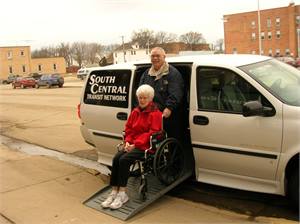
Customer service training for paratransit operators should also include respectful ways to communicate with a person who is using a wheelchair.
Customer perspective
In order to bring in the customer’s perspective with regard to transportation services for people with disabilities, it is highly recommended that providers establish a customer panel. This panel should include a diverse group of customers, including people of different ages, types of disabilities, genders and ethnicities.
“Get together three to five people, who represent your population served and develop a list of specific questions that they can answer about their experience using paratransit,” Smith says.
Developing a panel comprised of customers accomplishes several things: It allows the operator to hear how the customer perceives their service; and it helps operators become a little more comfortable with people with disabilities, Smith adds.
“They may come into the paratransit driving world without much direct experience or contact with people with disabilities, or very limited contact, so they may be a bit nervous about it,” Smith says.
If operations can’t manage to arrange a panel, which can take a bit of time within an organization, there are several disability service and advocacy group agencies that are willing to provide or send someone out to provide sensitivity or disability awareness training.
“The Centers for Independent Living, for example, often have someone on staff that would be able to talk to a group of operators to discuss disabilities and related issues,” Smith says.
Advisory committees
There are also advisory committees for paratransit service, which can provide feedback for services. The ESPA highly recommends that these committees be made up of people with disabilities.
“Sometimes you will have a disability advisory panel and it will be made up of service agency people. Those people who work in the field of disability service may be doing something like training people for employment or assisting people with rehabilitation type activities, but they are not people with disabilities directly,” Smith says.
While it’s fine to have service people on your panel, she explains, it is important to vary the representation from customers with disabilities. To ensure the effectiveness of your committee, it’s important to make considerations for who you are bringing in among people with disabilities and their skill in being able to serve on a committee in an effective way, Smith says.
“One of the downfalls that can happen is the advisory committee becomes a place where complaints can be made. You have people that are sitting on your advisory committee that are complaining about their rides specifically,” she explains.
To avoid this, you want to assist your advisory board to become more progressive with their approach so that they are talking about system issues as opposed to individual complaints.
Customers can provide other kinds of feedback as well, says McLaughlin, maybe not even feedback that is considered negative. Often advisory committees are asked to provide feedback for a change in policy, materials or process for ADA compliance.
“Sometimes agencies are looking to update their eligibility process for their paratransit service,” she adds, “So feedback from the disability community is very important in that case, because they are the ones that are going to have to go through that process.”
If policy issues arise with a customer, working directly with them to find a solution is recommended.
More New Mobility

From Hardware to Digital Partner: Luminator Charts Its Next Chapter
CEO Magnus Friberg discusses Luminator’s shift toward becoming a digital partner, the growing importance of software and interoperability, and how AI can help agencies improve operations and passenger experience.
Read More →
Biz Briefs: Alstom Lands Canadian Contract, LYT to Supply California TSP, and More
In METRO's latest installment, we take a look at recent news from Complete Coach Works, Beep, FlixBus, and more partnerships making headlines across the transportation sector.
Read More →
CharterUP’s Armir Harris on Technology, AI, and the Future of Group Mobility
In a recent episode of METROspectives, CharterUP Founder/CEO Armir Harris discussed the company’s evolution from an online charter bus marketplace into a technology platform supporting public- and private-sector mobility and much more.
Read More →
Jacksonville’s NAVI Project Charts a New Course for Autonomous Public Transportation
Through its NAVI program, JTA is showing how autonomous vehicles, intelligent infrastructure, and coordinated operations can work together to deliver everyday public transportation.
Read More →
Biz Briefs: Luminator Marks Milestone and More
From manufacturers and suppliers to transit agencies and motorcoach operators, these updates offer a snapshot of the projects, partnerships and business moves driving the industry forward.
Read More →
New Tricks for Old Bureaucracies: Joshua Schank on Making Transit Innovation Stick
Former LA Metro Chief Innovation Officer Joshua Schank discusses why good ideas aren't enough, how transit agencies can overcome resistance to change, and why today's challenges demand more innovation.
Read More →
How DART's GoPass Is Redefining Regional Mobility
Serving 14 transit agencies, GoPass simplifies multimodal travel by allowing riders to plan, pay for, and manage an entire trip through one app.
Read More →
Biz Briefs: OCTA Taps Clean Energy for Hydrogen Station, Stadler to Supply Via Rail Vehicles, and More
From manufacturers and suppliers to transit agencies and motorcoach operators, these updates offer a snapshot of the projects, partnerships and business moves driving the industry forward.
Read More →CharterUP Expands Into New Mobility and Autonomous Transportation
Vice President of New Mobility Stephen Joos discusses how CharterUP is leveraging its nationwide transportation network, technology platform, and autonomous vehicle partnerships to expand into workforce mobility, campus shuttles, and transit solutions.
Read More →
METRO Magazine Announces 2026 Innovative Solutions Awards Winners
Projects Recognized for Advancing Mobility Through Technology, Accessibility, Workforce Innovation, and Operational Excellence
Read More →