



FMCSA, NHTSA release NPRMs for EOBRS, seatbelts to increase safety
The proposed rule EOBR rule also would eliminate the need for motor carriers to retain certain HOS supporting documents, such as delivery and toll receipts, which are currently used to verify the total number of hours drivers spend operating the vehicle.
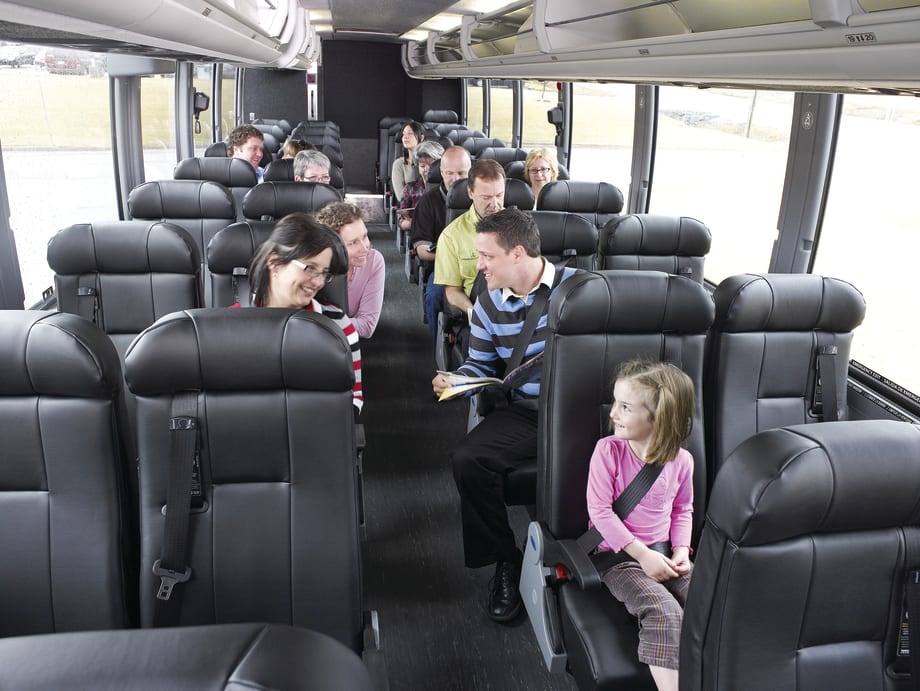
Photo Courtesy: American Seating
Photo Courtesy: American Seating
In January the Federal Motor Carrier Safety Administration (FMCSA) issued a regulatory proposal that would require commercial bus and interstate trucking companies to install electronic on-board recorders (EOBRs) to monitor their drivers' hours-of-service (HOS) compliance.
The proposed rule also would eliminate the need for motor carriers to retain certain HOS supporting documents, such as delivery and toll receipts, which are currently used to verify the total number of hours drivers spend operating the vehicle. This part of the proposal fulfilled an order of the U.S. Court of Appeals for the District of Columbia requiring FMCSA to publish a Notice of Proposed Rulemaking by Jan. 31, 2011. The comment period was set to expire at the end of March.
"EOBRs are part of the Motorcoach Safety Action Plan, but also was part of a commitment I made when I first spoke in my testimony to advance the agency's safety mandate," said Federal Motor Carrier Safety Administrator Anne Ferro. "We're supposed to place safety as our highest priority, and without EOBRs it's very tough to enforce Hours of Service effectively."
The call for EOBRs is just one of several recent proposed rules in the pipeline to help improve safety in the motorcoach industry, including two regarding texting and handheld cell phone use as part of the Distracted Driving initiative spearheaded by U.S. Secretary of Transportation Ray LaHood.
EOBRs automatically record the number of hours drivers spend operating the vehicle. Under the proposal, interstate carriers that currently use Records of Duty (ROD) logbooks to document drivers' HOS would be required to use EOBRs.
"Having recently installed a test model into one of my coaches, I already can see the brighter side; helping lower fuel costs, added driver oversight and records reduction," said George Childers, owner/operator of Vero Beach, Fla.-based Magic Carpet Ride. "Depending upon the services chosen, the cost is nominal for the benefit, thus I feel this regulation will have little negative impact on our industry."
Carriers that violate this EOBR requirement would face civil penalties of up to $11,000 for each offense. Noncompliance would also negatively impact a carrier's safety fitness rating and U.S. Department of Transportation's (U.S. DOT) operating authority. In April 2010, FMCSA issued a final rule that mandates EOBRs for interstate carriers with serious patterns of HOS violations.
"EOBRs are a good example of how technology can create efficiencies in safety departments and in motorcoach operations, while ensuring accuracy of information presented to authorities," said Jared Stancil, vice president of Anchor Trailways & Tours in Nashville, in support of the proposed regulation. "Motorcoaches have become increasingly more technologically advanced, and I believe that motorcoach drivers and operators can adapt to implement new technologies in safety."
Sticky debate
It appears that almost immediately following March's tragic accident in New York, legislators on Capitol Hill began lobbying for stricter regulations on motorcoaches to ensure safety. In actuality, though, the reintroduction of Sens. Sherrod Brown (D-Ohio) and Kay Bailey Hutchison's (R-Texas) Motorcoach Enhanced Safety Act occurred earlier in the month on the fourth anniversary of the Bluffton (Ohio) University baseball team bus crash that killed seven in Atlanta and seemingly picked up steam after the latest traffic incident involving a motorcoach.
The proposed bill would require seat belts and stronger seating systems to ensure occupants stay in their seats in the case of a crash. It would also require improved commercial driver training, anti-ejection glazing windows and "crush-resistant" roofs that could withstand rollovers, as well as reducing the flammability of motorcoach interiors, require more stringent vehicle safety inspections and make EOBRs mandatory.
A companion bill is being introduced in the House of Representatives by U.S. Rep. John Lewis (D-Ga).
In August 2010, however, the NHTSA introduced a Notice of Proposed Rulemaking (NPRM) for requiring seat belts on motorcoaches and is currently analyzing public comments that were submitted to the agency to complete the rule, which would take effect three years from the date it is finalized. It is also in the process of addressing many of the same issues the bill proposes.
"In 2010, Secretary LaHood announced a proposal that would require new motorcoaches to have lap-shoulder belts to help prevent driver and passenger ejections during a collision. The agency is working to finalize the rule," said NHTSA in a statement to METRO Magazine. "Other steps to improve motorcoach roof structure, fire safety protection and emergency egress are also under way."
NHTSA also added that it has completed its research on roof crush and rollover structural integrity test procedures and performance requirements and is planning to issue a NPRM later this year.
Many feel that the motorcoach industry would be better served if the proposed NHTSA regulations were followed rather than legislation like the Motorcoach Enhanced Safety Act.
"I question the necessity of legislation because we don't want to pre-empt what NHTSA's doing," says UMA President/CEO Victor Parra. "They have done crash testing and come out with a proposed rule for seat belts. NHTSA will also be looking at roof strength and window glazing, and is proceeding at a fairly good pace with the proper, robust science. I wouldn't want legislation to overtake this effort. I would like to make sure that science drives policy and not the reverse."
ABA President/CEO Peter J. Pantuso concurs with Parra, saying that the scientific approach is the right way to do things and, at the end of the day, "will make for a safer industry."
At this point operator reaction is mixed, with most welcoming the idea of seat belts, but fearing both the additional cost of the buses they purchase in the future and the requirement to retrofit its current fleet.
"For years, the industry opined that seats in coaches were compartmentalized and that seat belts were unnecessary," says Magic Carpet Ride's Childers. "After reviewing the studies, I think there is a safety benefit to three-point seats belts and installation of the equipment is reasonable despite the $13,000 cost, plus or minus, per coach. Since the market appears to already be driving this issue, we might as well jump on board. The real question, and, one that will have a much greater impact on the industry, will be the proposal to retrofit older equipment."
In its NPRM, NHTSA said it would not require operators to retrofit its fleet with seat belts, saying that it wouldn't be economically feasible for smaller carriers, but hasn't ruled out the possibility later down the road.
Childers says he recently received a quote of $40,000 to retrofit a 2008 coach and, if retrofitting is mandated, he foresees vigorous future legal debates given the various types and ages of equipment that are out on the road.
"If seat belts are mandated, the law should include a 'no liability clause' for operators who equip their equipment with belts, but experience accident injuries to persons who may have elected to not use the seat belts," he says.
At any rate, Pantuso says the requirement to add seat belts and other safety improvements to motorcoaches will end up being an important and expensive issue.
"It's going to have a very challenging impact on all the industry," he says. "When you look at the margins that operators run under right now and how tight things are, it is really difficult to think about the cost of a coach going from over $500,000 to almost $600,000 in a few short years. It will certainly change the economic dimensions of coach travel."
More Motorcoach

METRO Opens Submissions for 2026 Motorcoach Awards
Nominations are now being accepted for METRO Magazine’s Operator of the Year and Innovative Operator of the Year awards.
Read More →
Biz Briefs: Alstom Lands Canadian Contract, LYT to Supply California TSP, and More
In METRO's latest installment, we take a look at recent news from Complete Coach Works, Beep, FlixBus, and more partnerships making headlines across the transportation sector.
Read More →
Biz Briefs: RIPTA Unveils New Frontrunners, Clevland RTA Adds New Siemens, and More
In METRO's latest installment, we take a look at recent news from Siemens, Prevost, Dodge, and more partnerships making headlines across the transportation sector.
Read More →
People Movement: Holly Arnold Joins Transdev and More
In this edition, we also cover recent appointments and announcements at Pace, CamTran, MCI, and more, showcasing the individuals helping to shape the future of transportation.
Read More →
ABA Report: Motorcoach Travel Generates $161.6B Economic Impact
The 2025 analysis finds motorcoach travel supported nearly 900,000 jobs and generated $28 billion in federal, state, and local taxes.
Read More →
CharterUP’s Armir Harris on Technology, AI, and the Future of Group Mobility
In a recent episode of METROspectives, CharterUP Founder/CEO Armir Harris discussed the company’s evolution from an online charter bus marketplace into a technology platform supporting public- and private-sector mobility and much more.
Read More →
People Movement: ABC Names John Walsh as Chief Commercial Officer
In this edition, METRO also covers recent appointments and announcements at the DART, STV, and more, showcasing the individuals helping to shape the future of transportation.
Read More →
From Surviving to Thriving: Building Stronger Transportation Organizations
Bus Business Consultants founder Brian Dickson shares lessons on leadership, organizational health, and creating options for long-term success in a changing transportation industry.
Read More →
Biz Briefs: Luminator Marks Milestone and More
From manufacturers and suppliers to transit agencies and motorcoach operators, these updates offer a snapshot of the projects, partnerships and business moves driving the industry forward.
Read More →
ABAF Study Reveals Growing Insurance Crisis for Motorcoach Operators
Preliminary findings show 98% of operators faced premium increases over the past five years, while shrinking insurer participation is putting added pressure on businesses and customers.
Read More →