



Get On the Road Now With Equipment Financing
Even as transit agencies, municipalities, and tour and motorcoach operators meet new challenges in taking their operations to the next level, so must their managers consider all the available tools for optimal acquisition of equipment.
With squeezed budgets now the norm rather than the exception, more municipalities, transit agencies, and private tour and charter bus operators are considering equipment financing to maintain their fleets in uncertain economic conditions.
Equipment financing provides a range of flexible solutions that can be customized to fit a variety of needs and circumstances, whether public transit systems or private fleets. For governments and municipalities, equipment financing is a turnkey way to bring simplified processing and budget control together as a solution, no matter how limited the funds. For private tour and charter bus businesses, equipment financing helps guard against equipment obsolescence; enables upgrading of fleets to meet new government environmental regulations; offers tax depreciation benefits; and provides flexibility in loan customization or lease terms to best meet their business needs.
Options for coach operators
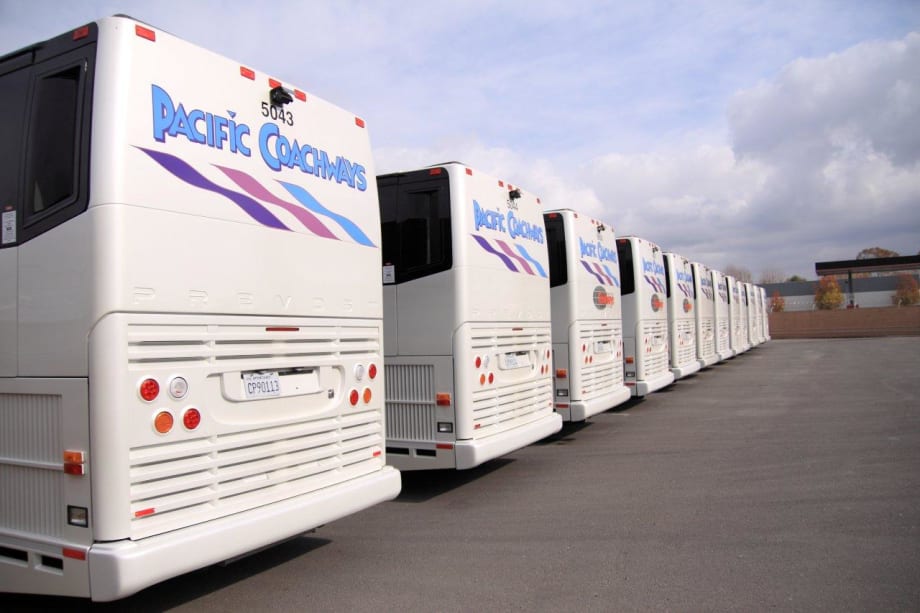
Tom Giddens, president of Garden Grove, Calif.-based Pacific Coachways Charter Services Inc., used equipment financing in 2009 to acquire four motorcoaches, in part to meet new environmental regulations on engines set by the California Air Resources Board.
“With the high cost of buses, financing plays a major part,” says Giddens, whose 23-year-old company now operates an 18-unit fleet of seven buses and 11 motorcoaches. “I don’t know too many people who pay cash for them, or whether they should.”
The reasons for using financing vary, but one of the most attractive benefits for private tour and charter bus operators is the ability to preserve capital for other uses, especially in this era of tight budgets. With financing, owners and operators can acquire the equipment they need to stay competitive, but can also reinvest in their businesses and improve their budgeting accuracy with fixed monthly payments and no floating rates.
Equipment financing is also appealing because it provides protection from equipment obsolescence, which is increasingly important as the transportation industry faces additional environmental regulations on engines and equipment. In addition, equipment financing provides the additional benefits of 100% financing and flexibility in terms and end-of-contract purchases options.
Some of the most frequently used equipment financing options for private tour and charter bus operators include:
• Loan financing.
• TRAC (Terminal Rental Adjustment Clause) leases.
• Fair market value (FMV) or true leases.
Typically, a loan is the most popular equipment financing choice for customers who can use the depreciation benefit. If a customer does not need the depreciation benefit or doesn’t value the depreciation, then the TRAC lease is of value because it offers a lower rate.
TRAC leases are the most common type of leases for business owners who want the option of buying the vehicle for a pre-determined price at the end of the lease. By comparison, the FMV lease, or true lease, provides maximum flexibility and low monthly payments, with the option to purchase the vehicle at its fair market value at the end of the term. [PAGEBREAK]

Equipment financing helps guard against equipment obsolescence; enables upgrading of fleets to meet new government environmental regulations; offers tax depreciation benefits; and provides flexibility in loan customization or lease terms to best meet their business needs.
Financing for municipalities, transit agencies
No matter how limited the funds of your municipality or transit agency, you will find that simplified processing and budget control can co-exist. Here are more reasons why equipment financing is a wise choice:
• Greater flexibility to upgrade or replace equipment.
• Reduction in overall lifecycle costs.
• No restrictive depreciation schedule.
• Preservation of capital funds.
• Forecasting and future budgeting advantages.
• Flexibility to acquire mission-specific equipment.
There are some specific financing products for transit agencies and municipalities to consider, including:
• Tax-exempt lease purchases.
• Fair Market Value or rental agreements.
The benefits add up
1. 100% financing:
Since leasing often does not require a down payment, it is equivalent to 100% financing. This means you can conserve the capital that would have been used for a down payment and reinvest it in your operation.
2. Flexibility:
With growth and changing needs, you may be able to upgrade your equipment at any point during the financing term.
3. Streamlined processes:
Equipment financing allows you to respond quickly to new opportunities with minimal documentation and red tape.
4. Improved cash forecasting:
With equipment financing, you can accurately forecast the cash requirements for the equipment since you know the amount and number of lease payments required, and with leasing, there are no floating fees.
5. Flexible end-of-term options:
There are typically three flexible options at the end of a term. The lessee can return the equipment, purchase the equipment from the financing company or extend the lease for an additional period of time.
6. Tax benefits:
For companies that do not need the Modified Accelerated Cost Recovery System (MACRS) for depreciation resulting from owning equipment, tax leases can be utilized to pass along the tax benefits in the form of lower payments. For companies who want the depreciation benefits, a non-tax lease or loan can provide those benefits.
7. Tax treatment:
The Internal Revenue Service does not consider certain equipment leases to be a purchase, but rather a tax-deductible overhead expense. Therefore, you can deduct the lease payments from income, thus reducing the net cost of financing.
8. Immediate write-off of the dollars spent:
With certain equipment leases, payments are treated as expenses on the income statement, so the equipment solution does not have to be depreciated over an extended term.
Finding the Right Fit
In looking for an equipment finance partner, consider whether the company brings specific knowledge of your industry and an understanding of your operation’s needs.
The right partner will provide simplified processing with documents that are guaranteed to comply with the local laws and the federal tax code; in-house specialists who are knowledgeable, including legal counsel and underwriters who provide quick, innovative solutions; and field resources who can help you navigate unique structures and procurement processes.
It’s important to note: Even though transportation equipment is the focus of your operation, just about any kind of equipment can be financed. This includes information technology hardware and software to help run the business or agency and office equipment and furniture.
Even as transit agencies, municipalities, and tour and motorcoach operators meet new challenges in taking their operations to the next level, so must their managers consider all the available tools for optimal acquisition of equipment. A good financing partner will take the time to ask questions and, more importantly, to listen as you work together through any questions.
The goal is to gain an understanding that will make the financing package as attractive as possible, because after all, the value of equipment comes from using it, not owning it.
Dave Johnson is regional sales manager for Key Equipment Finance, an affiliate of KeyCorp. For more information, you can contact him at Dave.Johnson@Key.com or call (952) 465-3954.
More Bus

Everett Transit, Community Transit Outline Consolidation Agreement
The proposed agreement calls for a 50% increase in bus service in Everett, a new microtransit zone, continued paratransit service, and the transfer of Everett Transit operations to Community Transit.
Read More →
SEPTA Details Accelerate Vision for Transit System
The plan outlines investments in trolley modernization, new Metro and Regional Rail vehicles, accessible stations, and more frequent bus and rail service.
Read More →
Report: Transit Bus Manufacturing Supports 34,100 Jobs, $5.1B in GDP
The “Buses Mean Business” report examines the transit bus manufacturing industry’s economic footprint, supply chain, and rising demand for vehicle replacements.
Read More →
Biz Briefs: New Flyer Delivers in Columbus, Houston, Beep and Freebee Merge, and More
In this edition of Biz Briefs, we spotlight the latest developments shaping the future of mobility.
Read More →
People Movement: Dan Dipert Coaches Adds Third-Generation Leader, Keolis Names New Valley Metro VP/GM, and More
In this edition, we also cover recent appointments and announcements at the Wabtec, SilverRide, HNTB, and more, showcasing the individuals helping to shape the future of transportation.
Read More →
New York MTA Plans Largest Bus Fleet Upgrade in More Than a Decade
The agency is seeking manufacturers for 650 new CNG buses to replace aging vehicles, improve reliability, and advance its broader fleet modernization strategy.
Read More →
Building a Flexible Path to Transit Electrification
John Hroncich discusses BAE Systems’ modular and scalable approach, lessons learned from decades of real-world operations, and how agencies can identify electrification strategies that fit their fleets.
Read More →
Bus Tech Talk: Keeping Transit Technicians Ahead of the Technology Curve
LA Metro’s Obed Mejia discusses technician training, evolving maintenance technology, fleet replacement, and strategies for getting the most out of today’s transit fleets.
Read More →
Biz Briefs: RIPTA Unveils New Frontrunners, Clevland RTA Adds New Siemens, and More
In METRO's latest installment, we take a look at recent news from Siemens, Prevost, Dodge, and more partnerships making headlines across the transportation sector.
Read More →
People Movement: Holly Arnold Joins Transdev and More
In this edition, we also cover recent appointments and announcements at Pace, CamTran, MCI, and more, showcasing the individuals helping to shape the future of transportation.
Read More →