



High-speed rail event highlights projects, need for support
The Western High Speed Rail Alliance's inaugural conference, held in Las Vegas in mid-October, brought industry professionals together to tout the benefits of high-speed rail and highlight projects and the need for funding and support.
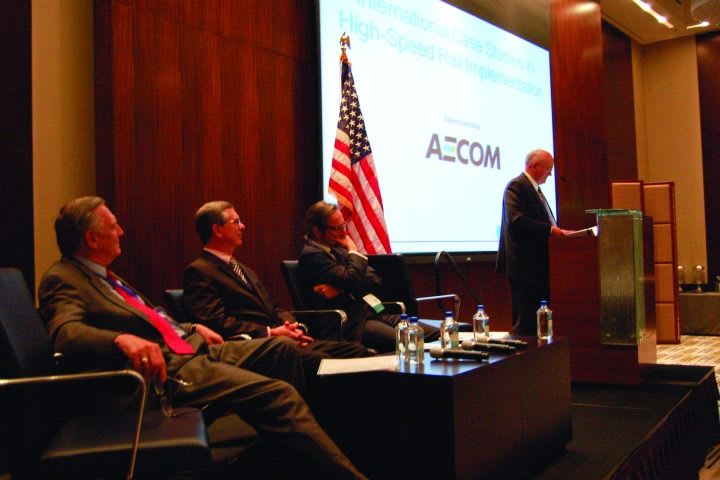
Al Engel, formerly with AECOM and, now, the VP of Amtrak's newly developed high-speed rail department, discussed Spain's foray into the mode at the conference.
[IMAGE]MET11news-hsrpanel-2.jpg[/IMAGE]The Western High Speed Rail Alliance's inaugural conference, held in Las Vegas in mid-October, brought industry professionals together to tout the benefits of high-speed rail and highlight projects and the need for funding and support.
American Public Transportation Association President Bill Millar, who gave the opening remarks, discussed challenges projects face, including the funding issue. "Some of the challenges to have are good, such as having too many riders - that's a great problem!" He also raised the question of workforce development. "Where are we going to get those people to work on these projects?" he asked.
Millar also brought up the last 25-mile problem and how the industry was going to integrate high-speed rail into the public transportation picture. "It will be key to link to local, regional, intercity bus and airports."
Economic development is another challenge Millar discussed. "In Hong Kong, transit makes a profit. They make money on their real estate in Japan. How can we take the value we have allowed to traditionally flow to the private sector and let it go into the transit system?"
Millar also brought attention to the need for funding. "We have to make sure that we don't damage the system we already have. Funding will be less of a challenge if we tell our story," Millar said. "We need to form grass roots support like the WSHRA. You need to become evangelists — get out there and tell the story, to help people understand that this is really revolutionary.
"We have to get out of the ad hoc, we need to come up with a real program for high-speed rail," he added.
Another highlight of the event was a panel discussion of international case studies. The panel featured French National Railway CFO, David Azema, who discussed lessons learned from France's SNCF high-speed rail system. "You need to focus on where the market is. It should be a 200-mile minimum distance; balanced traffic, with a mix of leisure and business."
High-speed rail should be considered a business challenge and not a technical challenge, Azema said. "You need to get it right from the start. Rail is a very heavy industry, you can't make a mistake."
Another key lesson in high-speed rail projects is to build segments first and think about connecting segments. The airlines' hub-and-spoke strategy can also apply to high-speed rail development, he added.
Azema also emphasized the need for high-speed rail to be developed as a whole system, with a business plan in mind, and to be able to interact successfully with other modes. Additionally, high-speed rail should not be viewed as an end solution, and traffic forecasting is not an exact science, Azema added.
Azema also touted the importance of station locations by considering the end-to-end need of the customer.
Steve Clark, associate principal/rail business leader, ARUP, discussed the projects in Brazil. "You need to be realistic and understand what the project can do," he said.
Richard Lawless, president/CEO of U.S. Japan High-Speed Rail spoke about the world-renowned Shinkansen system in Japan, which moves 378,000 passengers daily, with zero fatalities in 46 years. "You need to generate a return on revenues in a way that creates synergy with the economy," Lawless said of high-speed rail system development.
Al Engel, formerly with AECOM and, now, the VP of Amtrak's newly developed high-speed rail department, discussed Spain's foray into the mode. Fifty-percent of the country's infrastructure investment is devoted to rail, while 25 percent apiece is devoted to roads and ports/airports, he said. By 2020, the plan is to have 90 percent of the population within 30 miles of high-speed rail.
More Rail

New York MTA Advances Final Contract for Second Avenue Subway Expansion
Contract Four is the largest in the Second Avenue Subway Phase 2 project and includes construction of station infrastructure, tracks, and signals for the subway expansion, MTA officials said. Work on Contract Four will begin in 2027.
Read More →
San Diego MTS Breaks Monthly Trolley Ridership Record
Agency officials said July’s ridership indicates MTS’s continued recovery from the pandemic.
Read More →
Report Examines NJ TRANSIT Reliability, Funding Challenges
The Garden State Initiative analysis examines the roles of Amtrak infrastructure, fleet management, and agency operations while recommending a more performance-based approach to improving reliability.
Read More →
Stadler, CapMetro Sign Long-Term Rail Fleet Support Agreement
Beginning in 2027, Stadler will provide on-site technical expertise, spare parts support, training, and obsolescence management to help extend the reliability and longevity of CapMetro’s GTW fleet.
Read More →
Biz Briefs: Alstom Lands Canadian Contract, LYT to Supply California TSP, and More
In METRO's latest installment, we take a look at recent news from Complete Coach Works, Beep, FlixBus, and more partnerships making headlines across the transportation sector.
Read More →
CATS Gold Line Marks 5 Years of Service, 2.8M Passenger Trips
With a six-mile expansion planned, the Charlotte streetcar is positioned to connect more neighborhoods and major transit hubs across the region.
Read More →
Why Simulating Pedestrian Movement Has Become Essential for Modern Rail Stations
Pedestrian microsimulation is helping rail planners identify bottlenecks, test station designs, and prepare complex transit hubs for growing passenger volumes.
Read More →
Amtrak Begins Major Construction at New York’s Sunnyside Yard
The new maintenance facility will support Amtrak’s Airo trainsets while improving maintenance efficiency and turnaround times in New York.
Read More →
Chicago Leaders Unveil Plans for O’Hare Airport Express Train
The privately developed project would offer a 15-minute trip between downtown and O’Hare’s Terminal 2, with trains operating every 15 minutes on a dedicated track. The service would use battery-electric trains and three existing freight rail rights-of-way.
Read More →
OCTA Maps Out 30-Year Strategy to Protect Coastal Rail Corridor
The draft feasibility report identifies strategies to protect the coastal rail line for decades as the agency continues near-term stabilization and sand placement efforts.
Read More →