



Illinois transit group urges patent reform legislation
The call seeks to protect the industry, and subsequently other industries, from patent trolls — shell companies that purchase patents with no intention of innovating, but instead sue those who do.

The Champaign-Urbana Mass Transit District was one of at least 11 agencies that settled patent lawsuits with a company rather than embark on costly litigation.
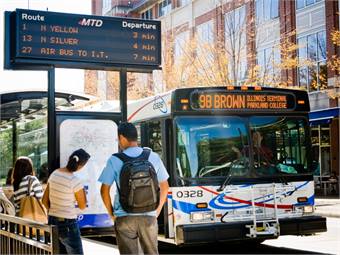
The Champaign-Urbana Mass Transit District was one of at least 11 agencies that settled patent lawsuits with a company rather than embark on costly litigation.
At a press conference in April, the Illinois Public Transportation Association (IPTA) along with its members and partners urged Congress to pass meaningful patent reform legislation. The call seeks to protect the industry, and subsequently other industries, from patent trolls — shell companies that purchase patents with no intention of innovating, but instead sue those who do.
The call by IPTA comes in the wake of three local transit agencies — Metra, the Champaign-Urbana Mass Transit District (MTD) and Rock Island’s MetroLINK — being threatened to be sued or named in lawsuits alleging patent violations.
The issue also impacts private partners providing technology to better serve riders, including security cameras and monitoring equipment for tracking vehicles and their estimated time of arrival.
“Becoming a victim to patent trolls continues to be a concern for transit agencies throughout the country, and it is costing them money,” explained Laura Calderon, executive director of IPTA. “It also is potentially costing passengers the ability to utilize technologies that can make their trips more seamless, which is a big concern.”
One local Illinois company, MCS Office Technologies, was forced to close an entire product line and cut five employees, while all three transit agencies reached financial settlements, due to patent trolls, added Calderon.
IPTA’s call for patent reform includes two key components: require shell companies that have no assets to put up a bond to pay for the victim’s attorney fees and other court costs, if the judge rules the lawsuit is frivolous, and demand more transparency and information in demand letters to more clearly outline information.
“Generally, what ends up happening is a transit agency will get these demand letters that are vague and don’t have much information, so we are looking for a requirement to clearly outline what the patent violation actually is,” Calderon said.
IPTA’s call comes on the heels of the House passing a patent reform bill in December and the U.S. Senate Judiciary Committee holding a hearing to discuss possible patent reform in March.
Just this past summer, the American Public Transportation Association (APTA) sued and settled on behalf of its more than 1,500 members with ArrivalStar, contending its patents related to arrival and status messaging systems for the transportation systems were invalid and unenforceable. APTA’s lawsuit also asserted the 11th amendment prohibits state and regional entities from being subject to such suits.
ArrivalStar had previously settled with at least 11 public transit systems, including MTD and MetroLINK, who decided it was better to settle than embark on expensive and time-consuming litigation.
“The estimates we hear to defend a patent case successfully, even if it’s a fairly simple patent with only a couple dozen claims within the patent itself, is around $2 million or $3 million by the time you get through the entire court system,” explained Jim LaRusch, APTA’s chief counsel and VP, corporate affairs.
To circumvent the system further, LaRusch added that shell companies will file an initial patent as well as create a family of derivatives, creating up to a few dozen patents in all.
“If the non-practicing entity sues an agency or other company and they successfully beat up on one of the patents, the non-practicing entity will then simply amend the lawsuit to include other patents,” he said. “I liken it to playing Whac-A-Mole.”
LaRusch added APTA urges its members to keep them informed whenever they receive a demand letter or anything similar from a shell company, while it continues to monitor the industry as a whole.
Since it is an issue that plagues several areas of business, the association is also partnering to urge Congress for reform.
“Certainly, we are watching for the next issue that could pop up in the industry,” said LaRusch. “We are also working with a broad coalition, which crosses several industries, of folks looking for patent reform to protect people from these sorts of predatory actions.”
More Bus

New York MTA Plans Largest Bus Fleet Upgrade in More Than a Decade
The agency is seeking manufacturers for 650 new CNG buses to replace aging vehicles, improve reliability, and advance its broader fleet modernization strategy.
Read More →
Building a Flexible Path to Transit Electrification
John Hroncich discusses BAE Systems’ modular and scalable approach, lessons learned from decades of real-world operations, and how agencies can identify electrification strategies that fit their fleets.
Read More →
Bus Tech Talk: Keeping Transit Technicians Ahead of the Technology Curve
LA Metro’s Obed Mejia discusses technician training, evolving maintenance technology, fleet replacement, and strategies for getting the most out of today’s transit fleets.
Read More →
Biz Briefs: RIPTA Unveils New Frontrunners, Clevland RTA Adds New Siemens, and More
In METRO's latest installment, we take a look at recent news from Siemens, Prevost, Dodge, and more partnerships making headlines across the transportation sector.
Read More →
People Movement: Holly Arnold Joins Transdev and More
In this edition, we also cover recent appointments and announcements at Pace, CamTran, MCI, and more, showcasing the individuals helping to shape the future of transportation.
Read More →
The High Cost of Transit Buses: Industry Leaders Look to Procurement Reform
Transit leaders and policymakers examine how standardized bus designs, streamlined procurement, and predictable funding could help agencies stretch budgets and deliver better service.
Read More →
The Business Voice Behind Public Transportation
As chair of APTA’s Business Members Board of Governors, Ray Melleady explains how more than 850 business members are partnering with transit agencies to advance funding, innovation, and industry-wide collaboration.
Read More →
From Surviving to Thriving: Building Stronger Transportation Organizations
Bus Business Consultants founder Brian Dickson shares lessons on leadership, organizational health, and creating options for long-term success in a changing transportation industry.
Read More →
Finding the ‘Happy Medium’: Optimizing Maintenance Without Sacrificing Reliability
The key to maintenance optimization isn’t doing less work—it’s doing the right work at the right time on the right assets.
Read More →
LA Metro, City of West Hollywood, and Partners Advance Smarter Bus Lane Enforcement
The award-winning partnership combines AI-powered detection with human oversight to improve bus reliability, accessibility, and enforcement efficiency.
Read More →