



Improving Bus Service Cost and Efficiency Using Indoor Location Systems
The new efficiencies in service that automatic vehicle location brings are being extended into transit yard operations using systems that can provide very accurate vehicle location through covered parking garages and maintenance facilities.
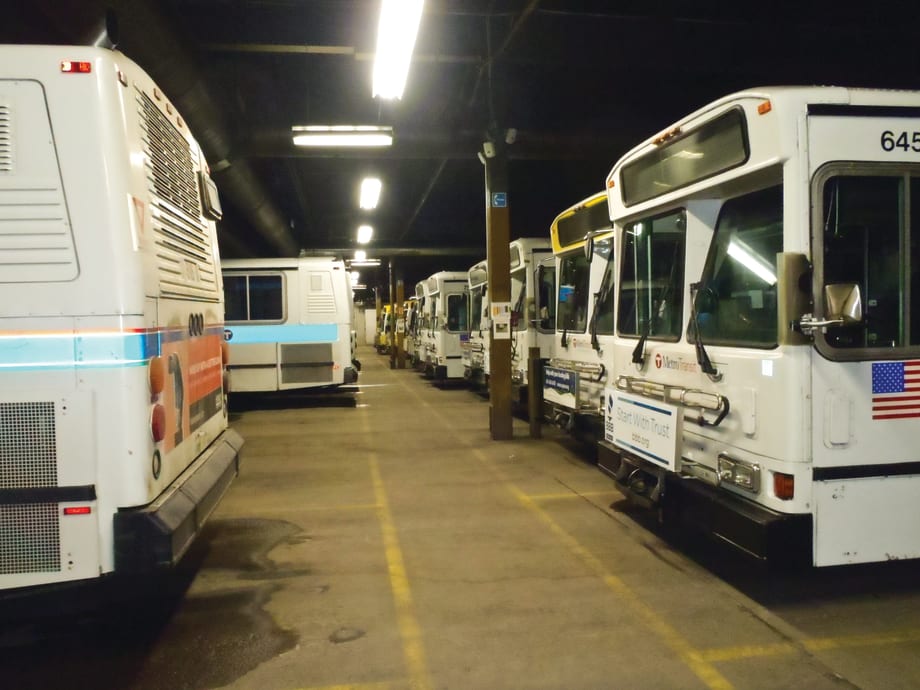
Courtesy Metro Transit
Courtesy Metro Transit
The transit community is starting to let go of its outdated processes and embrace new technologies that provide a variety of efficiencies. Specifically, location solutions are growing in popularity. For instance, automatic vehicle location (AVL) systems using GPS technology have brought location sensing into fleet management. With real-time knowledge of bus location en route, transit operators can make on-the-fly changes to maintain quality of service for their customers. The new efficiencies in service that AVL brings are being extended into transit yard operations, using indoor location systems that can provide very accurate vehicle location through covered parking garages and maintenance facilities.
Knowledge of the exact location of buses inside a facility provides three main areas of value: Efficiencies in finding buses, monitoring process flow and automating processes. Today, most transit operators still record the location of buses on manually created markup sheets that deliver value only in finding buses. These paper markup sheets are inefficient to update and disseminate so the data is often in error or out of date.
Reducing Search Time
An indoor location system can be thought of as a highly reliable, automatically created markup sheet that logs updates in real-time. Different from other operational efficiencies, such a system provides real ROI, based on improved bus-finding alone. There are many people who have a need to find a particular bus in a parking facility including drivers, maintenance staff, cleaning staff and outside contractors. Since the bus location information is in electronic form, it can be quickly accessed from anywhere in the facility on a secure network. Perhaps more importantly, the bus location system is integrated with other databases to provide detailed information about bus type, equipment and status in a fully searchable form.
Outside contractors performing on-site equipment maintenance are a good example of the time and money that a location system can provide. For example, a contractor may need to access all buses that are installed with a video monitoring system. On arrival at the garage, the contractor would use a computer kiosk to query the database for the location of all vehicles using a particular type of video surveillance equipment. A printable map showing the location of all applicable buses is instantly returned, helping the contractor to complete his tasks efficiently. Since many such maintenance contracts are invoiced on a time-on-site basis, removing bus-finding delays can translate into real bottom line savings.
Automatic Alerts
Similar efficiencies are also possible for internal maintenance staff needing to find particular vehicles for routine overnight maintenance or repair. Once again, maintenance staff may wish to find, for example, all hybrid buses that have driven a certain number of miles since the last service date. A simple, intuitive search at a computer provides all the necessary information.
Such a system can be further automated using real-time alerts in place of manual computer searches. Location systems can annotate a map view of the parking garage with icons showing bus status. For example, all buses requiring routine maintenance can be highlighted, with one mouse click revealing the details. Additionally, real-time alerts can provide instant information about critical faults either via e-mail, text message or alerts displayed on digital displays.
Taken a step further, location systems can help to improve this process. A bus arriving at the parking garage may have developed a critical fault as detected by the onboard monitoring equipment. Later in the evening, maintenance staff may query the system to find that bus quickly, but by then several buses may have to be shuffled in order to retrieve the affected vehicle. With real-time information about the location and status of all buses in the garage, a location system can help drivers park buses in such a way that helps maintenance staff retrieve vehicles. This can be done either by directing drivers to park in a holding area, or if no such area is available, directing the driver of the affected vehicle and all subsequent vehicles to park in a way that prevents blocking. For true real-time operation, maintenance staff can be alerted when a vehicle with a critical fault enters the facility and directed to the right location to retrieve it before others arrive to block it in. Once again, frustration and delays are reduced, translating into real savings.
[PAGEBREAK]
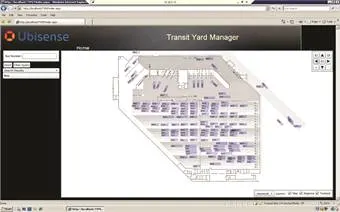
Location systems can annotate a map view of the parking garage with icons showing bus status. For example, all buses requiring routine maintenance can be highlighted, with one mouse click revealing the details.
Improving On-Time Departures
Bus blockage can also play a critical role in dispatching vehicles on time. On-time pull-out is critical to staying on schedule and maintaining the required level of service. A computer-aided dispatch (CAD) system makes a plan that gets the right buses on the right routes at the right time. However, in indoor parking structures where buses are typically parked in long rows, one mistake about bus location can cause pull-out delays; a bus physically cannot leave unless it is in the front of a row. Coordinating the pull-out sequence requires exact knowledge of the location of all vehicles as provided by an indoor location system. The out-of-date manual markup sheets simply do not provide the reliable information necessary.
Even with perfect knowledge about bus location, the unexpected can occur. One flat tire or non-starting bus can block all others behind it until it can be moved. In this case, contingency plans must be put into place immediately to stay on schedule and maintain service. This can involve significant shuffling of buses assigned to particular routes, which is difficult to do without knowledge of the exact location of all the vehicles in a garage. An indoor location system helps operators cope with the unexpected.
Decreasing Downtime
As with GPS, where people are finding more and more benefits from knowing location, transit operators are also realizing that maintenance department efficiencies can be significantly improved using these systems. Using the exact same indoor location system, operators are adding software solutions designed to optimize processes and react efficiently when the unexpected occurs.
Monitoring processes to improve efficiency can often be a surprising exercise for both maintenance staff and supervisors alike. For any routine task there is a plan - the bus may pass through a number of workstations in a given order with an expectation about how long the entire process should take. This is an important parameter since the goal is to hand a bus back to operations on schedule so it can be put back into service. Often, however, tasks routinely take longer than expected with little visibility to help understand why. A location system immediately provides that visibility in two different ways: A map view of the facility can allow users to observe buses moving through the facility in real time, as well as historical data recorded over a period of time, can allow analysis of what actually happens, rather than what we think happens.
A hypothetical problem illustrates how a location system can provide unprecedented insight. Imagine a transit authority running both single and articulated buses. It's known that articulated buses always leave the oil change station much later than planned, causing real issues in terms of getting them back into service. When asked, staff report that oil changes are completed within the allotted time, so the exact cause of the problem is unknown. Here, a location system can illuminate the issue. Viewing a graphical timeline showing the usage of a particular oil change station, it is seen that articulated buses are indeed serviced within the allotted time, but are always last to be serviced. It is also clear that a particular class of single buses takes longer than expected. The articulated buses are not late because of an issue with them, but because servicing on them commences late because of issues with other vehicles.
The location system has highlighted something unexpected and shows the way to fix the problem. Rather than asking maintenance staff, "Why do the artics take so long?" (Answer: They don't), supervisors should be asking, "Why are the artics always the last to get serviced?" (Answer: They are difficult to maneuver so we like to have the others out of the way), and "Why does the single bus take so long?" (Answer: It needs a special tool and we are always waiting to borrow the only one we own). The lateness of artics entering back into service after oil changes is remedied by purchasing more special tools for a completely different vehicle, an answer which couldn't have been found without the insight provided by the location system.
When a location system "peels the roof" off a facility, providing a level of visibility not previously achievable, many similar issues can be found and rectified. Over a period of time, tackling one bottleneck or issue after another, processes can be brought to a higher level of efficiency, which reduces overall maintenance downtime. But, even the most efficient plan becomes useless when the unexpected happens and, with maintenance and repair operations, the unexpected is to be expected. In these cases, a location system can help to flag issues in real time and provide data for contingency planning.
[PAGEBREAK]Managing the Unexpected
When issues arise, real-time alerts are a critical part of ensuring that all relevant parties have up-to-date information. As soon as reality deviates from the plan, it is critical that the correct staff are informed to start contingency planning and that operational staff are warned the bus will not be returned to service as scheduled. An indoor location system can quickly detect when a bus has remained in a given maintenance bay longer than expected or has not arrived at a certain bay at the expected time. This data requires no manual intervention since location updates are automatic. Because the information is in digital form, the alerts can be sent to multiple people instantaneously via e-mail, text message or digital display, for example.
A bus "stuck" in a certain bay has multiple effects: That bus is delayed, bays in which it is scheduled to arrive will stand idle and buses in line behind will be delayed. When these situations arise, the indoor location system once again provides the necessary visibility to maintain operational efficiency. With knowledge of the location of all vehicles either in maintenance or queued up to enter maintenance, scheduling can be rearranged to maintain throughput and avoid costly delays.
Indoor location systems bring a new level of visibility into transit yard management. Transit operators like Metro Transit in Minneapolis are already seeing positive results from using these systems. Metro Transit tracks upwards of 900 buses, uses its system to help maintenance staff find vehicles and has replaced its manual markup sheets with automatically created electronic versions. In the future, Metro intends to integrate the system further with other operations. A single location system can bring multiple benefits across departments with improvements in bus finding and parking, dispatching, and maintenance and repair. Operators like Metro Transit are seeing real improvements in both service and the bottom line.
Adrian Jennings serves as the vice president of technology for Ubisense Inc., a leading provider of location solutions. (www.ubisense.net)
More Bus

New York MTA Plans Largest Bus Fleet Upgrade in More Than a Decade
The agency is seeking manufacturers for 650 new CNG buses to replace aging vehicles, improve reliability, and advance its broader fleet modernization strategy.
Read More →
Building a Flexible Path to Transit Electrification
John Hroncich discusses BAE Systems’ modular and scalable approach, lessons learned from decades of real-world operations, and how agencies can identify electrification strategies that fit their fleets.
Read More →
Bus Tech Talk: Keeping Transit Technicians Ahead of the Technology Curve
LA Metro’s Obed Mejia discusses technician training, evolving maintenance technology, fleet replacement, and strategies for getting the most out of today’s transit fleets.
Read More →
Biz Briefs: RIPTA Unveils New Frontrunners, Clevland RTA Adds New Siemens, and More
In METRO's latest installment, we take a look at recent news from Siemens, Prevost, Dodge, and more partnerships making headlines across the transportation sector.
Read More →
People Movement: Holly Arnold Joins Transdev and More
In this edition, we also cover recent appointments and announcements at Pace, CamTran, MCI, and more, showcasing the individuals helping to shape the future of transportation.
Read More →
The High Cost of Transit Buses: Industry Leaders Look to Procurement Reform
Transit leaders and policymakers examine how standardized bus designs, streamlined procurement, and predictable funding could help agencies stretch budgets and deliver better service.
Read More →
The Business Voice Behind Public Transportation
As chair of APTA’s Business Members Board of Governors, Ray Melleady explains how more than 850 business members are partnering with transit agencies to advance funding, innovation, and industry-wide collaboration.
Read More →
From Surviving to Thriving: Building Stronger Transportation Organizations
Bus Business Consultants founder Brian Dickson shares lessons on leadership, organizational health, and creating options for long-term success in a changing transportation industry.
Read More →
Finding the ‘Happy Medium’: Optimizing Maintenance Without Sacrificing Reliability
The key to maintenance optimization isn’t doing less work—it’s doing the right work at the right time on the right assets.
Read More →
LA Metro, City of West Hollywood, and Partners Advance Smarter Bus Lane Enforcement
The award-winning partnership combines AI-powered detection with human oversight to improve bus reliability, accessibility, and enforcement efficiency.
Read More →