



Innovative Design Solutions Help Bring Streetcars Back to Cincinnati
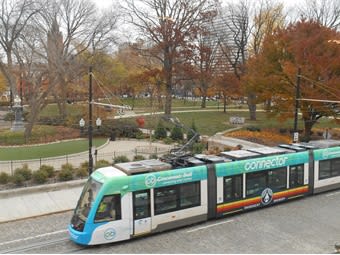
For the first time since 1951, streetcars are providing convenient and affordable public transportation in downtown. The 3.6-mile Cincinnati Bell Connector is the first fully low-floor system in the U.S.

Photos courtesy WSP | Parsons Brinckerhoff
Photos courtesy WSP | Parsons Brinckerhoff
For the first time since 1951, streetcars are providing convenient and affordable public transportation in downtown Cincinnati. The $148 million Cincinnati Bell Connector links Cincinnati’s central riverfront and historic Findlay Market, serving the city’s resurgent downtown and Over-the-Rhine (OTR) neighborhoods. The streetcar also connects to the Government Square transit hub downtown, where riders can transfer between buses and streetcars. The Cincinnati Bell Connector is the first fully low-floor streetcar system in the U.S., creating easier access for passengers to enter and exit the car.
WSP | Parsons Brinckerhoff (WSP | PB) was the prime designer of the streetcar and provided construction support services to the City of Cincinnati Department of Transportation and Engineering. The firm also was part of the team that conducted the feasibility study for the project in 2007.
The 3.6-mile loop is owned by the City of Cincinnati and operated by the Southwest Ohio Regional Transit Authority (SORTA). The firm has been involved in the streetcar since the concept was introduced in 2002 as part of the Central Area Loop Study, which the firm conducted for the Ohio-Kentucky-Indiana Regional Council of Governments, and the MetroMoves Regional Rail Plan conducted for SORTA. The local Alliance for Transit was also instrumental in developing and pursuing the streetcar concept.
Innovative solutions
The project team overcame several challenges to bring the Cincinnati Bell Connector project to life. Some unique challenges took the form of three existing bridges located at the southern end of the line. The streetcar crosses I-71 twice and makes two 90-degree turns over a skewed expansion joint onto Second Street, which itself was built as a structure and is technically a bridge. Approach slabs separate the bridges. The bridges are in close proximity, and the curved section of rail traverses two structures that expand and contract in different directions, requiring a unique design approach. The engineering team designed expansion boxes to allow the rail to expand and contract longitudinally and flex transversely via unrestrained flex zones. Using steel stops to control the amount of movement, this type of dual direction expansion joint is the first of its kind on a U.S. streetcar system.
Controlling movement was not the only issue. Since it was necessary to embed track slabs into the bridge decks, they required protection from water and stray current. A special dialectic membrane was used to provide this separation, and special drainage details were developed to direct storm water away from streetcar infrastructure.
Coordinating traffic, signals
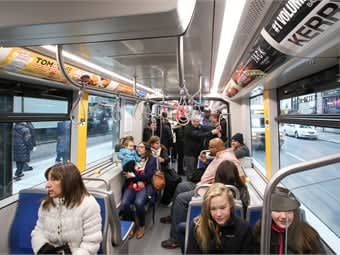
As of Jan. 25, 2017, more than 350,000 passenger trips have been taken since the streetcar’s Sept. 9, 2016 grand opening.
Because the streetcar runs primarily in mixed traffic, the project team had to identify the optimal traffic lanes for its operation to make the line as straight as possible, work around existing bus stops, and facilitate turns. For locations that required tracks to shift from one lane to another to enable a turn, the project team worked with the city’s traffic engineering staff to devise a signaling system that safely and efficiently moves streetcars across lanes and through intersections.
To improve speeds and schedule reliability, the city plans to study the traffic signal system overall to reduce the impact of traffic delays on streetcar travel times.
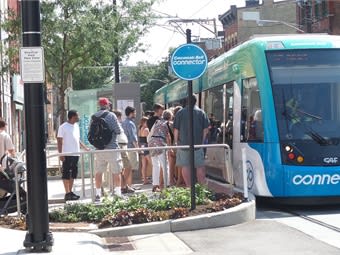
The streetcars require a 14-inch platform at station stops; however, this height is incompatible with buses. To solve this problem, the team worked with the city and SORTA to identify streetcar stop locations that are separate but well-integrated with the existing transit system to maximize convenience and ridership. The downtown transit center, Government Square, was redesigned approximately 10 years ago in anticipation of accommodating light rail or streetcar on both sides of the facility; today, passengers can easily transfer between the streetcar and bus systems at the stops that bracket the transit center.
Navigate dense urban fabric
Station stops were designed to avoid blocking views or access to buildings and activities along the route. Because the streetcar runs through the largest district of Italianate architecture in the U.S., the design underwent a rigorous review process by the neighborhoods, city and State Historic Preservation Office. The modern, simple, steel-and-glass structures achieve a transparent, streamlined contemporary look, complementing rather than imitating the historical architectural style. In addition, bioswales were installed to mitigate storm water run-off.
The design of a $12 million, two-story, 12,460-square-foot maintenance and operations facility underwent similar review. The building’s modern design, height, massing, materials, and other features are compatible with the surrounding area. The maintenance facility was also designed to the LEED (Leadership in Energy and Environmental Design) standards of the U.S. Green Building Council. The site is directly aligned with the streetcar route to avoid deadhead mileage. The new storage yard has capacity for 12 vehicles.
Align with funding sources
Changes in community and funding support of the project during the nine years from concept to revenue service resulted in significant challenges for the project designers. The WSP|PB team successfully adapted to political transitions and the requirements of various stakeholders. In 2011, state funding that previously had been designated to continue the streetcar line to Cincinnati’s Uptown district was withdrawn. The project team, city, and Federal Transit Administration analyzed the impact and determined that a first phase terminus near Findlay Market was viable. Although the Uptown extension was deferred, a junction and tail track were constructed to accommodate the extension while avoiding any interruption of service on the current line.
Coordinating with utilities
Coordinating the relocation of subsurface utilities is a challenge in a long-established city like Cincinnati, where some public and private utilities date from the 19th century. Overcoming this challenge required extensive exploration and documentation by the project team. The project also provided an opportunity for utility owners to replace aging infrastructure. Utilities along the alignment were replaced, rebuilt to “as good as new” condition, or relocated, as necessary. Pavement was removed to a depth of approximately 20 inches and 8.5 feet in width, and replaced with a rail-embedded reinforced concrete slab and aggregate base.
In addition, several buildings along the alignment have basement encroachments underneath sidewalks. More than 100 locations required advance exploration and documentation by the project team to assure placement of the catenary poles on a solid foundation and avoid costly fill-ins or other change orders during construction. Similarly, the engineers avoided placement of structures above an abandoned subway tunnel under Central Parkway, which separates downtown from the OTR neighborhood.
While the first phase of the streetcar project is now complete, expansion of the line is already being considered. Phase 2 will take the line north of downtown to Uptown. Meanwhile, the city of Newport, Ky., located across the Ohio River from downtown Cincinnati, is pursuing a feasibility study for an extension to its riverfront attractions and commercial district.
In September, Cincinnati celebrated the return of streetcar transit with a week-long celebration that included free rides for the public. The Cincinnati Bell Connector serves a highly diverse area economically and socially, and the fare has been kept very affordable: $1 for two hours and $2 for all-day unlimited ridership. Residents and visitors are now enjoying convenient streetcar service that connects them to employment, activities, and other opportunities in the city’s core.
Tim Reynolds, AICP, is a Cincinnati-based senior principal technical specialist in the transit and rail services group of WSP | Parsons Brinckerhoff.
More Rail
Trinity Metro Breaks Ground on $270M TEXRail Extension
The 2.1-mile extension will connect Fort Worth’s Medical District and Near Southside to downtown, surrounding communities, and Dallas-Fort Worth International Airport.
Read More →
Bringing Austin’s First Light Rail System to Life
Austin Transit Partnership CEO Greg Canally discusses the city's nearly 10-mile light rail project, its collaborative approach to project delivery, the importance of community engagement, and the milestones ahead as construction approaches in 2027.
Read More →
Metra Draft Plan Outlines Costs, Service Improvements for Regional Rail
The Systemwide Network Plan identifies infrastructure needs and potential investments to expand all-day, bidirectional rail service across the Chicago region.
Read More →
Amtrak Completes First Street Tunnel Upgrades, Restores Service
The nine-day construction project included replacing aging track infrastructure and modernizing switch systems near Washington Union Station.
Read More →
FRA Announces $2.3B for Passenger, Freight Rail Projects Nationwide
The CRISI Grant Program funding will support rail infrastructure improvements, safety upgrades, and projects aimed at improving freight and passenger rail service across 45 states and Washington, D.C.
Read More →
Caltrain’s Electrification Drives a New Era of Ridership Growth
The railroad’s shift to electric service has brought more frequent trains, stronger customer satisfaction, and increased ridership, earning it APTA’s Outstanding Public Transportation System award.
Read More →
FTA Advances $164M Broward County Commuter Rail Project
The proposed 10.5-mile commuter rail extension would connect Fort Lauderdale and Aventura, expanding passenger rail options in South Florida.
Read More →
New York MTA Launches Historic $1.9B Signal, Track Modernization Project
Funded in part by congestion pricing revenue, the project will replace nearly century-old signals along the A and C lines in Brooklyn and Queens.
Read More →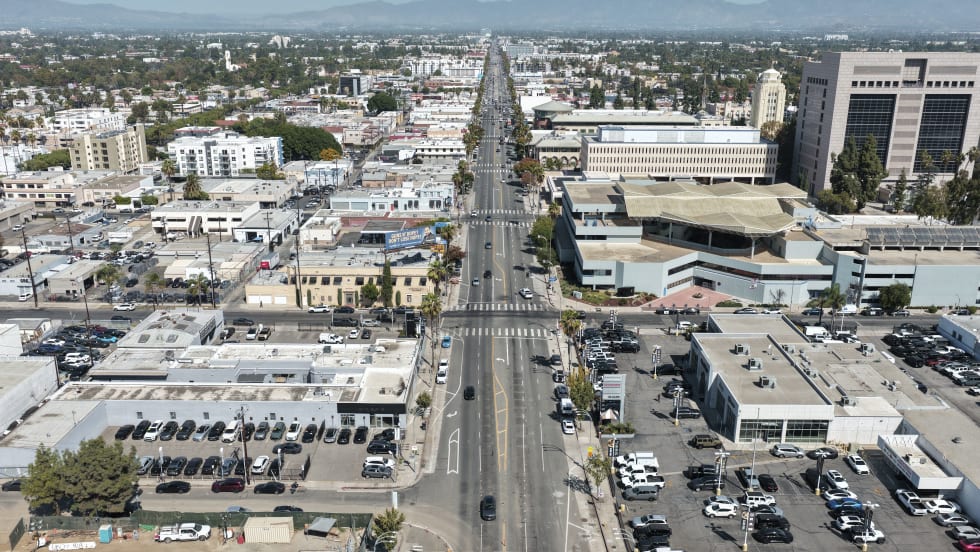
LA Metro Breaks Ground on East San Fernando Valley Light Rail Project
The 6.7-mile line will add 11 stations along Van Nuys Boulevard, expand access to jobs and regional transit connections, and support Metro’s broader efforts to improve mobility as rail ridership grows.
Read More →
CSA Group Releases Climate Resilience Standard for Transit, Passenger Rail
Developed with support from the Standards Council of Canada, CSA D700 guides assessing climate-related risks and planning adaptation measures for transit and passenger rail systems.
Read More →