



Inventory Management: Building a Transit Supply Chain Network
The business case for building a new materials supply chain is strengthened by the clear cost savings derived by adopting unified sourcing, delivery and storage techniques.
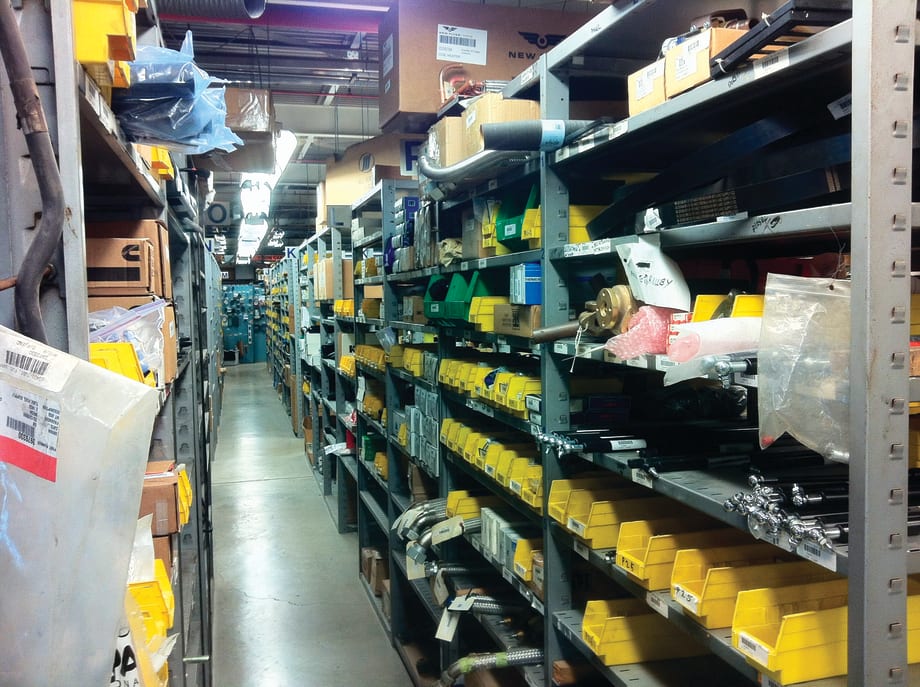
Few North American transit systems have been bold enough to challenge long-standing beliefs about parts inventory management. These transit systems think of parts inventory not as a method to hedge against stock-out risks, but as a component of an integrated network of part sourcing, delivery and usage. Underlying this paradigm shift has been the adoption of best practices from leading retail, automotive and consumer electronic supply chains.
This article will chronicle the experience of Canadian-based Metrolinx in developing an integrated vendor-managed inventory network across Southern Ontario.
Identifying the problem
In 2009, Metrolinx recognized the prevalence of inventory stockpiling practices across transit properties. To identify the cause of these lead times, Metrolinx commissioned a survey examining key inventory practices across Southern Ontario. It became evident that the threat of an out-of-service fleet was real, as long part inventory lead times, sometimes in excess of eight to 12 weeks for single parts, had become standard.
In many industries, similar statistics will prompt critical evaluation of how value can be maximized. However, in an area that has been the domain of power for suppliers than fleet managers and stockroom staff, these metrics tell only half the story. Consultation with key stakeholders across transit properties revealed the unique challenges related to the administration of transit properties. Procurement, finance and legal departments are but a few of the many stakeholders that influence what have become inefficient inventory procedures.
The Metrolinx experience affirmed that a project that seeks to dissect and reassemble the parts inventory supply chain requires interaction with all the key players as early as possible to develop a unified strategy.
Through the assembly of a team of core transit properties across Southern Ontario, Metrolinx began formulating a plan to minimize parts inventory costs and lead times on a regional basis.
Equally important was to open up lines of communication with fellow transit properties to share knowledge they have acquired by developing a Vendor Managed Inventory (VMI) system. VMI is a model of using a single supplier to plan and replenish all transit parts across one or more transit properties. Learning from the successes and challenges of properties adopting VMI enabled Metrolinx to avoid costly delays in establishing a similar inventory supply chain. For example, discussions with N.Y.-based
Rochester-Genesee Regional Transportation Authority led to the following:
• The identification of benchmark data for key performance indicators related to the current supply chain.
• Deeper understanding of transit information technology integration policies and potential hurdles.
• The general support of the shop room floor.
Charting new territory
The business case for building a new materials supply chain is strengthened by the clear cost savings derived by adopting unified sourcing, delivery and storage techniques. As part of this paradigm shift, Metrolinx examined 10,000 parts SKUs to determine the savings potential. While reviewing these parts, it became apparent that apart from transit jargon, there was a third language with the transit industry around part descriptions, which tended to vary from each property regardless of the fact the part number was the same. The analysis yielded for a fleet mix 70% specific to one bus assembler a parts match of only 7% from which the matched parts had a variance of 36.2% on average in price. An exercise of checking prices among peer transit systems was never carried out on this scale in Ontario. This discovery increased the interest of the core group of transit properties to explore this dynamic further.
Using an RFI
The supplier community was also interested in developing a unified inventory management system. By soliciting a Request for Information (RFI) to transit parts supplier in the region, Metrolinx asked suppliers 25 questions, including whether and how much they could save through this initiative. Utilization certainty and minimization of procurement costs were cited as key advantages to realigning the material procurement process. These findings strengthened the business case by gauging supplier interest and testing cost scenarios.
The RFI results provided the first form of engagement with the supplier regarding the potential benefits to be expected. These findings for Metrolinx help solidify the business case to move the project forward. Developing a strong financial model early on is a critical step to generate buy-in and delivery of a VMI system.
We recognized that getting better transit bus supply chain knowledge and access is at the heart of getting results from VMI. The same parties that can provide these benefits do not have the expertise in rail or general auto, and vice-versa. Just like you wouldn’t buy buses and railcars from the same supplier, keeping the VMI program focused on the relevant supply chain helps capture maximum benefits. [PAGEBREAK]How it played out
Savings scenarios were classified into three inventory categories: “Non-OEM,” “OEM” and “Consumables.” Non-OEM product is classified as approved substitution after warranty period on a bus, OEM is the original part purchased from the original equipment manufacturer and consumables that are expensed on a periodic basis rather than by the individual item by item basis. By obtaining three savings numbers and looking at the book value transfer of inventory of transit systems, Metrolinx was able to calculate the “Net Present Value” and compare that with the impact of business as usual.
It is critical to look at various levels of commitment and integration possibilities within a single supplier supply chain. Metrolinx revisited each transit system and worked with their respective finance and procurement departments to find a comfortable level of integration and partnership for the new supply chain. As some transit systems wanted a simple integration of contacting one supplier for parts, others wanted to move to full consignment. Metrolinx responded by developing a multi-tier service approach that allowed freedom within structure. The four service levels range from just buying parts, parts plus data integration, parts consignment and full turnkey stockroom operations.
VMI Misconceptions
Many suppliers argue the benefits of selling off inventory to them, the cost plus pricing model, or providing their own staff and complete IT solutions. However, one should examine these claims in detail before proceeding down VMI.
• Selling off inventory to a third-party supplier who does not know the difference between obsolete and active transit inventory will result in challenges during the transition period of book value vs. real value.
• Transparency in the supply chain with a true partner will reveal their current source and price. This will assure the transit properties of the savings and reveal the multiple layers built into the supply chain. However, some VMI vendors create complicated pricing layers and discount off-rack prices that make understating potential cost savings ambiguous.
• Suppliers who insist on a complete solution by using their own staff might generate unrest with local unions. This is, however, not the purpose of moving toward a single-source supply chain. Transit properties can retain their own stock keepers to continue to receive, stock and issue the parts with all the VMI benefits.
• Information technology solutions related to VMI may appear ideal prior to implementation. The cost of implementing these solutions is one of the most common pitfalls of introducing a single supplier supply chain through VMI. To circumvent this, IT integration does not have to include a complex real-time interface. Instead, static end-of-day patch orders using commonly-used business enterprise tools such as Excel, can save thousands of dollars and IT hours.
Lessons learned, key features
Metrolinx was able to advance and expand the VMI model to provide various service levels, enabling current and new agencies joining the program to pick their level of participation and comfort level to be built with the supplier throughout the integration process. Benefits included:
• The parts basket should have a sample of all new parts of various categories of fast and slow moving.
• A parts open house and tour of transit property facilities should be hosted to allow suppliers to physically examine the inventory. This is critical as part numbers and description might not be the same from one transit system to the next.
• A set of service levels should be developed to roll out various stages of the project as time goes on within the VMI contract, with the ability to highlight innovative solutions over time.
• Inventory and local commitments requiring the supplier to have the capacity to buy the inventory up front is critical to ensure that the supplier will have a local warehouse presence.
• Asking for an obsolete strategy is another huge benefit a partnership can utilize to understand the strategic value that the partner brings to the table.
• Develop a unique VMI agreement for supply chain, recognizing that rail and public works are unique supply chains that cannot all be folded into one giant VMI.
In conclusion, it is critical to move through the various phases of discovery to the issuance of RFP with a clear objective driven by data and evidence to be able to showcase the benefits of a true VMI to a transit property’s respective board and councils. Understanding the good, bad and ugly of inventory practices to move forward is key. Traditionally, Southern Ontario’s supply chain has been comprised of captive buyers who have purchased parts from convenient sources at a premium. This is due to not knowing the original component manufacturer source and original part number discrepancies. It is critical when moving in this direction to have strong support from all levels of your organization.
Naeem Farooqi is a program analyst with Toronto, Ontario-based Metrolinx.
More Bus

New York MTA Plans Largest Bus Fleet Upgrade in More Than a Decade
The agency is seeking manufacturers for 650 new CNG buses to replace aging vehicles, improve reliability, and advance its broader fleet modernization strategy.
Read More →
Building a Flexible Path to Transit Electrification
John Hroncich discusses BAE Systems’ modular and scalable approach, lessons learned from decades of real-world operations, and how agencies can identify electrification strategies that fit their fleets.
Read More →
Bus Tech Talk: Keeping Transit Technicians Ahead of the Technology Curve
LA Metro’s Obed Mejia discusses technician training, evolving maintenance technology, fleet replacement, and strategies for getting the most out of today’s transit fleets.
Read More →
Biz Briefs: RIPTA Unveils New Frontrunners, Clevland RTA Adds New Siemens, and More
In METRO's latest installment, we take a look at recent news from Siemens, Prevost, Dodge, and more partnerships making headlines across the transportation sector.
Read More →
People Movement: Holly Arnold Joins Transdev and More
In this edition, we also cover recent appointments and announcements at Pace, CamTran, MCI, and more, showcasing the individuals helping to shape the future of transportation.
Read More →
The High Cost of Transit Buses: Industry Leaders Look to Procurement Reform
Transit leaders and policymakers examine how standardized bus designs, streamlined procurement, and predictable funding could help agencies stretch budgets and deliver better service.
Read More →
The Business Voice Behind Public Transportation
As chair of APTA’s Business Members Board of Governors, Ray Melleady explains how more than 850 business members are partnering with transit agencies to advance funding, innovation, and industry-wide collaboration.
Read More →
From Surviving to Thriving: Building Stronger Transportation Organizations
Bus Business Consultants founder Brian Dickson shares lessons on leadership, organizational health, and creating options for long-term success in a changing transportation industry.
Read More →
Finding the ‘Happy Medium’: Optimizing Maintenance Without Sacrificing Reliability
The key to maintenance optimization isn’t doing less work—it’s doing the right work at the right time on the right assets.
Read More →
LA Metro, City of West Hollywood, and Partners Advance Smarter Bus Lane Enforcement
The award-winning partnership combines AI-powered detection with human oversight to improve bus reliability, accessibility, and enforcement efficiency.
Read More →