



Jacksonville Launches Nation’s First Public Autonomous Transit Service
Running weekdays from 7 a.m. to 7 p.m., NAVI is designed to seamlessly connect residents, businesses, and visitors across a vital urban corridor stretching from Pearl Street to EverBank Stadium.

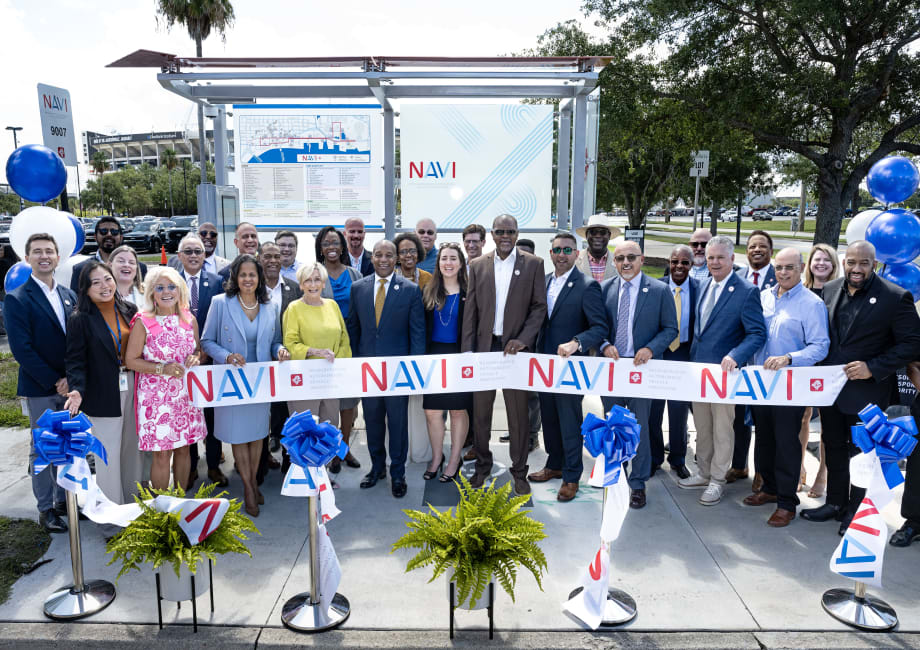
The NAVI service is the first phase of JTA’s Ultimate Urban Circulator program. Over the next decade, the second and third phases will convert the city’s aging Skyway infrastructure into an elevated AV-exclusive corridor.
Photo: JTA
Florida’s Jacksonville Transportation Authority (JTA) marked a historic milestone with the launch of NAVI — the Neighborhood Autonomous Vehicle Innovation initiative — the first autonomous vehicle (AV) service in the U.S. operating as part of a public transit system.
The groundbreaking service begins revenue operations on June 30, along the 3.5-mile Bay Street Innovation Corridor in Downtown Jacksonville.
Passenger-Centric and Data-Driven
Running weekdays from 7 a.m. to 7 p.m., NAVI is designed to seamlessly connect residents, businesses, and visitors across a vital urban corridor stretching from Pearl Street to EverBank Stadium.
The corridor links Jacksonville’s residential neighborhoods with its central business district and Sports & Entertainment District, enhancing access to key destinations such as the Florida Theatre, Jacksonville Naval Museum, Jacksonville Center for the Performing Arts, and more than 35 local restaurants.
“This launch marks a defining moment for transit in America,” said JTA CEO Nat Ford. “We’re the first in the nation to fully deploy a public transportation service using autonomous vehicles in revenue operation. NAVI represents a new chapter in mobility: inclusive, efficient, and community-building.”
To ensure continuous improvement, the JTA is encouraging riders to complete short surveys following their trips. This passenger feedback will help shape ongoing service adjustments as the AV program evolves.
NAVI is fare-free through Sept. 30, lowering barriers to adoption and maximizing opportunities for public input.
A Scalable, Future-Ready Fleet
Initially, NAVI will use 14 custom electric Ford e-Transit vans, outfitted with Oxa’s automated driving system (ADS) and meeting Buy America and Federal Motor Vehicle Safety Standards. Each vehicle seats up to nine passengers and includes ADA accessibility features.
Plans include the integration of the HOLON autonomous shuttle, with deployments anticipated as early as 2027.
HOLON is establishing a production facility in Jacksonville, which is expected to stimulate local economic growth and reinforce the city’s role in the national AV ecosystem.
The NAVI service is the first phase of JTA’s Ultimate Urban Circulator (U2C) program. Over the next decade, the second and third phases will convert the city’s aging Skyway infrastructure into an elevated AV-exclusive corridor.
Once complete, the network will link the urban core with key destinations in the Springfield, Brooklyn, Riverside, and San Marco neighborhoods, according to JTA officials, bridging gaps in healthcare, education, employment, and housing access.
The NAVI program was developed in collaboration with the Balfour Beatty Vision 2 Reality (V2R) team, which includes Beep, Superior Construction Company Southeast, WGI, Inc., Urban SDK, Miller Electric, and Grayline.
“With the NAVI launch, Jacksonville is leading by example,” said Beep CEO Joe Moye. “As autonomous vehicle regulations and technologies continue to evolve, this model can serve as a scalable solution for communities across the country.”
More Technology

From Hardware to Digital Partner: Luminator Charts Its Next Chapter
CEO Magnus Friberg discusses Luminator’s shift toward becoming a digital partner, the growing importance of software and interoperability, and how AI can help agencies improve operations and passenger experience.
Read More →
Beyond the Checklist: A Structured Approach to Transit Maintenance
Reliability-Centered Maintenance helps transit agencies move beyond routine checklists to focus limited resources on the assets and failures that have the greatest impact on safety, reliability, and service.
Read More →
NJ TRANSIT Advances Bus Technology Upgrades Across Statewide Fleet
More than 1,500 buses now feature upgraded technology designed to improve arrival predictions and provide free Wi-Fi, with deployment expected to reach nearly 2,000 buses by the end of 2026.
Read More →

Building a Flexible Path to Transit Electrification
John Hroncich discusses BAE Systems’ modular and scalable approach, lessons learned from decades of real-world operations, and how agencies can identify electrification strategies that fit their fleets.
Read More →
Biz Briefs: Alstom Lands Canadian Contract, LYT to Supply California TSP, and More
In METRO's latest installment, we take a look at recent news from Complete Coach Works, Beep, FlixBus, and more partnerships making headlines across the transportation sector.
Read More →
From Legacy Silos to Conversational Intelligence
What if transit leaders could ask any operational question and get a trusted answer in seconds? Conversational AI is transforming how agencies use their data.
Read More →
USDOT Announces Rail Vehicle Replacement Grants, Chattanooga AV Shuttle Funding
More than $191 million in federal funding will help three transit agencies replace aging rail vehicles and support a new autonomous shuttle service in Chattanooga.
Read More →
Bus Tech Talk: Keeping Transit Technicians Ahead of the Technology Curve
LA Metro’s Obed Mejia discusses technician training, evolving maintenance technology, fleet replacement, and strategies for getting the most out of today’s transit fleets.
Read More →
Biz Briefs: RIPTA Unveils New Frontrunners, Clevland RTA Adds New Siemens, and More
In METRO's latest installment, we take a look at recent news from Siemens, Prevost, Dodge, and more partnerships making headlines across the transportation sector.
Read More →
Why Simulating Pedestrian Movement Has Become Essential for Modern Rail Stations
Pedestrian microsimulation is helping rail planners identify bottlenecks, test station designs, and prepare complex transit hubs for growing passenger volumes.
Read More →