



Long Beach Transit Takes Innovative Path
Adding CNG vehicles to its diverse fleet, building a fueling facility and refurbishing its maintenance garage are some of the projects the system has on its plate.
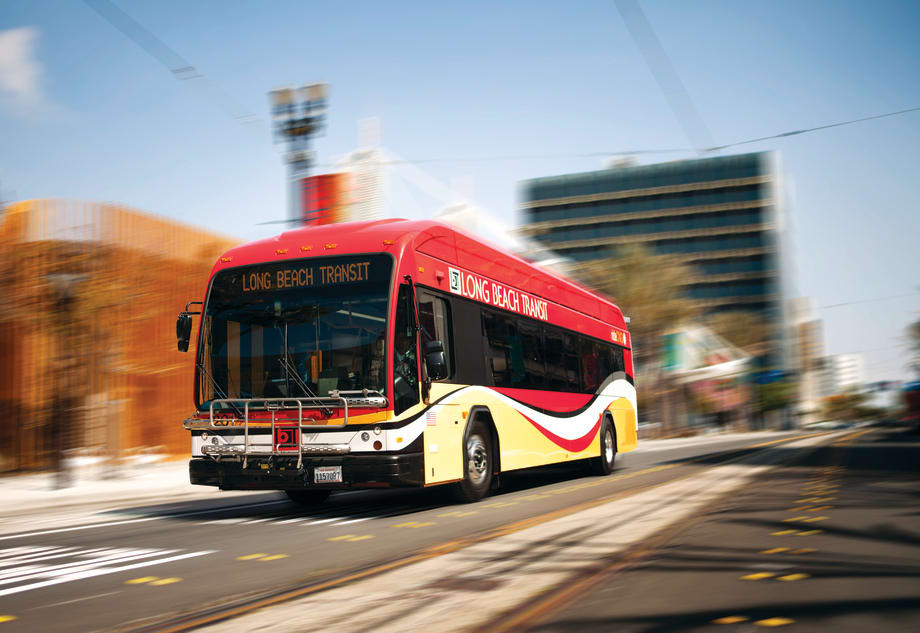
When Larry Jackson, president/CEO of California-based Long Beach Transit (LBT) became GM, as the position was previously called, in 1980, the “sleepy” transit system, carried about eight million people a year, with about 300 employees, he says. Today, the operation carries approximately 28 million customers, with a work force of approximately 800, plus an additional 100 contract workers.
Operation overview
Current services include fixed-route bus service, including ZAP express routes; Passport circulator service; AquaLink and AquaBus water taxi service; Dial-A-Lift paratransit service; and a seasonal Museum Express service, which combined, spans an area of 98 square miles.
The fleet is comprised of 228 buses total, including 185 40-foot coaches, 30 mid-sized Passport shuttles and 13 60-foot articulated coaches. The Dial-A-Lift paratransit service operates 20 vans, while four vessels are used for the water taxi services. Half of LBT’s fixed-route vehicles are hybrid gasoline-electric buses, with the remaining buses using ultra-low sulfur diesel fuel equipped with particulate traps.
All buses have state-of-the-art TranSmart communications systems on board. The system’s features include two-way text, data and voice communication capabilities; automatic stop announcements and global positioning vehicle location. It also enables the display of real-time schedule information on the operation’s website at the recently renovated First Street Transit Gallery and other major stops.
The new Gallery can be likened to a dazzling frame for the transit system’s dynamic bus fleet. Located in downtown Long Beach, the Gallery is a major transit hub that services, in addition to LBT, Los Angeles County Metropolitan Transportation Authority, Los Angeles Department of Transportation and Torrance Transit buses as well as the Metro Blue Line light rail service. Approximately 50,000 people traverse through the Gallery per day to reach their destinations.
The renovated $7 million transit hub, built using federal stimulus funding made available through the American Recovery and Reinvestment Act, features eight bus shelters with wave-like canopies. Other design elements include artwork by local artists (currently murals, poetry and photography with a marine life theme). Amenities include multiple bus benches, electronic real-time bus arrival displays, 24-hour touch screen information kiosks and public restrooms.
Fleet innovations
Taking on innovative projects is nothing new for LBT, as it has long been at the forefront when it comes to greening its bus fleet. More than a decade ago, the transit system introduced ultra-low sulfur diesel fuel to its program and equipped its diesel vehicles with particulate traps. In 2005, the operation moved to gasoline-electric hybrid vehicles, of which they have nearly 100. LBT was the first transit agency in the nation to utilize production model gasoline-electric hybrid technology, which they took on even before they needed to comply with California air standard requirements.
When it came time to replace the remainder of the aging ultra-low sulfur diesel fleet, LBT wasn’t sure if there was going to be a marketplace for hybrid-electric technology, as ISE, the supplier of the hybrid-electric drive systems on its current fleet, was no longer in business. “We couldn’t wait, we had to replace coaches,” Jackson says.
Last year, the transit system adopted a compressed natural gas (CNG) technology track and placed an order for 64 40-foot CNG vehicles from bus manufacturer Gillig out of Hayward, Calif. Per the estimated $32 million order, LBT expects to receive the final vehicles by year’s end.[PAGEBREAK]
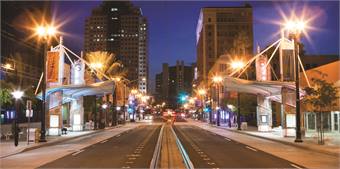
The new Long Beach Transit Gallery can be likened to a dazzling frame for the transit system’s dynamic bus fleet. It serves as a hub for several Los Angeles County transportation agencies.
CNG technology
LBT has already taken delivery of a prototype, the first of Gillig’s new BRTPLUS model featuring a modern streamlined design, which was displayed at the American Public Transportation Association (APTA) EXPO in New Orleans late last year.
“The new BRTPLUS model is designed to minimize the maintenance hours spent on the bus,” says Gillig VP, sales and marketing, Joe Policarpio. “We do that with large access and wheelwell panels, where they can easily access airbags, shocks, leveling valves and that sort of thing.”
The company also introduced specific designs to increase vehicle safety, such as the integrated side impact barrier, which would protect passengers in the event of a side collision. The new model also sports a standard size tire, which is more cost effective for transit systems because the tires have a standard profile for better wear.
The 40-foot low-floor vehicle is equipped with a Cummins ISL G, 280 hp engine and a ZF EcoLife transmission. The interior features brightly upholstered seats and vibrant yellow powder-coated stanchions to make the vehicle more appealing to customers, adds Policarpio.
To accommodate the new CNG fleet, LBT is building a federally funded $6.7 million CNG fueling facility at its Jackson Transit Center, which also houses the transit system’s additional maintenance garage.
The station will be able to refuel two large buses simultaneously in about six minutes each and is capable of compressing about 16 gasoline gallons equivalent per minute of CNG to more than 3,600 psi. Additionally, it will be able to support the daily fueling of as many as 100 CNG buses, according to Ryan Erickson, project manager for GNA, an environmental consulting company guiding LBT on the project.
A larger electrical transformer will be installed to accommodate the power needed to run the compressor station as well as a larger supply line to deliver a greater volume of gas, says Kevin Lee, LBT’s media relations manager. A new compressor station will be added that will have five “skids” with four levels of compression in each, and a new dispenser will be installed on the fuel island to service the buses. Long Beach Gas & Oil Department will supply the CNG to LBT.
“For safety purposes, the fueling site will be controlled and monitored by an automated computer at all times, says Lee. “When a vehicle is fueling, it is unable to start and drive,” he explains.
The maintenance garage at the transit center is also being overhauled with improved ventilation, heating and lighting and electrical as well as a natural gas leak detection systems. The detection system will have two stages of warning: the first will turn on a yellow warning light and exhaust fans, while the second stage uses red warning light and horn that also turns on the exhaust fans and automatically opens the facility doors.
“The electrical components in the shop will be changed out or retrofitted to withstand and avoid an explosion,” Lee says.
Financial footing
While Jackson has been instrumental in keeping LBT on the cutting edge, he has also managed to successfully steer the transit system through financial challenges.
“Over the past 35 years, we have gone from living hand to mouth, to having retirement funds that are fully funded, which is quite an accomplishment in today’s difficult-public sector market,” he says.
In its 49-year history, the transit system has never missed a day of service, experienced a labor strike and never put itself in a situation that would necessitate layoffs, Jackson says proudly. “I continue to run our public transit corporation as a private business.”
Putting the company on sound financial footing and being able to get through the last four years of the recession was the result of making shared sacrifices, Jackson says. The corporation has built up emergency cash flow reserves over 30 years, which they had to dip into to help get through the more recent challenges.
In the last few years, the company had to raise fares twice and cut service by about 3.5%, its employees haven’t received pay raises since 2008 and they’ve had to contribute more toward pensions and health benefits.
“So effectively, our employees have swallowed hard and have taken a pay cut, but everyone is grateful to have the security and stability of a job,” Jackson says of the sacrifices. He also adds that many of the people LBT hires today as drivers and maintenance personnel are those who have been laid off from other transit systems.[PAGEBREAK]
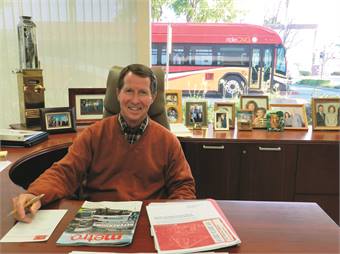
LBT’s President/CEO Larry Jackson has helped the agency grow significantly since taking over as GM in 1980, including growing ridership from eight million to 28 million passengers per year.
Another accomplishment Jackson is proud of is the fact that numerous transit industry leaders have “cut their teeth at LBT at some point in their career” and have gone off to leadership positions, including several California-based CEOs. He names Karen King (Golden Empire Transit District/Bakersfield), Carl Sedoryk (Monterey Salinas Transit), Jack Gabig (Gardena Municipal Bus Lines), Art Ida (Culver City Bus) and Larry Rubio (Riverside Transit Agency) as former employees.
“Being able to be an organization that has developed a lot of people who are leaders one way or another in this industry — that’s one of the legacies that I’m most proud of,” Jackson says.
He also acknowledges the loyalty of the company’s employees. “Our chief operating officer started out as our payroll clerk.”
The operation has a tuition reimbursement program so employees can get meaningful education to advance their careers. LBT also looks to the Leadership APTA Program and a Leadership Long Beach program as valuable resources to help cultivate their employees. Additionally, for the past 20 years, LBT has worked with Spencer/Shenk/Capers & Associates Inc., a consulting firm, to provide administrative staff with management motivation and process communication training.
“So, we can speak the same language,” Jackson says, “We’re all achievement driven and customer focused.”
On the operator side, Jackson says driver training is comprised of an eight-week course, which besides teaching the mechanical and technical sides of driver training, also includes other skills, like marketing and customer service. “Long Beach is one of the most diverse cities in the nation, so you have to be sensitive to all cultures, and this comes through during the training,” he adds.
Challenges
Besides the oft-mentioned challenge of lacking a predictable, sustainable funding source, other challenges faced by the transit system include being able to keep up with the increasing popularity of public transportation.
“Long Beach is a very multi-modal-friendly community, and walking, biking and riding the bus are trending right now. This trend is great news, and we are very happy to be serving our community in this way, but it is also a challenge. We are always looking for opportunities to be creative in order to distribute our limited resources and still accommodate the demand,” Lee says. “This will become a greater challenge if gas prices continue to rise and more people get on the bus.”
More New Mobility

From Hardware to Digital Partner: Luminator Charts Its Next Chapter
CEO Magnus Friberg discusses Luminator’s shift toward becoming a digital partner, the growing importance of software and interoperability, and how AI can help agencies improve operations and passenger experience.
Read More →
Biz Briefs: Alstom Lands Canadian Contract, LYT to Supply California TSP, and More
In METRO's latest installment, we take a look at recent news from Complete Coach Works, Beep, FlixBus, and more partnerships making headlines across the transportation sector.
Read More →
CharterUP’s Armir Harris on Technology, AI, and the Future of Group Mobility
In a recent episode of METROspectives, CharterUP Founder/CEO Armir Harris discussed the company’s evolution from an online charter bus marketplace into a technology platform supporting public- and private-sector mobility and much more.
Read More →
Jacksonville’s NAVI Project Charts a New Course for Autonomous Public Transportation
Through its NAVI program, JTA is showing how autonomous vehicles, intelligent infrastructure, and coordinated operations can work together to deliver everyday public transportation.
Read More →
Biz Briefs: Luminator Marks Milestone and More
From manufacturers and suppliers to transit agencies and motorcoach operators, these updates offer a snapshot of the projects, partnerships and business moves driving the industry forward.
Read More →
New Tricks for Old Bureaucracies: Joshua Schank on Making Transit Innovation Stick
Former LA Metro Chief Innovation Officer Joshua Schank discusses why good ideas aren't enough, how transit agencies can overcome resistance to change, and why today's challenges demand more innovation.
Read More →
How DART's GoPass Is Redefining Regional Mobility
Serving 14 transit agencies, GoPass simplifies multimodal travel by allowing riders to plan, pay for, and manage an entire trip through one app.
Read More →
Biz Briefs: OCTA Taps Clean Energy for Hydrogen Station, Stadler to Supply Via Rail Vehicles, and More
From manufacturers and suppliers to transit agencies and motorcoach operators, these updates offer a snapshot of the projects, partnerships and business moves driving the industry forward.
Read More →CharterUP Expands Into New Mobility and Autonomous Transportation
Vice President of New Mobility Stephen Joos discusses how CharterUP is leveraging its nationwide transportation network, technology platform, and autonomous vehicle partnerships to expand into workforce mobility, campus shuttles, and transit solutions.
Read More →
METRO Magazine Announces 2026 Innovative Solutions Awards Winners
Projects Recognized for Advancing Mobility Through Technology, Accessibility, Workforce Innovation, and Operational Excellence
Read More →