



Maintenance Departments Feeling Pinch of Shrinking Budgets
In METRO's inaugural Bus Maintenance Survey, transit agencies find they are often asking their maintenance departments to do more with less, including cutting overtime, watching costs, reshuffling mechanic and fueler schedules, and extending vehicle life cycles.
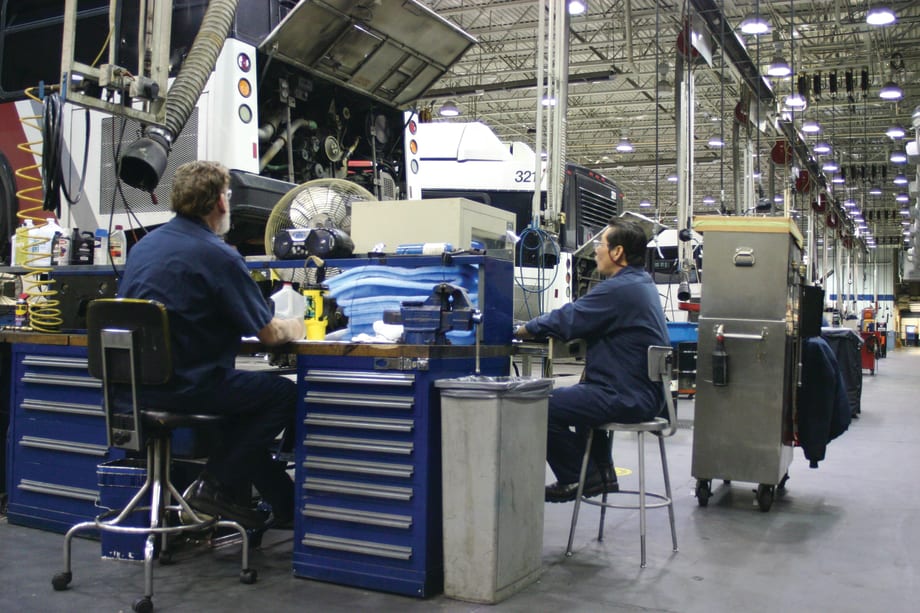
Photo Courtesy: The T
Photo Courtesy: The T
With transit agencies experiencing shrinking budgets, their maintenance teams are also feeling the pinch, with a large majority of maintenance managers saying they are indeed being asked to cut back or maintain services with fewer resources, according to METRO Magazine's inaugural Bus Maintenance Survey.
"We are being asked to expand service, but hold our budget flat," explains one respondent. "Our board is using every available dollar to fund our expansions."
When asked how they are dealing with this dynamic, answers ranged from cutting overtime and watching costs "very closely" to reshuffling mechanic and fueler schedules to better suit their needs.
METRO sent out more than 40 surveys — with questions ranging from training practices and practical experiences with alternative-fuel technologies to biggest challenges and most frequently seen issues in the shop — to agencies across the U.S. and Canada, with about one-third responding.
Agencies varied in fleet size, with the largest maintaining 990 buses and the smallest 72, and in staff, which ranged from 220 full-time mechanics to just 14. On average, those surveyed run each vehicle in their fleet 47,857 miles per year, with one respondent averaging as high as 100,000 miles per vehicle, per year. The lowest annual average was approximately 26,000 per year.
Overall, the most frequent issue in the shop, according to respondents, was parts, which included concerns about availability, lead times and frequent failures. Meanwhile, dealing with new cleaner burning engines with alternative propulsion, electrical (issues/training), scheduling service and frequent brake change/failures rounded out the top five.
Sixty-one percent of those surveyed say they are having difficulty hiring new mechanics, with reasons ranging from lack of training in ever-evolving technologies to budget constraints to the large number of baby boomers retiring. Interestingly, the majority of the 39 percent that responded "no," say the economy has resulted in less turnover of mechanics and a wider field of experienced applicants when a job is available.
Shrinking budgets are also impacting vehicle replacement, with a majority of respondents saying they have to extend the life cycle of their current fleets and/or change the way they spec future buses to get an extra two to three years of life.
Below are some select answers to questions posed throughout the survey. METRO hopes to expand and refine the Bus Maintenance Survey in the future. If you would like to participate or provide feedback on issues you would like to see covered, please email us at info@metro-magazine.com.
[PAGEBREAK]
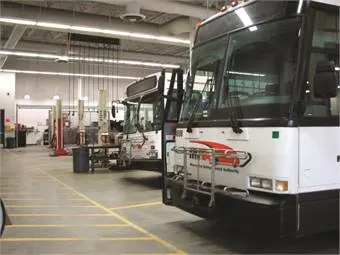
Agencies polled for this year's survey varied in fleet size, with the largest maintaining 990 buses and smallest 72. Photo Courtesy: MVTA
What does your mechanic training program consist of, what methods are you using and what materials are covered? How do you handle retraining?
"We are the recipients of a D.O.L. training grant. This year will be a busy year for training. We provide hands-on as well as classroom instruction. We cover everything from hybrid propulsion systems to diesel engine rebuilds to electrical troubleshooting. We are implementing a six-month, ongoing rotation for training. This means that every mechanic should receive training and/or refresher courses every six months."
"We have a six-week course for new mechanics; we are hiring a lot of new mechanics as well as putting all our first line supervisors through the new mechanic training this year. We have computer-based subject matter that is used for refresher training. In addition, if a mechanic demonstrates a weakness in a specific area on the job, that mechanic is sent through the new mechanic training to address his specific weakness."
"We mandate that our contractor provide two maintenance trainers, our contract also requires 40 hours annually and ASE certifications. We utilize trainers using a training program developed in conjunction with our contractor, ASE training, manufacturer training by the bus manufacturer and major component training."
"We have two on staff trainers who manage the training program. They provide classroom training, computer based training and vendor training. They give retraining as needed. They also manage our mechanic apprentice program. Training includes both hands-on as well as book and theory."
"We have our own staff of trainers that provide all the training. Our program is accredited with the local community college and earns all of our employees their diesel mechanic certificate. Retraining is performed on an as-needed, as-requested basis."
"Training is limited to OEM, due to budget constraints."
What technologies, products or methods are working for you? Are you seeing a real return on investment either in lower cost or an improvement in performance that you can directly tie to a technology, product or method?
"Our continuing education program and laptop diagnostic crash carts are both showing a great return on investment. By keeping up with technology advancements in bus repair, we have really streamlined our garage. Some of the education programs carry a price tag, but it's money well spent because everyone in the maintenance department gets cross-trained, which, in turn, helps reduce diagnostics down time. The mechanics also follow a 'cause, complaint and correction' method, which allows them to analyze a problem as opposed to just replacing a part to see if it sticks."
"We've currently implemented a fuel additive to combat asphaltene contamination inherent with ULSD and biodiesel. We have seen our road calls, due to clogged fuel filters, go down and filters are appearing cleaner upon inspection. We also electrified the cooling systems on our newer buses that will be kept on property for a significant amount of time. We also continue to test out other products and concepts as they come out."
"We utilize system mock ups, such as CNG engines, ABS brake systems, air conditioning and I/O controls, to provide hands-on training without having to remove a vehicle from service. These systems definitely ensure that the quality of work on the floor improves."
[PAGEBREAK]
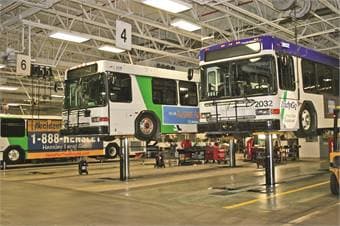
With budgets becoming increasingly constrained, many transit agencies report that they are being asked to extend the life of their vehicles from 12 years to 14 or 15 years. Courtesy:IndyGo
Are you able to fund your vehicle replacement plan? How does the future for vehicle replacement look and how are you dealing with this issue?
"We are able to fund our replacement vehicle schedule at this time. We have to be very selective on which vehicles to replace and exactly when to replace them. We often exceed the 12-year life expectancy mark, sometimes by two or three years."
"Yes, we have been able to keep up on bus replacement, [but] it will be very tight in the future, as we did a lot of expansion and have bought anywhere from 57 to 68 buses in one year. We have changed our bus specification [to] extend our bus life, staring in 2007, from a 12-year bus to a 15-year bus."
"Funding is always a struggle for both replacement and future expansion vehicles, given these days of significant budget deficits. The future is uncertain, but we keep all funding options open."
"We are experiencing funding issues for all capital projects, [but] the future looks tenuous. We are working on plans to extend the life of our vehicles where possible; however, we are seriously in doubt of future fund availability for small to medium transit agencies because there is such a huge need by large systems."
"While we do have a bus replacement plan, we do not have a regular flow of funds to keep on schedule. We do receive federal formula dollars, typically reserved for capital investments, but we have been using those dollars for our preventive maintenance program. So, we are creative and apply for grants. We were fortunate enough to receive ARRA funds, allowing us to purchase 22 new buses. Because we had additional funds for "alternative" fuel, we were able to convert 11 of those 22 to hybrid buses. We apply for grants for the purchase of vehicles when applicable."
[PAGEBREAK]
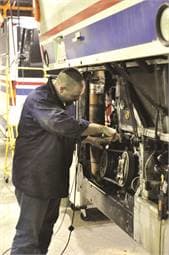
Sixty-nine percent of respondents say they are having difficulty hiring trained, skilled mechanics. Photo Courtesy: COTA
What is your biggest challenge in the garage and how have you tried to address it?
"Controlling budget costs — plan and anticipate repair, scheduling maintenance practices and finding parts at the lowest cost available. Scheduling is becoming more difficult because of time it takes to find lower cost parts."
"Trying to keep up with training in an ever-changing and trying economy."
"Finding good, qualified mechanics. We are growing our own through an internal apprentice program and by providing lots of training for existing or new mechanics."
"We have been unable to keep up with the growth of the city, have run out of storage area and our maintenance facility can no longer sustain workload effectively. What we have done is create more weekend and off-peak operation positions. We plan to expand buildings at two of our existing locations."
"Competing priorities are a daily challenge and require a constant reassessment of which problem will be number one today."
"Maintaining an aging fleet. Some of our vehicles are no longer manufactured. We have searched throughout the U.S. to find replacement parts that allow us to continue service. In many cases, we have modified air conditioning systems and electrical systems in order to facilitate operational needs."
More Paratransit

Biz Briefs: RIPTA Unveils New Frontrunners, Clevland RTA Adds New Siemens, and More
In METRO's latest installment, we take a look at recent news from Siemens, Prevost, Dodge, and more partnerships making headlines across the transportation sector.
Read More →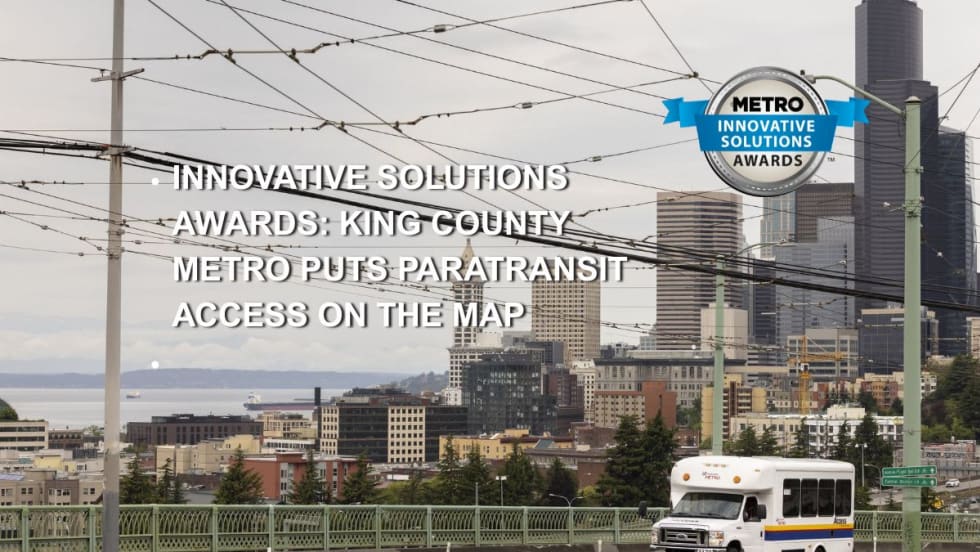
King County Metro Makes ADA Paratransit Easier to Navigate
METRO's Innovative Solutions Award winner replaces complex service-area descriptions with an accessible, interactive map that puts paratransit information directly in customers’ hands.
Read More →
Jacksonville’s NAVI Project Charts a New Course for Autonomous Public Transportation
Through its NAVI program, JTA is showing how autonomous vehicles, intelligent infrastructure, and coordinated operations can work together to deliver everyday public transportation.
Read More →
Driving Smarter Paratransit
John Hanlon shares how AlphaRoute is leveraging AI-powered technology to help paratransit providers optimize operations, support frontline staff, and enhance the rider experience.
Read More →
METRO Magazine Announces 2026 Innovative Solutions Awards Winners
Projects Recognized for Advancing Mobility Through Technology, Accessibility, Workforce Innovation, and Operational Excellence
Read More →
Biz Briefs: STV teams with Amtrak, Motorcoach Operators Boost Fleet and Land Contracts, and More
From manufacturers and suppliers to transit agencies and motorcoach operators, these updates offer a snapshot of the projects, partnerships and business moves driving the industry forward.
Read More →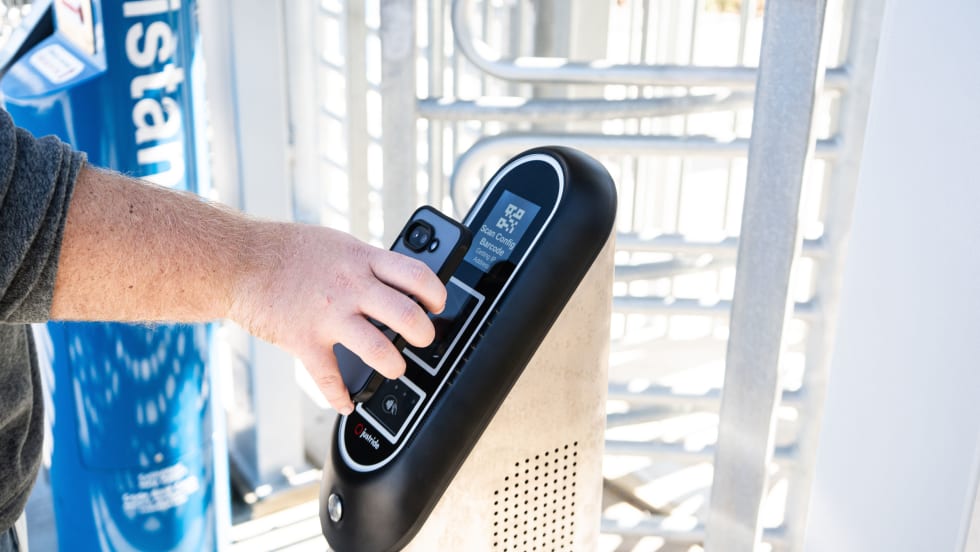
Biz Briefs: Masabi Teams with St. Louis Metro and More
In METRO's latest installment, we take a look at recent news from Transdev, Hitachi, and more partnerships making headlines across the transportation sector.
Read More →
New York MTA Leverages Zoning Program to Advance Station Accessibility
Accessibility enhancements at Nevins St Station will be financed through a development agreement tied to the MTA's Zoning for Accessibility initiative.
Read More →
Reinventing Fleet Maintenance with Real-time Visibility and AI
Transit leaders need to know what needs fixing, where to look, who is responsible, when work is completed, and what it costs without having to chase information across disconnected systems.
Read More →
SamTrans Sets Priorities for Potential Connect Bay Area Revenue
The board-approved framework allocates future funding to maintaining service, rider improvements, equity initiatives, and infrastructure repairs.
Read More →