



Mississauga rebrands transit system, focuses on growing ridership
A new citywide strategic plan is playing a major role in changes being made at the Ontario-based Mississauga Transit. The transit system is rebranding its services, and adding a BRT line and 15 new hybrid vehicles to its fleet.
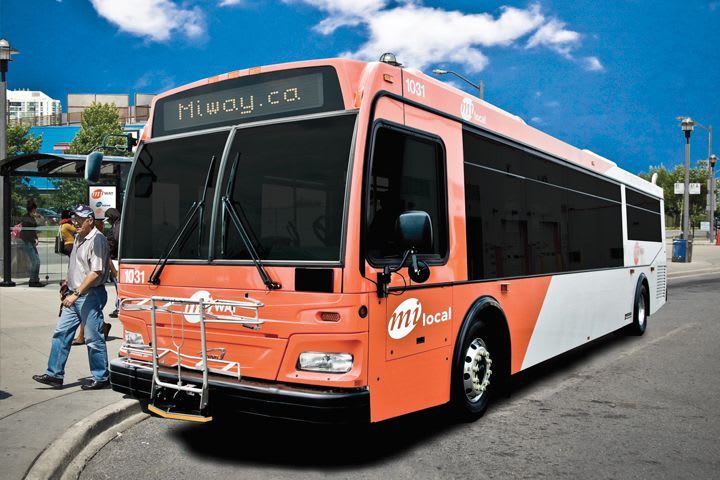
As part of the rebranding, MiWay procured 15 Orion VII hybrid buses from Daimler Buses North America, equipped with BAE hybrid propulsion systems, which were delivered between August and September.
[IMAGE]Miss-10.jpg[/IMAGE]A new citywide strategic plan is playing a major role in changes being made at the Ontario-based Mississauga Transit. The transit system is rebranding its services, and adding a bus rapid transit (BRT) line and 15 new hybrid vehicles to its fleet.
The changes began when the city decided it wanted to begin "Developing a Transit-Oriented City" as part of its five "Strategic Pillars for Change."
"The vision of this pillar is that the future Mississauga is a city where people can get around without an automobile and where transit will directly influence and shape the form of the city," said Geoff Wright, director, transportation project office.
Transit service changes were implemented with three objectives in mind: To influence a modal shift to transit, specifically by attracting the choice rider; for transit to support land use, intensification and the development of a transit-oriented city; and to establish a framework to support the development of a rapid transit network.
The city also changed the name of its transportation system from Mississauga Transit to MiWay this past August.
Beginning Oct. 4, customers will be able to choose between two types of the newly rebranded MiWay service — MiExpress (blue) buses that will operate on five limited-stop express routes and MiLocal (orange) buses, which will operate on local and school routes. "The new brand represents a customer-focused approach to grow ridership and is the beginning of an ongoing journey to enhance the value of service being delivered to our existing customers and to earn the business of new riders," Wright explained.
As part of the rebranding, MiWay procured 15 Orion VII hybrid buses from Daimler Buses North America, equipped with BAE hybrid propulsion systems, which were delivered between August and September.
"Discussion to purchase hybrid buses was influenced by a number of factors, including reduced emissions, increased fuel economy and reduced maintenance costs compared to conventionally powered buses," Wright said. "Passenger comfort is also expected to be enhanced on these buses by the quieter operation from the propulsion system."
A new MiWay Website — www.miway.ca — was also planned for launch in September, along with a version for mobile devices that displays the next three departure times or the full schedule for any day of the week, for any bus stop in Mississauga.
Scheduled to begin operation in 2013, the $249 million BRT project will create an 11-mile, dedicated east-west BRT corridor across Mississauga to be shared by Toronto's Go Transit, which will combine the use of a dedicated busway and Provincial Highway bus bypass shoulders and will see the construction of 11 new transit stations.
Meanwhile, the Hurontario/Main Street Light Rail Transit (LRT) Project, an 11-mile, north-south LRT corridor, is entering the preliminary design and environmental assessment stage.
A continuing communication and education campaign is needed to grow ridership among two distinct and equally important audiences, Wright explained. The first consists of existing riders, which includes business commuters and students. The second audience comprises "choice riders," such as those traveling in their vehicles to work or school during peak traffic hours.
"In many cases, choice riders are considering the purchase of a second vehicle," Wright explained. "The ongoing communication and education campaign will present a compelling proposal to encourage the transit choice as a smart, reliable and convenient transportation option."
The campaign will continue over the next three years, as service improvements are introduced and as the BRT system opening approaches. The campaign is expected to achieve an 80 percent penetration rate among all Mississauga residents in its first year.
More Bus

New York MTA Plans Largest Bus Fleet Upgrade in More Than a Decade
The agency is seeking manufacturers for 650 new CNG buses to replace aging vehicles, improve reliability, and advance its broader fleet modernization strategy.
Read More →
Building a Flexible Path to Transit Electrification
John Hroncich discusses BAE Systems’ modular and scalable approach, lessons learned from decades of real-world operations, and how agencies can identify electrification strategies that fit their fleets.
Read More →
Bus Tech Talk: Keeping Transit Technicians Ahead of the Technology Curve
LA Metro’s Obed Mejia discusses technician training, evolving maintenance technology, fleet replacement, and strategies for getting the most out of today’s transit fleets.
Read More →
Biz Briefs: RIPTA Unveils New Frontrunners, Clevland RTA Adds New Siemens, and More
In METRO's latest installment, we take a look at recent news from Siemens, Prevost, Dodge, and more partnerships making headlines across the transportation sector.
Read More →
People Movement: Holly Arnold Joins Transdev and More
In this edition, we also cover recent appointments and announcements at Pace, CamTran, MCI, and more, showcasing the individuals helping to shape the future of transportation.
Read More →
The High Cost of Transit Buses: Industry Leaders Look to Procurement Reform
Transit leaders and policymakers examine how standardized bus designs, streamlined procurement, and predictable funding could help agencies stretch budgets and deliver better service.
Read More →
The Business Voice Behind Public Transportation
As chair of APTA’s Business Members Board of Governors, Ray Melleady explains how more than 850 business members are partnering with transit agencies to advance funding, innovation, and industry-wide collaboration.
Read More →
From Surviving to Thriving: Building Stronger Transportation Organizations
Bus Business Consultants founder Brian Dickson shares lessons on leadership, organizational health, and creating options for long-term success in a changing transportation industry.
Read More →
Finding the ‘Happy Medium’: Optimizing Maintenance Without Sacrificing Reliability
The key to maintenance optimization isn’t doing less work—it’s doing the right work at the right time on the right assets.
Read More →
LA Metro, City of West Hollywood, and Partners Advance Smarter Bus Lane Enforcement
The award-winning partnership combines AI-powered detection with human oversight to improve bus reliability, accessibility, and enforcement efficiency.
Read More →