



Motorcoach Operators, Public Transit Teaming to Offer More Options
Through public-private partnerships, both entities are able to service customers and diversify their businesses, while solving complicated transportation issues in the areas they serve.

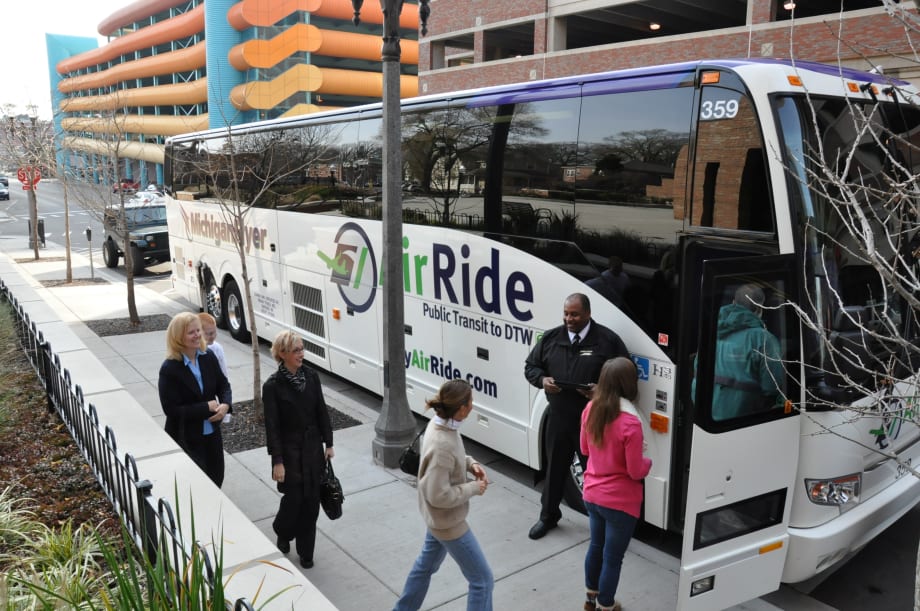
A partnership between Indian Trails and TheRide increased the daily frequency of roundtrips from eight to 12 on the Ann Arbor/DTW segment of Michigan Flyer’s route from East Lansing.
Photo: TheRide
Sometimes viewed as adversaries, public transportation agencies and private motorcoach operators are teaming up to expand transportation options in some areas with agreements called public-private partnerships (P3).
The P3 agreements are proving to be extremely beneficial for both private operators, who have focused on diversifying their operations post-9/11, and public transit agencies, who are trying to capitalize on growing demand by offering even more services.
METRO spoke to two motorcoach operators, and a public transportation agency, about their P3s and how and why they have proven to be successful.
AirRide: Bridging the Gap Between Ann Arbor and DTW with Efficient Public Transit
Michigan Flyer
Service: Air Ride
Partners: Indian Trails Inc., its subsidiary Michigan Flyer, and the Ann Arbor Area Transportation Authority (TheRide)
In 2006, Michigan Flyer was founded by Indian Trails and Okemos Travel as the first intercity bus carrier to serve Detroit Metro Airport (DTW) on a daily, regularly-scheduled basis.
Following the adoption of a 30-year vision calling for better regional public transit connections in 2011, TheRide and Michigan Flyer formed a P3 to operate a new public transportation service, “AirRide,” with 12 daily roundtrips scheduled between Ann Arbor and DTW, beginning in April 2012. The new partnership increased the daily frequency of roundtrips from eight to 12 on the Ann Arbor/DTW segment of Michigan Flyer’s route from East Lansing.
Michael Ford, CEO of TheRide, explains the partnership came about when residents in the Ann Arbor area said they needed a convenient, affordable and reliable way to get to and from DTW.
“In the transportation world, convenient usually means frequent, and we wanted to establish a public transit service that would make at least 12 roundtrips a day,” Ford says. “It’s a 25-mile trip that takes 30 to 40 minutes, depending on traffic. However, even with taxpayer support, it would have been overly ambitious and expensive to start such a service without an established base of airport passengers.”
In 2011, TheRide reached out with a formal bid to partner with a private carrier to launch and operate a new airport shuttle service.
“We proposed a contract under which we’d boost the frequency of daily roundtrips, as well as provide the logistics, drivers, vehicles and fuel to operate that segment on TheRide’s behalf. We also agreed to brand the segment ‘AirRide’ to stay consistent with TheRide’s family of services branding,” says Chad Cushman, VP, Indian Trails. “Because we already had infrastructure in place, our bid proposal was competitive. We were able to expand the service and reduce the cost by putting private resources to public use.”
The shuttle service serves nearly 60,000 passengers a year. Standard one-way fares are as low as $12 between Ann Arbor and DTW. Michigan Flyer also provides airport shuttle service for customers in East Lansing that complements the public transportation leg between Ann Arbor and DTW.
AirRide’s $1.3 million budget does not include any funds from local property taxes, but relies on a combination of passenger fares ($829,837), state operating assistance ($385,817), purchasing of service agreements ($199,900) and federal discretionary funds ($11,374).
“At the time when we launched AirRide, the total cost was estimated to be about $1.2 million per year,” Ford explains. “With a modest promotional push, passenger volume has climbed beyond our expectations, and with the increase in farebox revenue, TheRide’s share of costs has dropped sharply.”
“Our original 2012 contract with TheRide guaranteed that Michigan Flyer/Indian Trails would not charge them more than $700,000 for operating AirRide,” adds Cushman. “However, ridership increased so much by the second year that we were able to cut the not-to-exceed amount to $300,000. Now in 2014, it’s just $170,000. Clearly, it’s a resounding success.”
Michigan Flyer/AirRide’s fleet of comfortable, eco-friendly 52-passenger motorcoaches make near-hourly trips each day, with 98% on-time reliability. Altogether, they connect with approximately 700 daily nonstop airline flights between DTW and top domestic and international destinations.
Cushman compares bringing together the perspectives of the public sector and private sector in a joint enterprise is a little like two people getting married.
“At first, much of [our partnership] was about defining our individual roles in the partnership, how to manage our budget, and how to ensure that our AirRide offspring would grow and thrive,” he says. “Naturally, given our different perspectives, we sometimes saw things differently…Ultimately, both TheRide’s leadership and ours have always been able to focus on putting the passenger first, and that’s a big reason why it works.”
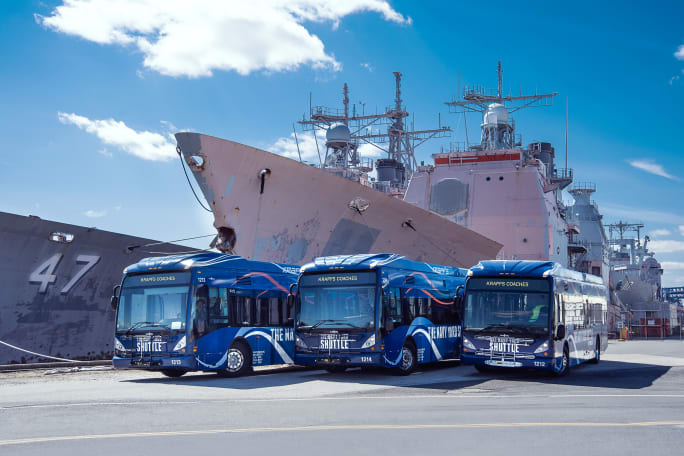
Through their experience with P3s and working with Transportation Management Associations, Krapf’s Coaches has been able to secure even more work, including shuttle service for the corporate center at the Philadelphia Navy Yard.
Photo: Krapf
Krapf's Coaches: Navigating P3 Success with SEPTA and Nonprofits
Krapf Coaches
Services: Several, including fixed-route and paratransit services and suburban shuttle services
Partners: Krapf’s Coaches, the Southeastern Pennsylvania Transportation Authority (SEPTA) and local Transportation Management Associations (TMAs)
West Chester, Pa.’s Krapf’s Coaches Inc. has several P3s in place not only with SEPTA but with nonprofits as well.
Krapf’s won its first SEPTA contract in 1994, and over the years, has done work in the suburban outliers the agency serves with smaller equipment Krapf’s can operate more efficiently because of proximity. Currently, Krapf’s holds three separate contracts with SEPTA — two fixed route and one paratransit.
“Overall, we have serviced probably six routes overall, with many of the services being either demonstration routes or tied to highway construction, and therefore, have short lifespans,” says Gary Krapf, president for Krapf’s Coaches. “We have renewed the three contracts we currently have multiple times and view them as very successful.”
Krapf says the Request for Proposals (RFP) process typically associated with public transportation service bids can be daunting, especially for smaller “mom and pop-type” motorcoach operators.
“The first time you see one of these RFPs, which are like two inches thick, it can really scare an operator away, to be honest,” says Krapf. “Through time and experience, we now have gotten to the point that we have just developed a template to respond to these things.”
Krapf says that his father Dale and their operation began exploring P3-type arrangements even before 1994, when then President Ronald Reagan created legislation pushing for transit agencies to subcontract a percentage of their services. He says that over the years, he has seen even more competition for contracts as they come back up for rebid.
“We really do see more competition, including from some of the national contracting companies as well as some local and regional private motorcoach operations,” Krapf says. “Normally, if you’re doing a good job, have established the relationships and the price is reasonable, you are able to retain the contracts, however.”
Krapf’s also has several other P3 transportation agreements with TMAs, where the operation provides shuttle services in both Pennsylvania and Delaware, which often are partially funded through federal Job Access and Reverse Commute (JARC) grants.
Krapf says there is literally a TMA for every suburban county of Philadelphia.
“In one particular case, a TMA took a service I had been operating that was unfunded and they found funding for it, so we worked together to run that service on a sole source contract as opposed to an RFP process,” he explains. “To me, that’s a true P3 — working together to really make something happen.”
Krapf says one way operators can stay aware of these types of opportunities as they arise, is to join the TMAs in their areas and interact with members of the local transportation agency’s board, if not outright becoming a member of that board.
Krapf says being active in these groups has opened the doors for other business opportunities.
“A lot of the membership of the TMAs are engineering and planning firms,” he explains. “By forging relationships with those folks, I became involved in the planning process for a project at the Philadelphia Navy Yard, which was partially being converted into a corporate center that now has 143 companies, with thousands of employees. We now operate four corporate shuttles to the Navy Yard daily, which has been incredibly successful for our business.”
More Bus

New York MTA Plans Largest Bus Fleet Upgrade in More Than a Decade
The agency is seeking manufacturers for 650 new CNG buses to replace aging vehicles, improve reliability, and advance its broader fleet modernization strategy.
Read More →
Building a Flexible Path to Transit Electrification
John Hroncich discusses BAE Systems’ modular and scalable approach, lessons learned from decades of real-world operations, and how agencies can identify electrification strategies that fit their fleets.
Read More →
Bus Tech Talk: Keeping Transit Technicians Ahead of the Technology Curve
LA Metro’s Obed Mejia discusses technician training, evolving maintenance technology, fleet replacement, and strategies for getting the most out of today’s transit fleets.
Read More →
Biz Briefs: RIPTA Unveils New Frontrunners, Clevland RTA Adds New Siemens, and More
In METRO's latest installment, we take a look at recent news from Siemens, Prevost, Dodge, and more partnerships making headlines across the transportation sector.
Read More →
People Movement: Holly Arnold Joins Transdev and More
In this edition, we also cover recent appointments and announcements at Pace, CamTran, MCI, and more, showcasing the individuals helping to shape the future of transportation.
Read More →
The High Cost of Transit Buses: Industry Leaders Look to Procurement Reform
Transit leaders and policymakers examine how standardized bus designs, streamlined procurement, and predictable funding could help agencies stretch budgets and deliver better service.
Read More →
The Business Voice Behind Public Transportation
As chair of APTA’s Business Members Board of Governors, Ray Melleady explains how more than 850 business members are partnering with transit agencies to advance funding, innovation, and industry-wide collaboration.
Read More →
From Surviving to Thriving: Building Stronger Transportation Organizations
Bus Business Consultants founder Brian Dickson shares lessons on leadership, organizational health, and creating options for long-term success in a changing transportation industry.
Read More →
Finding the ‘Happy Medium’: Optimizing Maintenance Without Sacrificing Reliability
The key to maintenance optimization isn’t doing less work—it’s doing the right work at the right time on the right assets.
Read More →
LA Metro, City of West Hollywood, and Partners Advance Smarter Bus Lane Enforcement
The award-winning partnership combines AI-powered detection with human oversight to improve bus reliability, accessibility, and enforcement efficiency.
Read More →