



New Rail Project Will Resolve a Royal Pain
The much-delayed Elizabeth Line, which is 13 years in the making, could help ease bottlenecks on city streets and save money for people entering the city.
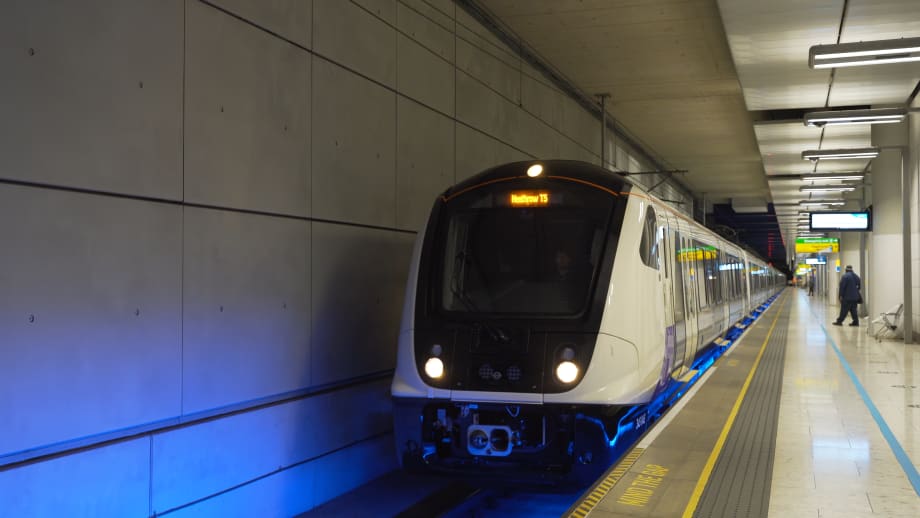
A new rail line in London, Crossrail, will help ease a transit system and will carry 200 million passengers a year. The system is expected to become operational in 2022.
Crossrail
Automobile travel in London is pricey and could be increasing soon. Drivers already pay a congestion charge, an Ultra Low Emission Zone charge to help improve air quality, and in December, city officials considered instituting a “Greater London Boundary Charge.” If adopted, the additional charge would increase the daily cost to travel across London’s streets to about $36. There are 1.3 million vehicle trips per day into the city, which has the distinction of having Europe’s worst traffic congestion.
A new project, 13 years in the making, could help ease bottlenecks on city streets and save money for people entering the city. Crossrail, which will officially be named the Elizabeth Line, is a 73-mile railway line that will feature new electric trains and run up to 24 trains per hour in each direction. The line is expected to carry 200 million passengers per year when it becomes fully operational in 2022.
“Crossrail is an incredibly exciting prospect as it will link London’s business and economic centers from both east and west, as well as connecting to Heathrow Airport. I am delighted to be driving toward the biggest rail development in London since the Underground was built,” said Sir Christopher Benson, chairman of Cross London Rail Links Ltd. He made the comment in 2001, eight years before construction even began.
Officials expected the line to be completed by 2018, but delays slowed construction. The COVID-19 pandemic also impacted the timeline, and helped push the cost to about $22.7 billion, nearly $4.8 billion more than initial estimates.
Riders, and government officials, are counting on the project being worth the wait.
Project Glance
When it is completed, Crossrail will change the way people travel within London. The line will serve 41 stations, including 10 new ones. It will stretch more than 60 miles from Reading and Heathrow in the west through central tunnels across to Shenfield and Abbey Wood in the east.
It is currently Europe’s largest infrastructure project, and will be fully integrated with London’s existing transport network. It will be operated by Transport for London (TfL), the same governmental agency that governs vehicular traffic.
The Elizabeth Line will add about 10% to London’s rail capacity, Howard Smith, director of operations at TfL, said in a CNN article last year. The trains are about 50% longer than other underground trains in the city. In addition, most of London’s main railway stations are on the edge of the city. Passengers must exit the trains to take buses or the London Underground to move inside the city.
“If you think of it,” Smith told CNN, “it’s an odd idea to bring people into mainline rail stations on the edge of the center to then change trains and go down into electric trains.”
Even before the first shovel hit the ground in 2009, the project has long been on the city’s radar. The first proposals were put forth in 1941. A private bill promoted by London Underground and British Rail was submitted to Parliament in 1991, but was rejected in 1994. Cross London Rail Links unveiled its proposal in 2001 and the Crossrail Act 2008 was approved in July 2008.
“Crossrail will add at least €20 billion to the economy and employ some 14,000 people,” Boris Johnson, the Mayor of London and now the nation’s Prime Minister, said in 2009. “It’s crucial to London’s economic prosperity and I’m absolutely delighted to see work steaming ahead.”
Beset by Delays
The project included the boring of railway tunnels, installation of track, and powering overhead lines. Through the first half of 2018, all those tasks had been completed and the target opening date for December 2018 seemed to be within reach.
It quickly ground to a halt in August of 2018. A Crossrail executive blamed a decision to delay purchase of trains in 2013 as part of the reason for the stall. Other Crossrail officials blamed an explosion at an electrical substation, while current Chief Executive Mark Wild said tunneling delays were to blame.
In 2018, an annual report from the Infrastructure Projects Authority warned of cost or schedule overrun if “significant issues” were not addressed.
Those setbacks paled in comparison to the delays that the project encountered amid the COVID-19 pandemic. Construction slowed to a crawl, and the delay became even more pronounced.
“Delivery of the Elizabeth Line is now in its complex final stages and is being completed at a time of great uncertainty due to the risk and potential impacts of further COVID outbreaks,” Wild said. “We are working tirelessly to complete the remaining infrastructure works so that we can fully test the railway and successfully transition the project as an operational railway to Transport for London.”
The delays also contributed to cost overruns. A report in August 2020 said the project could be more than $1.3 billion more than the agreed financing package, and €450 million more than the estimates given in November 2019. It is expected to be more than $4.8 billion over its original budget.
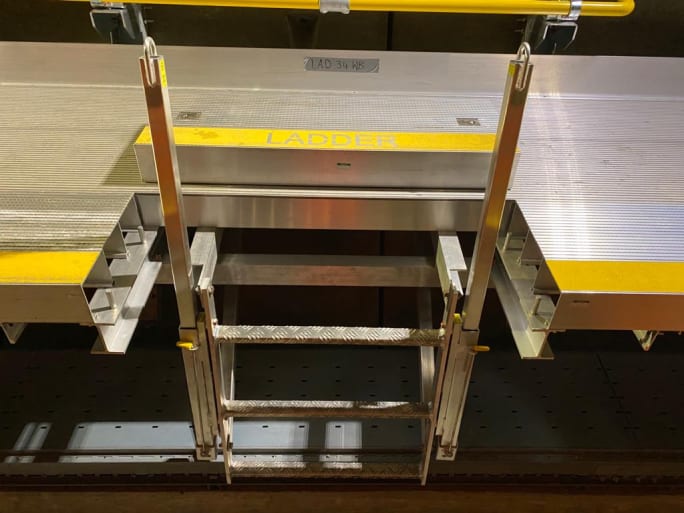
More than 350 Ladder Up® Safety Posts from BILCO are used along the 73-mile underground railway, helping provide engineers with unobstructed access to walkways to conduct maintenance.
BILCO
Safety Measures
Project planners installed an assortment of safety measures to help protect train crew members. One of the most widely used are LadderUp® Safety Posts from BILCO.
Workers installed 350 of the posts to provide easier, safer access to maintenance walkways. They were specified by Crossrail’s systemwide contractor, Alstom TSO Costain Joint Venture (ATC Systemwide). The specification process, managed by Construction & Rail Contractors McNealy Brown, focused on the requirement for durable yet functional access solutions that would consistently provide a safe and direct step-through on to the walkway, without impacting surrounding electrical services.
“When we first began researching potential access solutions for the Crossrail project’s central section, it became clear quite quickly that the BILCO LadderUp® Safety Post was the only product available on the UK market that would fulfill our extensive list of requirements,” said Clive Burfoot, contract manager at McNealy Brown.
Worker safety has been one of the top priorities all along in the project. Martin Brown, health and safety director of Crossrail, led the development of initiatives to help keep workers safe. There was a worker death about midway through the construction process, but officials have strived to maintain a safe working environment.
“We wanted to understand why — particularly on large projects — there seems to be more of an accident problem at the start, which then falls and rises near the end of the project,” Brown said in Global Railway Review. “We discovered the importance of establishing the right safety culture early on and maintaining it through the later stages when the smaller trades come on board.”
End of the Line
The project is now in a trial run, and the number of test trains in the new tunnels has increased from four to eight. Officials are testing scenarios as close to operational conditions as possible. More testing will occur next year.
It is an exciting time in London, as the complex final stages are now underway. After all the time planning, constructing, and navigating around such unforeseen hurdles, such as COVID-19, the time is almost at hand where Londoners can move more easily and efficiently throughout the city.
“This is an incredibly important milestone for Crossrail to reach and puts us firmly on the journey to unlocking Trial Running in 2021,” Wild said. “We are doing everything possible to deliver the Elizabeth Line as safely and as quickly as we can, and we know that Londoners are relying on the capacity and connectivity the Elizabeth Line will bring.”
Thomas Renner writes on building, construction, and other trade industry topics for publications throughout the U.S.
More Rail
New York MTA Launches Historic $1.9B Signal, Track Modernization Project
Funded in part by congestion pricing revenue, the project will replace nearly century-old signals along the A and C lines in Brooklyn and Queens.
Read More →
LA Metro Breaks Ground on East San Fernando Valley Light Rail Project
The 6.7-mile line will add 11 stations along Van Nuys Boulevard, expand access to jobs and regional transit connections, and support Metro’s broader efforts to improve mobility as rail ridership grows.
Read More →
CSA Group Releases Climate Resilience Standard for Transit, Passenger Rail
Developed with support from the Standards Council of Canada, CSA D700 guides assessing climate-related risks and planning adaptation measures for transit and passenger rail systems.
Read More →
LA Metro September Ridership Climbs 3.9%, Led by Rail Growth
The agency recorded more than 27.2 million boardings, with rail ridership increasing 12.4% year over year and the D Line posting the largest gains.
Read More →
First Full MetroLink Rail Expansion Completed in 20 Years with $192M Airport Project
The project links two St. Louis-area airports by light rail while adding roadway and bike trail connections to improve regional access and mobility.
Read More →
Utilimarc Launches SmartReplace to Optimize Fleet Replacement Decisions
AI-powered SmartReplace helps fleets prioritize vehicle replacements, model budget scenarios, and build more defensible long-term strategies.
Read More →
Scenes from APTA TRANSform & EXPO 2026
Transit leaders, manufacturers, and industry professionals gathered in Chicago to explore new technologies, share ideas, and discuss the future of public transportation.
Read More →
USDOT Awards $416 Million for Florida Rail Crossing Safety Upgrades, New Brightline Station
The projects aim to reduce risks for motorists and pedestrians at rail crossings while expanding passenger rail access along Florida’s Space Coast.
Read More →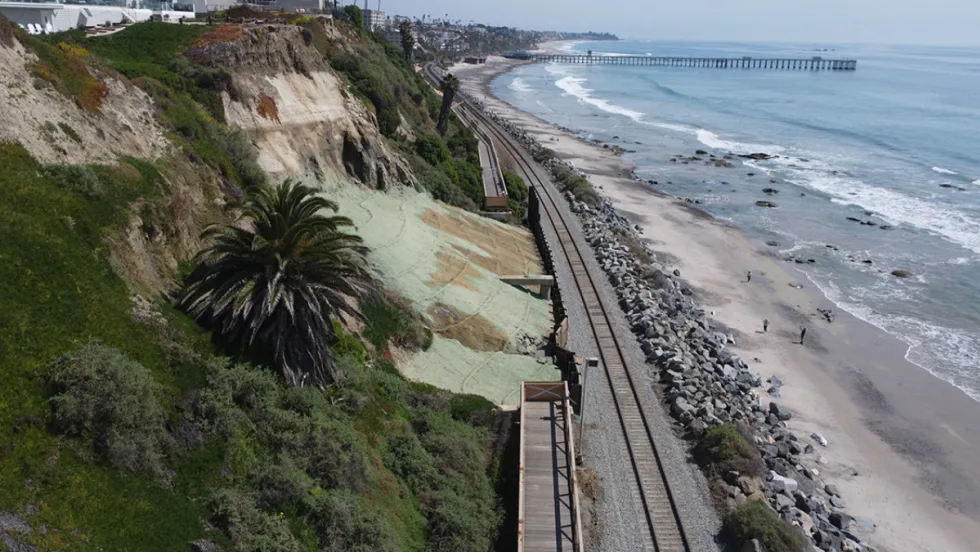
OCTA Declares Emergency to Protect Rail Corridor From Coastal Erosion
The California agency is accelerating shoreline protection and plans to place approximately 690,000 cubic yards of sand along the San Clemente coast to protect a key passenger and freight rail link.
Read More →
More Than a Summer Job: Building the Next Generation of Transit Talent
The Delaware River Port Authority and PATCO have transformed their internship program into a hands-on professional development experience that introduces students to the breadth of transportation careers — and creates a pipeline for future employees.
Read More →