



New reports vindicate environment, BRT
Growing number of studies and operators are demonstrating improved economic case for hybrids.

WestStart-CALSTART has issued two reports showing that bus rapid transit (BRT) and hybrid bus technologies can demonstrate significant economic, energy and environmental benefits for cities that deploy them. In the first new report, released in December, a growing number of studies and operators are demonstrating that the economic case for hybrids has improved as the marginal unit cost has come down and fuel prices have climbed. The federally funded document, “The Case for Hybrids in Transit: A Meta-Analysis,” shows that while the agencies that have procured hybrid buses to date did so for largely non-economic reasons, the investment is also beginning to pencil out economically as well. For example, at $2.40-per-gallon diesel prices, transit agencies that run their buses a typical 42,000 miles annually expect to save each year at least $4,800 per bus in fuel costs alone, not to mention the savings on brake life, engine wear and other items. Viewed as strictly a return on local match dollars invested in hybrid bus procurements, the operation and maintenance savings (also local expenditures typically) can be expected to pay for the local capital invested in the seventh year. “Since local match and operational dollars are hard to come by, this represents a significant economic consideration for transit agencies looking to get the environmental and energy security benefits of hyrbids for their cities,” said Cliff Henke, senior director at WestStart-CALSTART, who authored the study. The report follows a second WestStart-CALSTART report, “BRT Ridership Analysis,” released last October. In it, authors Matthew Peak and Lawrence Wnuk analyzed ridership trends at six early-adopter BRT properties, four that have already opened segments for revenue service (in Los Angeles; Oakland, Calif.; Phoenix; and Boston) and two that are under construction (in Eugene, Ore., and Cleveland). They found that for those that have deployed, net ridership has increased by a median of 40% per route (even after factoring in the existing local service in the corridor). For all six cities, bus design figured prominently in the community’s, agency’s and riding public’s favorable response to BRT. In addition, the report contains an appendix analyzing the environmental and energy benefits of this net increase in BRT ridership. It concludes that because roughly one-third to half of the ridership represents a modal shift from single auto commutes to transit, more than 1 million gallons of gasoline equivalent are saved per corridor annually. The study is also significant because these gains are often from arterial BRT systems that largely re-deploy the existing bus fleet with faster and more productive service. “Thus, these savings are sometimes achieved with marginal or even no increases in capital or operating expenses,” Henke said. For more information or to obtain copies of the studies, visit the WestStart-CALSTART Website at www.westart.org.
More Management
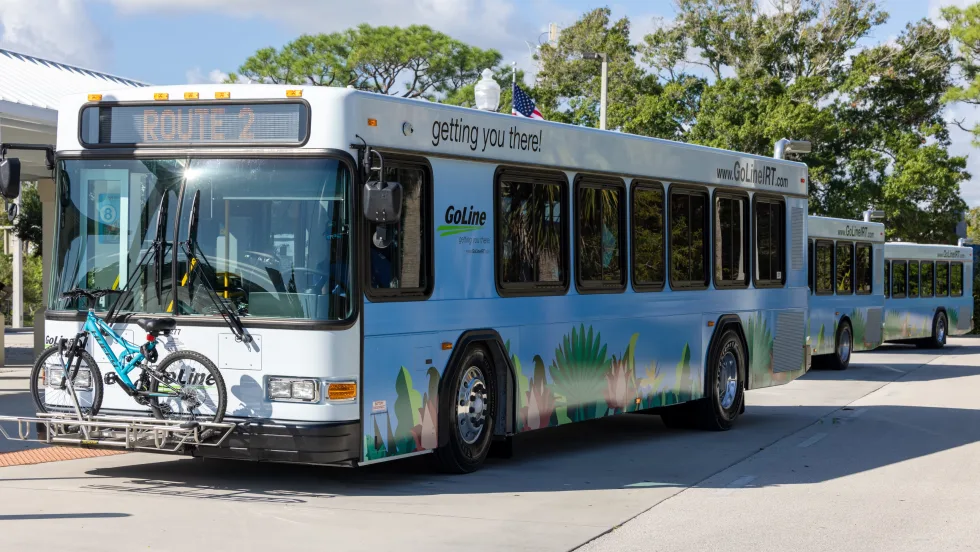
Indian River Transit’s Community-Focused Approach Earns National Recognition
Named APTA’s 2026 Outstanding Public Transportation System in its size category, Florida’s Indian River County transit system continues to grow ridership through fare-free service and a focus on evolving community needs.
Read More →
ENC Lands MATA Contract and More in Biz Briefs
In this edition of Biz Briefs, we spotlight the latest developments shaping the future of mobility.
Read More →
From Surviving to Thriving: Building Stronger Transportation Organizations
Bus Business Consultants founder Brian Dickson shares lessons on leadership, organizational health, and creating options for long-term success in a changing transportation industry.
Read More →

Everett Transit, Community Transit Outline Consolidation Agreement
The proposed agreement calls for a 50% increase in bus service in Everett, a new microtransit zone, continued paratransit service, and the transfer of Everett Transit operations to Community Transit.
Read More →
Strada360’s Steve Lassey on Turning Transit Data Into Better Decisions
From breaking down data silos to preparing for AI, Strada360 CEO Steve Lassey discusses how transit agencies can use technology to improve operations, customer information, and long-term decision-making.
Read More →
People Movement: Phil Washington Joins HNTB, Denver RTD Launches CEO Search, and More
In this edition, we also spotlight recent personnel moves at STV, the Eno Center for Transportation, and more, highlighting the people taking on new roles across the transportation industry.
Read More →
SEPTA Details Accelerate Vision for Transit System
The plan outlines investments in trolley modernization, new Metro and Regional Rail vehicles, accessible stations, and more frequent bus and rail service.
Read More →
FTA Ends Direct Oversight of MBTA Safety Actions
The federal agency closed its remaining special directive to the Massachusetts Department of Public Utilities following a safety review that began in 2022.
Read More →
Report: Transit Bus Manufacturing Supports 34,100 Jobs, $5.1B in GDP
The “Buses Mean Business” report examines the transit bus manufacturing industry’s economic footprint, supply chain, and rising demand for vehicle replacements.
Read More →
LIT Marks 10-Year Milestone at Annual Summit
Hosted by the COTA from September 10 to 13, the Summit carried the theme “Celebrating 10 Years of Excellence, Leadership, and Impact,” with every part of the program honoring the people, agencies, and partners who built LIT over its first decade.
Read More →