



Passengers Seek More Ways to Pay Fares
Transit agencies across the country are discovering that passengers want to pay for fares the same way they pay for everything else — with their own bank cards or smartphones.
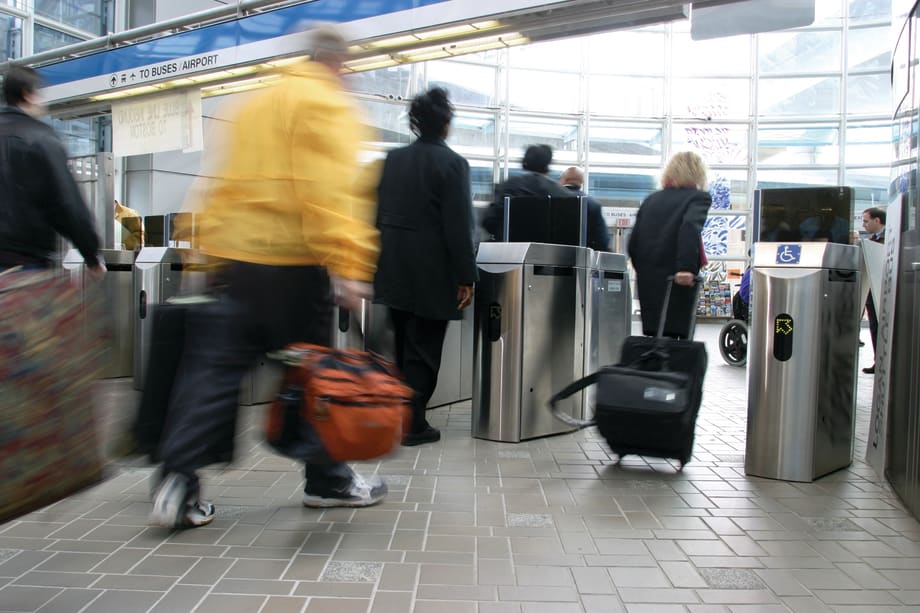
When the Southeastern Pennsylvania Transportation Authority (SEPTA) began gathering information from the public about fare collection, they discovered people wanted to pay for transit the same way they paid for everything else — with their own credit and debit cards or mobile devices.
The agency has been working since November 2011 to bring an open payment system to its customers, which will allow them to “choose how they want to pay their fare,” according to John McGee, chief officer, new payment technologies, for SEPTA.
By spring 2014, passengers will be able to use their own contactless cards, a traditional SEPTA card, or a smartphone with Near Field Communications (NFC) capabilities to board buses or trains.
The Chicago Transit Authority (CTA) and Dallas Area Rapid Transit (DART) are also moving to implement open payment systems by 2013 and 2015, respectively. Officials say an open payment system is beneficial to passengers and transit agencies alike.
“[Open payment] is easier for [passengers] to use and more straightforward,” says David Leiniger, executive VP/chief financial officer, DART. “The customer side of this is very important to us, so we just think it’s the better way to pay.”
More payment options
“Open payment provides passengers with the convenience of carrying a card or device that can serve multiple purposes, including fare payment,” according to Kim Green, president, SPX Genfare. “So, the major benefit for the passenger is convenience.”
Open payment offers flexibility other systems don’t, according to Eric Reese, director, revenue, for CTA, because it “more generally resembles a customer’s retail experience on a day-to-day basis.”
Through its Ventra system, CTA will offer customers the opportunity to purchase a Ventra Card, which can be used as a prepaid debit card to make retail purchases as well as pay for transit service. Passengers will also have the option of using their own contactless bank-issued credit and debit cards or a mobile phone, which they will tap at “L” stations to board a bus.
The Ventra Card will eventually be available for purchase at more than 2,500 locations within a one-third mile of all bus stops, Reese says.
Similarly, SEPTA passengers will be able to use a traditional SEPTA card, but also a contactless credit or debit card — “in which case they don’t have to buy anything; they can actually board the bus or go through the turnstile using that card,” McGee says.
“Looking ahead, we believe that the marketplace is moving away from the traditional cards to open payment NFC-enabled devices, such as contactless credit cards and mobile payment,” he adds.
DART’s Leiniger points out that giving passengers the option to pay via smartphone is a savvy move.
“From 2010 to 2012, the uptick of utilization of smartphones went from under 30% to over 60%,” he says. “Interestingly enough, the lower income and transit-dependent demographic actually had a higher use of smartphones than the general population…so mobile payment for us became a very attractive strategy.”[PAGEBREAK]
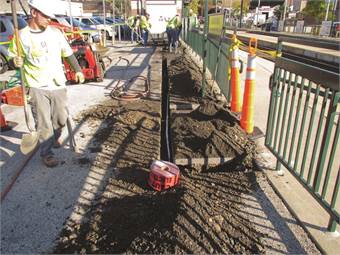
Construction workers install an electrical conduit needed for the new fare system at the Fox Chase Regional Rail Station in Philadelphia.
Financial benefits
Another benefit of an open payment system is it allows transit agencies to mitigate the risk of credit card fees and security breaches.
“One of the great benefits CTA gets, from a financial perspective, is that we shift the risk of credit card processing over to a private partner,” Reese points out. “You’re talking about hundreds of millions of dollars in transactions every year and the risk of credit card fee increases — but now, [the fee] has been actually fixed for the entire term of the contract.”
Agencies using open payment will also have the added bonus of handling less cash, Leiniger says.
“One way we save money is by just not handling as much cash, which reduces the risk of operator abuse and increases safety,” he explains.
SEPTA’s McGee also touts the financial benefits of an open payment system. Once the switch-over takes place, he says, “we’ll have a much more secure revenue accounting and collection system than we have today. We still collect a fair amount of cash, but we expect that to drop. As you can imagine, there’s always high costs involved with handling cash.”
In DART’s search for a new payment system, Leiniger says, “my mantra is ‘more ridership, more revenue, less cost.’” After exploring smart cards as an option, DART officials realized the costs were a lot higher than they had anticipated — and there was no discernible improvement in ridership or revenue.
The agency opted to go in an entirely different direction once they saw other agencies were moving toward open payment. Major agencies across the U.S. are exploring the option, Leiniger says, in part because “what they really wanted to do was to get out of being the card issuer — as a smart card provider you are issuing a credit card. It’s proprietary, but it’s a credit card, and therefore, you are the bank. You then shoulder the cost of getting those cards stocked, and managing and maintaining inventories.”
However, Green warns agencies to carefully consider the challenges of an open payment system, including the costs of cyber security and compliance and transaction costs and fees charged by the financial institutions processing the transactions.
“An effective and efficient system should balance the convenience, performance and cost,” he says.
Uniform fare structure
Open payment has given SEPTA the opportunity to create a uniform payment structure across all its services.
“For example, today, if someone is riding the SEPTA regional rail system and also riding a bus, they have to buy two different fare instruments,” McGee says.
Also, visitors who want to use the system have to buy an Independence Pass, which they must purchase from a physical vendor. As of mid-January, however, this will no longer be the case.
Once the new system is launched, “a customer will be able to make a virtual transaction over the Internet or by calling an 800 number and saying, ‘just add an Independence Pass to my account.’ Provided they’ve registered with their [SEPTA] card, or they have a contactless credit card or debit card, they can have the Independence Pass placed right on those devices,” he adds.
For DART, the major challenge was to create a mobile solution that would work at their non-gated stations.
“We are un-gated on our platforms…so the issue for us is a different problem called proof of payment,” Leiniger points out. “How is it that you know that somebody who just walked onto the train car actually paid? And how do they prove that they have paid and should be there?”
If passengers were to just tap a card at a turnstile, there would be no receipt. To overcome this, DART developed a plan for mobile ticketing, in particular, the delivery of a receipt to a cellphone.
“The mobile payment option really fit well with our requirements,” Leiniger says. “We’re multi-modal — we have commuter rail, light rail, express bus, local bus and paratransit. On all of those modes you could use mobile ticketing.”[PAGEBREAK]
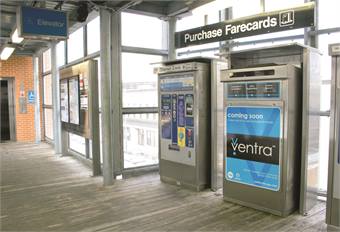
The CTA will offer customers the opportunity to purchase a Ventra Card which can be used as a prepaid debit card to make retail purchases as well as pay for transit service.
Do more with less
Another benefit of open payment is that it cuts down on waste, according to McGee. SEPTA stills uses tokens and paper transfers, but that will soon change.
“Passengers today who have weekly and monthly passes have to buy new cards every week or every month. The old cards have to be thrown away, [and] new cards have to be purchased and distributed by SEPTA to our vendors, both internally and externally,” McGee says.
With the new system, SEPTA cards will have a five-year life. Users will be able to sign up for auto-load without having to visit a third-party site or vending machine. They also have the option of using their own debit or credit cards.
“You no longer have to buy a special card just to ride transit,” Reese says of CTA’s system. “It lowers the hurdle for customers to get on the system.”
Also, DART officials are excited about the possibility of providing multiple services using one system.
“We think [open payment] is a better value proposition, because in addition to train passes and bus passes, we can also allow passengers to combine those with a parking pass or even a pass to a zoo or a sporting event,” Leiniger says. “So, there are a lot of propositions and benefits for passengers — and that crosses over into a lot of revenue benefits for us.”
DART will be able to take a commission for selling merchandise, such as zoo or parking passes, using its new system. The new system is a three-agency initiative — DART’s partners include the Fort Worth Transportation Authority (The T) and the Denton County Transportation Authority (DCTA) — so users will be able to use seamless passes for all three agencies.
“We can actually do joint promotions around an event,” Leiniger explains. “And if we get riders showing up in large quantities who are unfamiliar with buying tickets, they can actually download our [smartphone] app to buy passes directly.”
He adds that there are also a lot of teaming opportunities that are represented by these new payment technologies.
Customer input
DART’s new smartphone app will let customers purchase tickets and show a proof of payment to fare officers on the platform. Developing the app — called GoPass — involved plenty of customer input.
Customers told DART that the name “GoPass” was forward-thinking and has connotations of movement, a ticket and transportation.
For the logo, customers “indicated they really wanted to see a symbol that they could recognize as a train or bus so it was communicated very clearly what the app was, in terms of its purpose,” Leiniger explains.
SEPTA officials have talked with thousands of customers about its New Payment Technologies (NPT) project, first about what they wanted the system to do, and now in regard to specific technology like vending machines — for instance, the number of buttons and font sizes.
“The types of questions we’re asking our customers and the type of research we’re doing is changing as we move into a production phase for the system,” McGee says.
Future-proofing
From conception to initiation to deployment of its open payment system, DART will have spent six years on the project, according to Leiniger. During this time, officials have seen agencies move away from smart cards and toward NFC, only to switch to MFC barcoding technology.
To avoid costly changes, Leiniger suggests that agencies select a system with modularity “so that as different technologies do emerge, you can go attach the module that you need to upgrade or replace without needing to do a wholesale change-out of everything.”
Green says that Genfare’s Web-based system allows agencies to “take advantage of today’s proven technology while being ready to add new technology advances as they are developed and made available.” This is important to agencies like DART, which operate much equipment that will need to be updated over time.
DART’s newest buses are equipped with seven cameras, four different GPS-related systems, and will soon have 4G cellular equipment to allow the agency to process credit cards at high speeds. Officials jokingly refer to the buses as MTPs — “mobile technology platforms that also happen to carry riders.” This in itself presents a huge challenge when it comes to keeping abreast of the latest technology.
“The danger we confront is picking the wrong horse in the technology world and then finding out that we actually have got an obsolete solution,” Leiniger explains. “That’s the biggest challenge.”
More Bus
Improving Transit Safety and Reliability Through AI
Hayden AI’s Chief Growth Officer, Charley Territo, discusses how AI-powered camera enforcement is helping transit agencies keep bus lanes and stops clear, improve accessibility, and move from pilot programs to full-scale deployments.
Read More →
Castro to Lead RTC of Southern Nevada and More in People Movement
In this edition, we also cover recent appointments and announcements at the STV, MCI, and more, showcasing the individuals helping to shape the future of transportation.
Read More →
Study: Denver RTD Generates $2.1 Billion in Annual Economic Activity
An economic impact study finds the agency supports approximately 17,500 jobs, delivers $1.6 billion in annual community and mobility benefits, and generates $2.42 in economic value for every dollar invested.
Read More →
Mark Aesch Nominated to Lead Federal Transit Administration
The former Rochester transit chief and TransPro founder, who has also contributed to METRO Magazine, brings decades of industry experience and a focus on performance, accountability, and financial sustainability to the nomination.
Read More →
Pierce Transit Moves to Expand Fleet Following Proposition 1 Approval
The agency authorized the purchase or refurbishment of up to 60 buses to support a 47% service expansion, as voters nationwide approved billions in new transit funding.
Read More →
Transit Expands Agency Partnerships, Reaching 200 Official App Partners
COO Jake Sion discusses Transit’s growth, the success of its Transit Royale program, and how technology is helping agencies improve the rider experience.
Read More →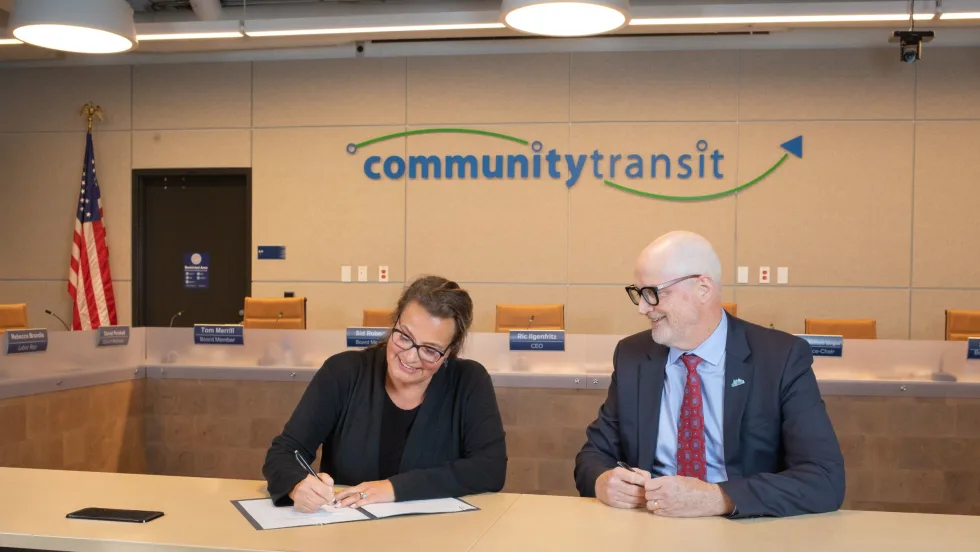
Everett Transit, Community Transit Approve Consolidation of Services
The agreement will bring Everett Transit into Community Transit’s network in April 2027, with plans to increase bus service by 50% by 2031 and expand regional connections.
Read More →
Brian Dickson on Building Stronger, More Resilient Transportation Organizations
Bus Business Consultants Founder Brian Dickson discusses the leadership principles, operational discipline, and strategic planning that separate transportation companies positioned for long-term success from those stuck in survival mode.
Read More →
LA Metro Breaks Ground on Vermont BRT Project
The 12.4-mile corridor is projected to serve 66,200 daily riders, reduce travel times by up to 24%, and create the nation's busiest bus rapid transit corridor.
Read More →
Roman Cornell on ABC Companies’ Evolution and the Future of Passenger Transportation
The company’s CEO discusses carrying forward a third-generation family legacy, ABC’s continued evolution in passenger transportation, support for increasingly complex fleets, and how technology and continued investment could help operators improve uptime.
Read More →