



Performers compete for chance to entertain N.Y. passengers
In May, several hundred musicians auditioned for the MTA's Music Under New York program.
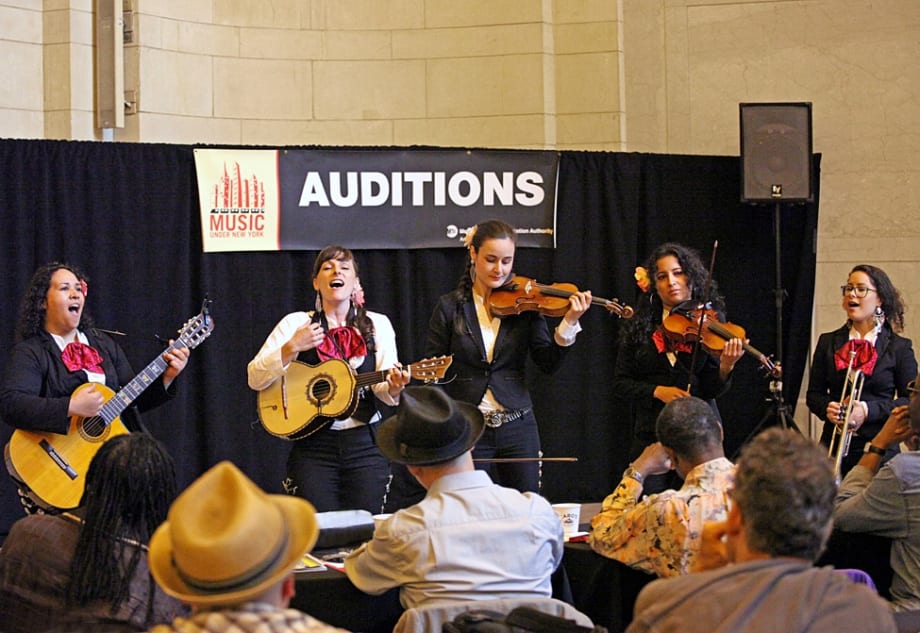
The program allows performers to showcase their musical talents and collect donations from their audience.

Each year, hundreds of musicians apply for a chance to participate in Metropolitan Transportation Authority’s (MTA) Music Under New York (MUNY) program.
Launched 25 years ago, MUNY is run through MTA’s Arts for Transit division, whose mission is to enhance the experience of passengers by including visual and performing arts as they travel through the transit system, said Amy Hausmann, assistant director of MTA’s Arts for Transit and Urban Design.
MUNY presents more than 7,500 annual performances at 25 different locations, making subway entertainment something to count on. Participating stations include Penn Station, Grand Central Terminal and Atlantic terminal.
Musicians are asked to submit their CDs in the beginning of the year.
“There’s a wide range of music styles, which is very similar to the kind of diversity you find in New York City itself,” said Hausmann.
From the submissions, MTA chooses 70 performers to present a five-minute audition in front of a panel of 30 judges, consisting of musicians, music and performing arts professionals, MTA representatives and others. This year, the auditions, which are open to the public, took place in Grand Central Terminal.
From the 70 candidates, MTA then selects 20 to 25 winners to join its ongoing roster of MUNY performers, which is currently 350 musical acts long.
“Since the program has been around for a while, it has a certain cache,” Hausmann explained. “People who see these performers under the MUNY banner in the subways know they’ve been hand-selected.”

When choosing winners, the judges evaluate three aspects of each act: the quality of musicianship, the variety of music, and whether or not their act is appropriate for the subway environment.
“For example, a marching band wouldn’t be a good fit for this type of venue,” said Hausmann. “There are many regulations for subway performers — like decibel level, no blocking traffic, no amplification — that we must abide by.”
Once brought into the program, musicians are responsible for calling in to be scheduled. “We schedule 150 performances a week,” said Hausmann.
“A lot of them are professionals, so they might not be in town on a regular basis. When they are available, they let us know.”
Musicians in the MUNY program don’t get paid but are allowed to collect donations from their audiences.
Among the Mississippi blues groups, musical saw players, opera singers, harpists, mariachi bands and other unique applicants, there is Chris Conly, a 30-year-old guitarist from Cape Elizabeth, Maine. A recent graduate of Berklee College of Music, Conly, and his band Chicken Barn Heroes, were chosen to audition this year.
Although Conly isn’t new to subway busking, it was his first time applying to the MUNY program. “The great part about performing for MUNY is that your space and time slot will be reserved for you, just like any other legitimate venue,” Conly said. “You’re supplied with the proper official MUNY signage showing that you’re a trusted musician, and you can sell CDs, promote performances, as well as accepting tips, of course.”
If added to the roster, Conly told METRO that he will look forward to performing for thousands of New Yorkers every year in addition to connecting with potential clients seeking live music for private events.
Richie Kaye, a guitarist/comedian along with his bandmate, a sax and clarinet player, auditioned this past May as well.
“Much of the music we play was written in New York City by New Yorkers and now it’s mostly vanished from everyday life,” Kaye said. “We’d love to help bring it back to New York, even just in our small way.”
In addition to playing at jazz festivals and other venues throughout the year, Kaye, hailing from New Haven, Conn., is also an audiobook narrator.
“If I can participate in the MUNY program, I hope to get a couple more people walking away in the bustle of Manhattan whistling a happy tune,” he said.
The 2012 MUNY winners were announced on May 31. Both Chicken Barn Heroes and Richie Kay Music — in addition to 23 other artists, including an African drumming group, a vibraphone player, a gospel singer and a harpist — were opportunely added to the roster. For more information, visit: www.mta.info/mta/aft/muny/.
More Rail
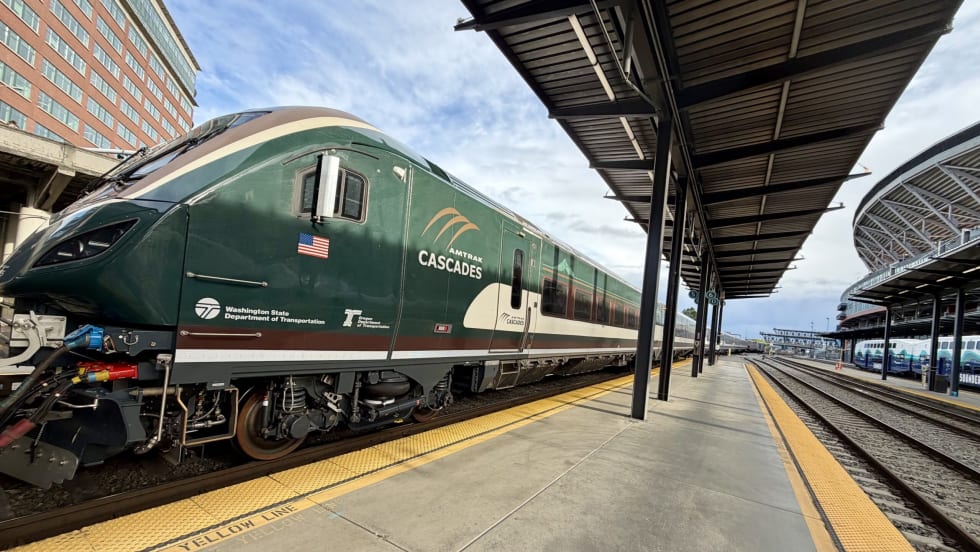
FRA Announces $5.3B in Rail Investments, Including $2B for Amtrak
Funding will support grade-crossing improvements, infrastructure upgrades, and new Amtrak equipment in 23 states.
Read More →
Finding the ‘Happy Medium’: Optimizing Maintenance Without Sacrificing Reliability
The key to maintenance optimization isn’t doing less work—it’s doing the right work at the right time on the right assets.
Read More →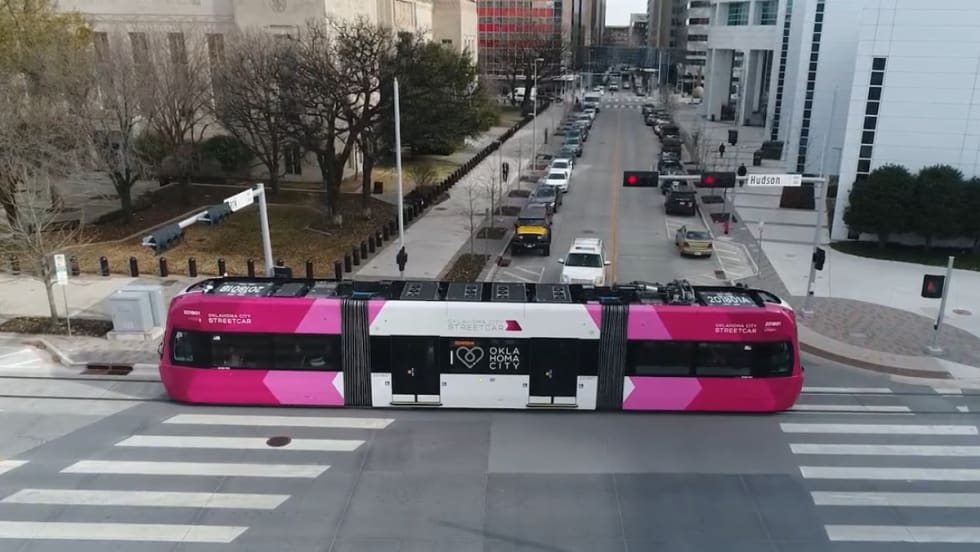
OKC Streetcar Makes Zero-Fare Service Permanent
Ridership increased an average of 71% compared with the same period a year earlier during the fare-free pilot.
Read More →
DART Customer Satisfaction Reaches Six-Year High
Overall satisfaction rose to 74.9%, while the agency’s Net Promoter Score reached a record 33.7.
Read More →
How DART's GoPass Is Redefining Regional Mobility
Serving 14 transit agencies, GoPass simplifies multimodal travel by allowing riders to plan, pay for, and manage an entire trip through one app.
Read More →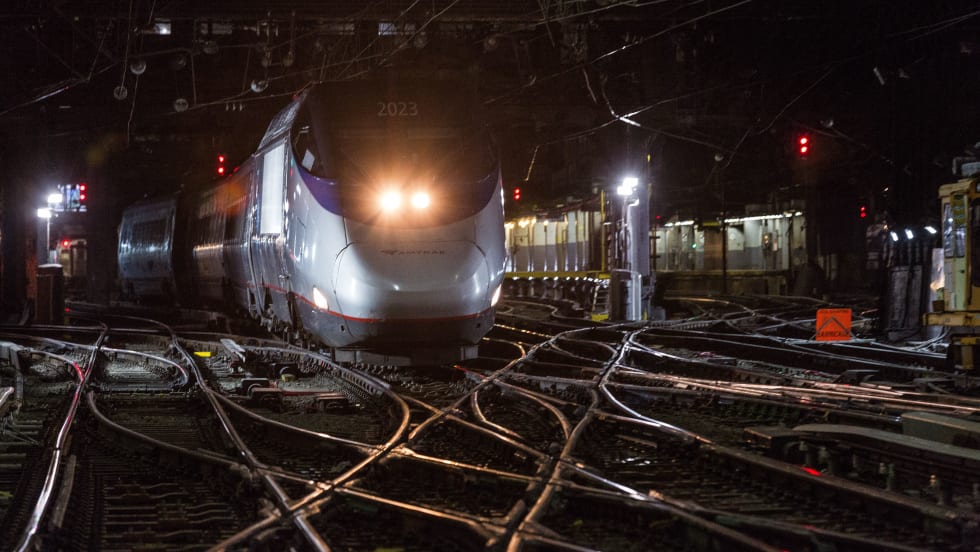
Amtrak Board Advances Plan to Restructure Organization, Seeks Public Input
The proposal, developed by Amtrak management and approved by the board for further consideration, is intended to modernize the organization's structure while improving accountability, operational efficiency, and customer service.
Read More →
Biz Briefs: STV teams with Amtrak, Motorcoach Operators Boost Fleet and Land Contracts, and More
From manufacturers and suppliers to transit agencies and motorcoach operators, these updates offer a snapshot of the projects, partnerships and business moves driving the industry forward.
Read More →
Metra Celebrates 100 Years of Electric Rail, Looks to the Future
The event was also a celebration of recent reforms to public transportation in the Chicago area, changes that could be as transformative in the future as the major civic achievement a century ago, said officials.
Read More →
LA Metro Marks Banner Year, Sets Ambitious Goals for New Fiscal Year
Incoming LA Metro Board Chair and Los Angeles Mayor Karen Bass joined outgoing Board Chair Fernando Dutra and LA Metro CEO Stephanie Wiggins to review accomplishments from fiscal year 2026, which included the opening of new rail extensions, advancement of major transit projects, expanded safety programs, and new rider amenities.
Read More →
DART Taps Nathaniel P. Ford Sr. as Next President/CEO
Since 2012, Ford has served as the CEO of the Jacksonville Transportation Authority
Read More →