



Proper driver training decreases road incidents, increases safety
Louis Maiello, former director of training, New York City Transit Bus & Safety Division, 2003 NTI Fellow and current Transit Training Specialist at FAAC Inc., was a featured speaker at BusCon. Here he discusses elements from his presentation "Advanced Performance Driver Training" and key steps for "producing a world-class operator."
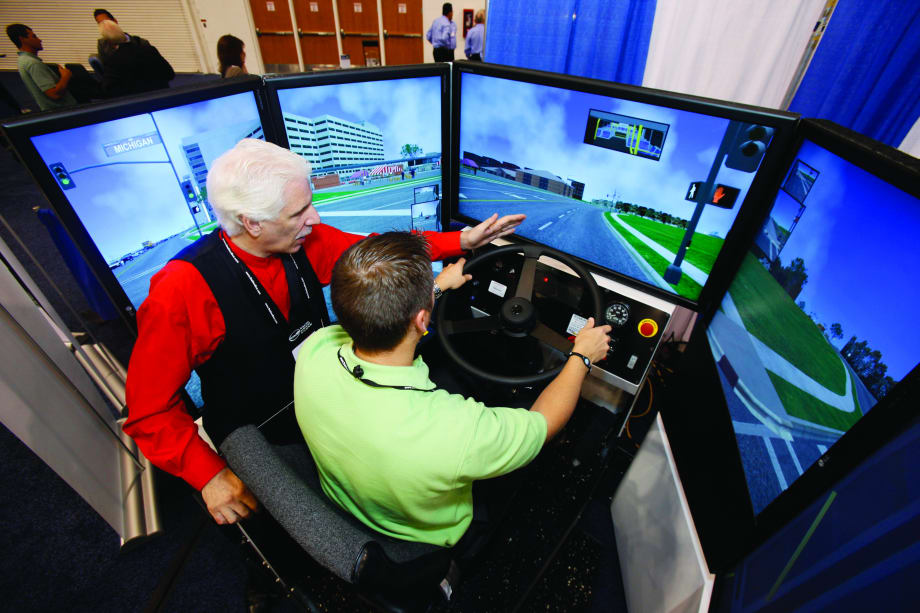
Many workshop attendees tried out the simulator at the FAAC exhibit, which allowed them to see how simulators can be utilized to support the programs and corrective actions that were presented and discussed during the workshop.
Many workshop attendees tried out the simulator at the FAAC exhibit, which allowed them to see how simulators can be utilized to support the programs and corrective actions that were presented and discussed during the workshop.
Louis Maiello, former director of training, New York City Transit Bus & Safety Division, 2003 NTI Fellow and current Transit Training Specialist at FAAC Inc., was a featured speaker at BusCon. Here he discusses elements from his presentation "Advanced Performance Driver Training" and key steps for "producing a world-class operator."
Louis Maiello: During my BusCon presentation, I set out to outline how an agency might infuse new operators with a solid core curriculum in slightly less than 13 hours, at a time when some agencies might be devoting 40-plus hours to initial training. We discussed a training process that starts - and stays — on the bus until students are able to demonstrate operational proficiency.
Bottom line: keep your training activities focused on the hands-on operation of the bus until the cream rises. Once you've identified your drivers, you can move into the classroom to cover the other aspects associated with the job that defines a professional operator.
Simulators can be utilized as a supplemental tool for basic training. This tool can be used to reduce the dramatic rise in left-side bus/pedestrian incidents and proper training remains our best defense against this alarming trend.
A standardized curriculum, featuring five specific criteria that can be defined with absolute outcomes, can be the key to increasing your agency's efficiency. The lack of a standardized curriculum, however, and set time limits for achieving mastery of each required task makes it impossible to determine whether identical protocols and techniques are being taught to all students, and more importantly, whether your students are actually absorbing the material being conveyed.
I identified training strategies that will serve the needs of a bus operator throughout their career in passenger service. Refresher programs are an important element of this strategy, which needs to be delivered consistently and aimed at specific risk concerns. Empowerment of your operators becomes real when they understand the problems the transit agency has been experiencing and how they can impact and attain the desired improvements.
Key training strategies that will collectively serve your operational staff:
Standardized criterion-based curriculum to predict the safety performance of student operators after release from training.
Supplemental "training tools" (i.e. driving simulator) to expose the student to specific hazards in a controlled environment where neither the public, nor equipment is at risk.
An effective "Train the Trainer" program to ensure that the line instructors - seasoned operators that provide "route familiarization" - are knowledgeable regarding what the student was taught at the training center.
Corrective action/refresher solutions to fix exposed problems and weakness areas (driver-based) and attack known risks (agency-based).
Post training programs that promote a "hire to retire" philosophy, offering programs, messages and training experiences that will help keep your operators safe throughout their careers as bus operators.
Key steps for producing a world-class operator and how to ensure a successful simulator-based program:
Select best-qualified applicants, i.e. those that meet your defined standards.
Provide a validated, documented, criterion-based training program that is fair and equitable to all participants.
Multi-layered comprehensive safety program that connects training to known problems and/or specific risk concerns.
Proactively retrain and monitor, using ride checks, camera-based systems and customer feedback to ensure that needed training is being delivered.
Continue to evaluate progress and redesign/implement new programs to address emerging needs as they are being discovered.
I also talked about the importance of a true "hire to retire" philosophy, which can be employed by creating programs that allow management to be hands-on throughout the career of the operator. Once a student graduates and leaves the umbrella of their instructors, it should not take the occurrence of an incident to warrant a return visit to the training center. A trip back to the training center for simulator refresher training should be a requirement and not always attached to a bad incident. It should be the moral obligation of the training department staff to ensure that additional skills be given to the operator, which will improve their behind-the-wheel performance and maintain an acceptable, or dare I say, exemplary safety record.
In the case of a probationary operator where one incident can cost them their job, becoming proactive by exposing them to the most common types of collisions on a simulator before finding themselves in a real-life situation can be the difference between having or avoiding the collision. Every instructor should be aware of the transit agency's most frequent type of collision and how they intend to prevent them from happening.
Corrective actions can be effectively administered using a simulator by creating a concise "training episode" that will reveal to the student the following:
1. Root Cause - The incorrect actions taken by the student which led to the incident.
2. Corrective Action Application - The correct way of doing it to minimize a future occurrence.
3. Successful Application - Allowing students to apply the corrective action without incidence.
More Bus
People Movement: Dan Dipert Coaches Adds Third-Generation Leader, Keolis Names New Valley Metro VP/GM, and More
In this edition, we also cover recent appointments and announcements at the Wabtec, SilverRide, HNTB, and more, showcasing the individuals helping to shape the future of transportation.
Read More →
New York MTA Plans Largest Bus Fleet Upgrade in More Than a Decade
The agency is seeking manufacturers for 650 new CNG buses to replace aging vehicles, improve reliability, and advance its broader fleet modernization strategy.
Read More →
Building a Flexible Path to Transit Electrification
John Hroncich discusses BAE Systems’ modular and scalable approach, lessons learned from decades of real-world operations, and how agencies can identify electrification strategies that fit their fleets.
Read More →
Bus Tech Talk: Keeping Transit Technicians Ahead of the Technology Curve
LA Metro’s Obed Mejia discusses technician training, evolving maintenance technology, fleet replacement, and strategies for getting the most out of today’s transit fleets.
Read More →
Biz Briefs: RIPTA Unveils New Frontrunners, Clevland RTA Adds New Siemens, and More
In METRO's latest installment, we take a look at recent news from Siemens, Prevost, Dodge, and more partnerships making headlines across the transportation sector.
Read More →
People Movement: Holly Arnold Joins Transdev and More
In this edition, we also cover recent appointments and announcements at Pace, CamTran, MCI, and more, showcasing the individuals helping to shape the future of transportation.
Read More →
The High Cost of Transit Buses: Industry Leaders Look to Procurement Reform
Transit leaders and policymakers examine how standardized bus designs, streamlined procurement, and predictable funding could help agencies stretch budgets and deliver better service.
Read More →
The Business Voice Behind Public Transportation
As chair of APTA’s Business Members Board of Governors, Ray Melleady explains how more than 850 business members are partnering with transit agencies to advance funding, innovation, and industry-wide collaboration.
Read More →
From Surviving to Thriving: Building Stronger Transportation Organizations
Bus Business Consultants founder Brian Dickson shares lessons on leadership, organizational health, and creating options for long-term success in a changing transportation industry.
Read More →
Finding the ‘Happy Medium’: Optimizing Maintenance Without Sacrificing Reliability
The key to maintenance optimization isn’t doing less work—it’s doing the right work at the right time on the right assets.
Read More →