



San Antonio's BRT Service Offers Fast, Comfortable Transport
Distinctive service features include modern, stylized 60-foot buses built by North American Bus Industries, which are powered by compressed natural gas and carry up to 90 passengers.
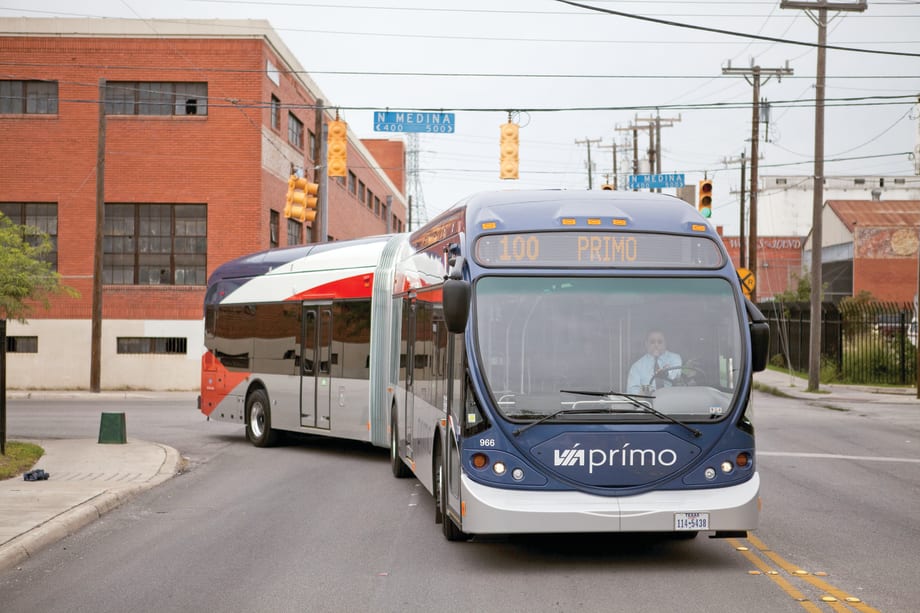
Prímo, which began service in December 2012, connects the two largest employment centers in the region.
Prímo, which began service in December 2012, connects the two largest employment centers in the region.
Located in South Central Texas, San Antonio is one of the fastest growing cities in the country. With robust employment opportunities and low cost of living, the city experienced a 16% growth in population since 2000, according to the U.S. Census Bureau. Seven years ago, forward-thinking leaders at the VIA Metropolitan Transit felt this growth would create traffic congestion issues and started looking at solutions to improve overall transportation along the city’s high-ridership corridors. The result was San Antonio’s first bus rapid transit (BRT) service — Prímo.
Prímo, which began service in December 2012, along the 12-mile Fredericksburg Road corridor, connects the two largest employment centers in the region — the central business district in downtown San Antonio and the South Texas Medical Center. The BRT service, which includes a limited extension to University of Texas at San Antonio, also provides convenient connections to other transit services.
In late 2007, to successfully complete this project, VIA commissioned Lockwood, Andrews & Newnam Inc. (LAN), a planning, engineering and program management firm headquartered in Houston, to serve as the general engineering consultant. Subsequently, VIA contracted URS Corp. to provide environmental assessment and preliminary engineering services and Parsons to provide detailed architectural and engineering plans and specifications. O’Haver and Prudent Technologies Inc. served as contractors.
“The Prímo project is the first step in expanding transit options in San Antonio,” says Justin M. Cain, PE, LAN’s project manager. “As such, it is a significant and visible project for the city.” [PAGEBREAK]
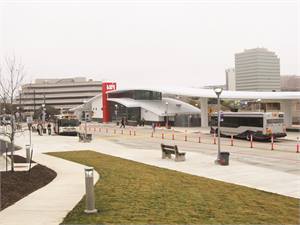
The Medical Center Transit Center is one of two large terminals along the Prímo route. The terminal serves Prímo buses and functions as a major transfer hub for many of VIA’s regular buses.
Prímo Features
To enable San Antonio residents to travel faster and with more comfort, Prímo offers several distinctive features. Modern, stylized 60-foot buses by North American Bus Industries carry up to 90 passengers (45 sitting and 45 standing) and provide service every 10 minutes on weekdays and 15 minutes on weekends. Powered by compressed natural gas (CNG), a cost-effective and more environmentally-friendly fuel, the buses are hinged near the center to negotiate tight corners in city streets. The buses are also equipped with a self-secure wheelchair system that allows users to strap themselves rather than requiring the operator to assist, specialized bike racks at the rear door, liquid crystal display monitors to provide VIA information, near-level boarding and security cameras.
“People love the new buses,” says Arturo Herrera, strategic planner at VIA.
Along the Prímo route are two large terminals — the Medical Center Transit Center and the Westside Multimodal Transit Center. The Medical Center Transit Center, built on a 7.5-acre site, serves Prímo buses and functions as a major transfer hub.
The facility, designed with a modern art-deco style, includes a spacious 60-seat lobby, 128 parking spaces with additional parking for the disabled, overhead canopies for customers waiting outside, bike racks, security cameras, and real-time travel information outside and inside the building. The terminal, which opened the same day Prímo began service, also features sustainable elements, such as solar arrays to supplement its electrical power and drought tolerant landscaping. Eventually, the transit center will also provide parking/plug-in stations for vehicles that use green technologies.
West of downtown San Antonio is the Westside Multimodal Transit Center, which is being constructed in two phases. Phase 1, scheduled to be completed in March 2013, includes the renovation of the historic International & Great Northern Railroad Depot into a passenger waiting facility complete with a customer information center, ticket sales office and other indoor transit amenities. The facility also will house VIA’s new police headquarters. Outdoors, a transfer facility with on-street shelters and real- time passenger information will be provided. Phase 2 of the project, which will be completed in May 2015, includes the construction of a new transit plaza just east of the Phase 1 project.
Another attractive feature of Prímo is the use of dedicated stops, called stations. Between the two terminals are eight Prímo stations in each direction. Unlike traditional VIA stops that are small and placed frequently along a route, Prímo stations are larger and spaced further apart.
Constructed with a unique canopy look, each station is 100 feet long and 12 feet deep with a six-foot sidewalk behind it. Stations include several amenities, such as benches, security cameras, vehicle arrival information displays and raised platforms for ADA access. Later this year, similar to rail transit, all Prímo stations will include ticket vending machines for fare collection.
One of the innovative features that sets Prímo apart is the use of a first-of-its-kind Transit Signal Priority (TSP) system. The system, which operates on Global Positioning Satellite (GPS) technology, allows Prímo buses to pass quickly through traffic lights, getting riders to their destinations faster. As a Prímo bus moves down the corridor, its GPS coordinates are acquired by VIA and transmitted to San Antonio’s traffic control system. When the bus approaches a traffic signal, the lights switch to green as quickly as possible or stay green longer.
“One of the great advantages with this TSP system is that it also extends to other buses operated by VIA,” says Herrera. “Now, the buses have the ability to ‘talk’ to every upgraded traffic signal in San Antonio. We can use this system on other heavily traveled corridors or bus routes.” [PAGEBREAK]
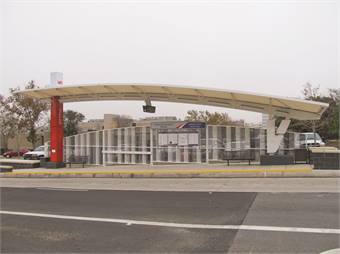
Prímo uses dedicated stops, called stations. Between the two terminals are eight Prímo stations in each direction
Community Benefits
VIA’s Prímo provides several social, economic and sustainable benefits to the community. Chief among them is the ability to travel to different destinations along the Fredericksburg Road corridor more quickly.
According to Herrera, Prímo’s riders can save as much as 15 minutes in each direction.
“For a transit user, 15 minutes in each direction is amazing,” says Herrera. “We weren’t even expecting the travel time savings to be that high. And as we move forward, there is still room for improvement.”
By providing a safe, efficient and environmentally-friendly transportation solution to passengers, Prímo has helped alleviate congestion, reduce emissions and increase throughput in one of the city’s most traveled corridors. In addition to regular transit riders, Herrera says the service is bringing in new riders who have a choice between using cars and public transit. Eventually, VIA’s goal is to pull a significant number of cars off the road by attracting more of these riders.
The project also is expected to spur Transit Oriented Development in and around the terminals. Once completed, the West Side Multimodal Transit Center will provide seamless travel connections for several modes of transportation, including the proposed modern streetcar, intercity bus, taxi services, Amtrak and the anticipated Austin-San Antonio commuter rail system.
Project Challenges
The scale of the project created a number of complex challenges. During the preliminary stages, the project team considered a number of exclusive lane options for the service. However, the team’s modeling and analysis showed that construction efforts resulting from a dedicated lane would create traffic impacts and significant right-of-way challenges.
“The roadway corridor was under the control of three different entities, the right-of-way was under the control of City of San Antonio and City of Balcones Heights, and the actual pavement in route was under the control of Texas Department of Transportation (TxDOT),” says Cain. “So, there were multiple overlapping interests.”
Consequently, the team decided on a mixed-flow option with Prímo buses sharing auto lanes. This eliminated additional construction efforts, which saved significant time and money and minimized the impact to the public.
The project also required extensive collaboration with several entities undertaking infrastructure projects along the Fredericksburg Road corridor at the same time, including TxDOT, City of San Antonio, City of Balcones Heights, Bexar County and the Texas Medical Center Foundation. Through a proactive approach that included frequent meetings, streamlined schedules, and public workshops, the project was completed on time and under budget.
VIA, which will extend the service to the Leon Valley later this year, is also looking at potential opportunities to implement Prímo in other parts of the city’s south and north central corridors as part of the agency’s long-term planning. Prímo is an excellent example of how a state-of-the-art BRT project can address a city’s transportation challenges, expand its residents’ commuting choices and enhance the region’s environmental and economic development.
More Bus

New York MTA Plans Largest Bus Fleet Upgrade in More Than a Decade
The agency is seeking manufacturers for 650 new CNG buses to replace aging vehicles, improve reliability, and advance its broader fleet modernization strategy.
Read More →
Building a Flexible Path to Transit Electrification
John Hroncich discusses BAE Systems’ modular and scalable approach, lessons learned from decades of real-world operations, and how agencies can identify electrification strategies that fit their fleets.
Read More →
Bus Tech Talk: Keeping Transit Technicians Ahead of the Technology Curve
LA Metro’s Obed Mejia discusses technician training, evolving maintenance technology, fleet replacement, and strategies for getting the most out of today’s transit fleets.
Read More →
Biz Briefs: RIPTA Unveils New Frontrunners, Clevland RTA Adds New Siemens, and More
In METRO's latest installment, we take a look at recent news from Siemens, Prevost, Dodge, and more partnerships making headlines across the transportation sector.
Read More →
People Movement: Holly Arnold Joins Transdev and More
In this edition, we also cover recent appointments and announcements at Pace, CamTran, MCI, and more, showcasing the individuals helping to shape the future of transportation.
Read More →
The High Cost of Transit Buses: Industry Leaders Look to Procurement Reform
Transit leaders and policymakers examine how standardized bus designs, streamlined procurement, and predictable funding could help agencies stretch budgets and deliver better service.
Read More →
The Business Voice Behind Public Transportation
As chair of APTA’s Business Members Board of Governors, Ray Melleady explains how more than 850 business members are partnering with transit agencies to advance funding, innovation, and industry-wide collaboration.
Read More →
From Surviving to Thriving: Building Stronger Transportation Organizations
Bus Business Consultants founder Brian Dickson shares lessons on leadership, organizational health, and creating options for long-term success in a changing transportation industry.
Read More →
Finding the ‘Happy Medium’: Optimizing Maintenance Without Sacrificing Reliability
The key to maintenance optimization isn’t doing less work—it’s doing the right work at the right time on the right assets.
Read More →
LA Metro, City of West Hollywood, and Partners Advance Smarter Bus Lane Enforcement
The award-winning partnership combines AI-powered detection with human oversight to improve bus reliability, accessibility, and enforcement efficiency.
Read More →