




RELATED: San Diego MTS deploys propane buses
San Diego MTS Begins Transition of Smaller Vehicles to Propane Autogas
Long a proponent of alternative fuels, the San Diego Metropolitan Transit System (MTS) recently added 31 minibuses and 46 paratransit buses to begin transitioning its smaller vehicle fleet to propane autogas.
April 13, 2017
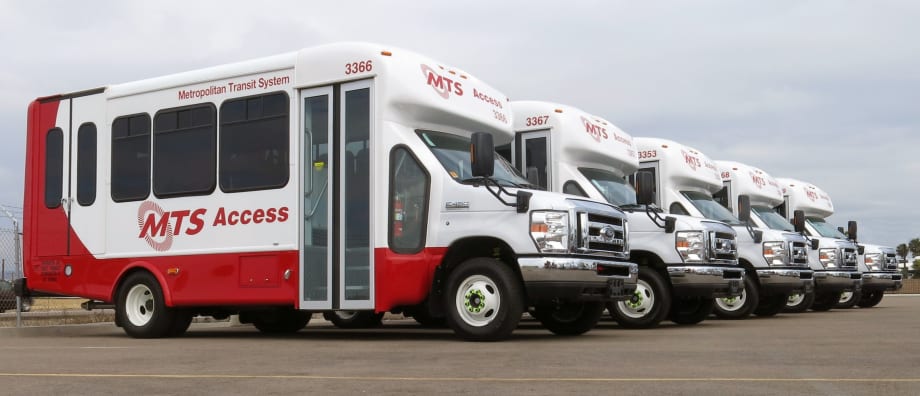
San Diego MTS did an “exhaustive” cost analysis of propane versus gasoline to project cost savings going forward.
4 min to read
San Diego MTS did an “exhaustive” cost analysis of propane versus gasoline to project cost savings going forward.
Long a proponent of alternative fuels, the San Diego Metropolitan Transit System (MTS) recently added 31 minibuses and 46 paratransit buses to begin transitioning its smaller vehicle fleet to propane autogas.
“We have a few commuter buses that are still using diesel, but for the most part our entire fixed-route fleet runs on CNG,” explains Bill Spraul, COO for MTS. “A couple of years ago, we began taking a look at our smaller buses, which were still using gasoline, to see if we can find an alternative cost-efficient alternative fuel, while also achieving significant emission reductions.”
Spraul explains that MTS quickly landed on propane autogas because it immediately filled those two important factors. In fact, the agency predicts the first 77 vehicles — 46 2016 Starcraft Allstars on Ford E450 chassis and 31 2016 ENC (formerly ElDorado National) Aero Elite 320s on Ford F550 chassis, which both feature a Ford 6.8L V10 engine with a ROUSH CleanTech propane autogas fuel system — will save somewhere between $750,000 to $1 million in fuel costs, as well as reduce two million pounds of greenhouse gas emissions per year.
Also, even with the additional cost of $20,000 per paratransit vehicle and $27,000 per minibus vehicle, MTS expects payback on the extra capital cost to occur somewhere between one-and-a-half to two years.
For other agencies looking to make the switch, Spraul says that MTS did an exhaustive cost analysis of propane versus gasoline, which included the examination of the propane market to understand the volatility of the fuel, so that it could project forward what the cost savings could be.
“A system has to really pay attention to make sure the savings are there for their operation based on how many miles they operate and the prices they pay for propane versus gasoline,” he says.
“We get the question a lot if there is a still a business case to make the switch to propane since gas and diesel are so cheap right now, and the answer is yes,” adds Todd Mouw, VP, sales and marketing at ROUSH. “Even with depressed fuel prices of gas and diesel, we have such a great supply that propane is cheap as well. Most of our customers on the transit side are paying about a buck a gallon for propane, or under, just based on the volume they are buying.”
“Most of our drivers tell us that their experience with propane compared to gasoline is better, in terms of acceleration and operation of the vehicle. Another side benefit is that both our drivers and our customers say that these vehicles operate much more quietly than the gasoline vehicles.”
— Bill Spraul, COO for MTS
The vehicles are part of an approximate 215-vehicle fleet that operates out of MTS’ Copley Park Division, which houses its entire paratransit fleet and covers 30 of the agency’s bus routes, serving 1.3 million passengers annually. Spraul says, right now, the agency is bringing in two fueling trucks nightly to fill the vehicles, but plans to implement the necessary fueling infrastructure as its propane autogas fleet grows.
“One of the plans we are looking at now, is when we have more propane-fueled vehicles than we do gasoline, we would take the footprint where the gasoline tanks are now, remove those, and put propane tanks in,” says Spraul. “Then, we would begin to start bulk fueling onsite with propane and wet hose with gas. It’s really when we get enough vehicles switched to propane that we’ll begin to switch the tanks out.”
At this point, Spraul says feedback both from drivers and the agency’s customers has been positive.
“Most of our drivers tell us that their experience with propane compared to gasoline is better, in terms of acceleration and operation of the vehicle,” he says. “Another side benefit is that both our drivers and our customers say that these vehicles operate much more quietly than the gasoline vehicles.”
Spraul adds that MTS began training its drivers a couple of months ahead of delivery and had to educate both its drivers and customers about the misperception that propane is volatile and explosive. “We just had to educate them a bit that the perception is different than the reality,” he says.
Although no timetable is yet set, the agency does plan to transition its entire smaller vehicle fleet to propane autogas.
Subscribe to Our Newsletter
More Bus

New York MTA Plans Largest Bus Fleet Upgrade in More Than a Decade
The agency is seeking manufacturers for 650 new CNG buses to replace aging vehicles, improve reliability, and advance its broader fleet modernization strategy.
Read More →
Building a Flexible Path to Transit Electrification
John Hroncich discusses BAE Systems’ modular and scalable approach, lessons learned from decades of real-world operations, and how agencies can identify electrification strategies that fit their fleets.
Read More →
Bus Tech Talk: Keeping Transit Technicians Ahead of the Technology Curve
LA Metro’s Obed Mejia discusses technician training, evolving maintenance technology, fleet replacement, and strategies for getting the most out of today’s transit fleets.
Read More →
Biz Briefs: RIPTA Unveils New Frontrunners, Clevland RTA Adds New Siemens, and More
In METRO's latest installment, we take a look at recent news from Siemens, Prevost, Dodge, and more partnerships making headlines across the transportation sector.
Read More →
People Movement: Holly Arnold Joins Transdev and More
In this edition, we also cover recent appointments and announcements at Pace, CamTran, MCI, and more, showcasing the individuals helping to shape the future of transportation.
Read More →
The High Cost of Transit Buses: Industry Leaders Look to Procurement Reform
Transit leaders and policymakers examine how standardized bus designs, streamlined procurement, and predictable funding could help agencies stretch budgets and deliver better service.
Read More →
The Business Voice Behind Public Transportation
As chair of APTA’s Business Members Board of Governors, Ray Melleady explains how more than 850 business members are partnering with transit agencies to advance funding, innovation, and industry-wide collaboration.
Read More →
From Surviving to Thriving: Building Stronger Transportation Organizations
Bus Business Consultants founder Brian Dickson shares lessons on leadership, organizational health, and creating options for long-term success in a changing transportation industry.
Read More →
Finding the ‘Happy Medium’: Optimizing Maintenance Without Sacrificing Reliability
The key to maintenance optimization isn’t doing less work—it’s doing the right work at the right time on the right assets.
Read More →
LA Metro, City of West Hollywood, and Partners Advance Smarter Bus Lane Enforcement
The award-winning partnership combines AI-powered detection with human oversight to improve bus reliability, accessibility, and enforcement efficiency.
Read More →