



Seoul Improves Smart Cards, Allows A Negative Balance
South Korea's T-money card gives riders discounts off base bus, subway fares.
Seoul Metropolitan Government has made improvements to its “T-money” payment system, providing greater flexibility and convenience for riders.
Run by Korea Smart Card Co. Ltd. (KSCC), the T-money cards are purchased for a small fee and give riders a discount off the base fare for each bus and subway trip — ranging from a savings of 10% for adults and up to 50% for children — versus cash tickets.
The cards, embedded with CPU-enabled self-calculation, are used for public transportation — buses, subway and taxis — as well as other public services (including parking lot fees, museums and vending machines) throughout the city. Using cash, card holders can continually add value to the cards at a variety of outlets.
Since the end of April, passengers who use T-money transportation cards can get cash receipts to submit with their tax returns at the end of the year. Now, after registering online with T-money, card holders can have the company send cash receipts to the Republic of Korea’s National Tax Service if monthly card charges total 5,000 won ($5.39 USD) or more.
In mid-May, the city government also began a Minus Transportation Policy, which enables passengers to buy a special “T-money minus card” for an extra 1,000 won ($1.08 USD) refundable deposit.
“Before this policy, if passengers were short of the final fare, they had to pay in cash and could not get the benefit of a transfer [between bus and train] discount,” said Hyeon-Jeoung Kim of Seoul Metropolitan Government. “People can now receive the discount even with insufficient funds, albeit limited to only once.” The negative balance is recorded on the card, and the next time the card has money added to it, the passenger makes up the “minus balance.”
This policy is especially helpful for passengers who transfer from bus to subway.
Normally, a base fare is deducted while aboard the bus, and when the card holder transfers to the subway, he or she doesn’t have to pay a second base fare. Before the policy, if the card did not have a minimum of 250 won, passengers had to pay cash for the transfer.
Both of these pre-paid card policies were created for the benefit of the rider, who spends an average of 104,670 won ($113.25 USD) per month on public transportation fees. “It is the hope of the Seoul Metropolitan Government that the public transportation system becomes more convenient and attractive for the citizens,” Kim said.
More Management

ENC Lands MATA Contract and More in Biz Briefs
In this edition of Biz Briefs, we spotlight the latest developments shaping the future of mobility.
Read More →
From Surviving to Thriving: Building Stronger Transportation Organizations
Bus Business Consultants founder Brian Dickson shares lessons on leadership, organizational health, and creating options for long-term success in a changing transportation industry.
Read More →
Everett Transit, Community Transit Outline Consolidation Agreement
The proposed agreement calls for a 50% increase in bus service in Everett, a new microtransit zone, continued paratransit service, and the transfer of Everett Transit operations to Community Transit.
Read More →
Strada360’s Steve Lassey on Turning Transit Data Into Better Decisions
From breaking down data silos to preparing for AI, Strada360 CEO Steve Lassey discusses how transit agencies can use technology to improve operations, customer information, and long-term decision-making.
Read More →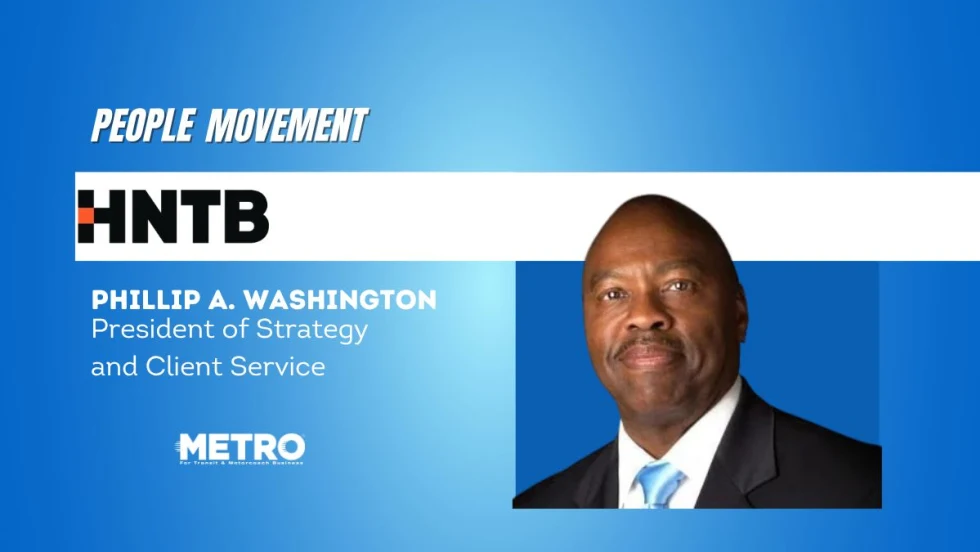
People Movement: Phil Washington Joins HNTB, Denver RTD Launches CEO Search, and More
In this edition, we also spotlight recent personnel moves at STV, the Eno Center for Transportation, and more, highlighting the people taking on new roles across the transportation industry.
Read More →
SEPTA Details Accelerate Vision for Transit System
The plan outlines investments in trolley modernization, new Metro and Regional Rail vehicles, accessible stations, and more frequent bus and rail service.
Read More →
FTA Ends Direct Oversight of MBTA Safety Actions
The federal agency closed its remaining special directive to the Massachusetts Department of Public Utilities following a safety review that began in 2022.
Read More →
Report: Transit Bus Manufacturing Supports 34,100 Jobs, $5.1B in GDP
The “Buses Mean Business” report examines the transit bus manufacturing industry’s economic footprint, supply chain, and rising demand for vehicle replacements.
Read More →
LIT Marks 10-Year Milestone at Annual Summit
Hosted by the COTA from September 10 to 13, the Summit carried the theme “Celebrating 10 Years of Excellence, Leadership, and Impact,” with every part of the program honoring the people, agencies, and partners who built LIT over its first decade.
Read More →
People Movement: Dan Dipert Coaches Adds Third-Generation Leader, Keolis Names New Valley Metro VP/GM, and More
In this edition, we also cover recent appointments and announcements at the Wabtec, SilverRide, HNTB, and more, showcasing the individuals helping to shape the future of transportation.
Read More →