




Related: New Orleans RTA Approves Temporary Transit Fare Reductions
Service, Safety, & Equity: New Orleans RTA in Action
Hear how the RTA is focused on on-time performance, improved customer service, and equity…not to mention plans for a network redesign, and service and vehicle upgrades in the city that is home to the world’s oldest continuously operating streetcar line.
August 5, 2021
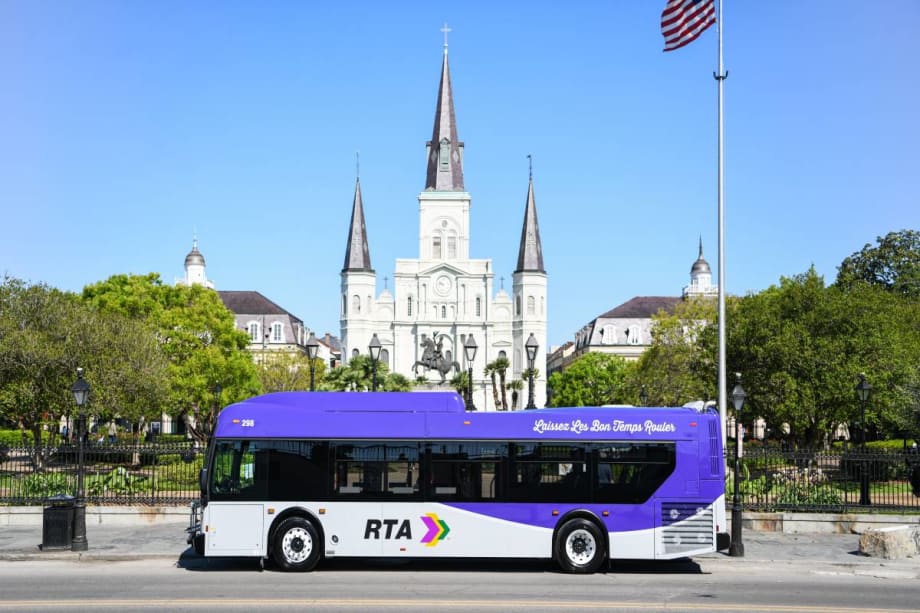
New Orleans RTA’s bus redesign was launched in May 2021.
Photo: New Orleans RTA
7 min to read
In New Orleans, one medium-sized transit agency is committed to moving residents and visitors throughout the Big Easy. The New Orleans Regional Transit Authority (RTA) helps people get around through five streetcar lines, 34 bus routes, and two ferry routes, as well as paratransit services.
Today, only in NOLA
A few things make transit unique in New Orleans: use of the Mississippi River, regular threats of hurricanes, and one historic streetcar.
The city is proud to serve as home to the world’s oldest continuously operating streetcar line, the St. Charles — a beloved historic line running since 1835. The line, which takes about 40 minutes one full way, travels from the edge of the French Quarter to St. Charles Avenue and onto tree-lined South Carrollton Avenue. Each green and crimson “Perley Thomas” car is a National Historic Landmark and offers a ride through the past.
And because the city is a tourist destination, weekends are typically dominated by visitors, many of whom hop on the St. Charles, which transforms into a quasi-tour bus. During the weekdays, RTA’s core ridership consists of people going to and from work. “As an agency, we have to maintain focus on service quality that benefits our core ridership while recognizing the unique features of our streetcars,” says RTA CEO Alex Wiggins.
While most public transit companies are familiar with guidance set forth from the Federal Transit Administration (FTA) and DOT, ferry lines receive oversight, safety, and security from the U.S. Coast Guard. Two RTA ferry executives have this unique background, as one is a retired Coast Guard officer and the other is a former executive director of a ferry system officer in Puerto Rico. “In transit, we know a lot about planes, trains, and automobiles, but maritime is a whole different world, and you really have to go out and get that specific expertise,” Wiggins says.
The city is no stranger to major weather events. While we are all familiar with the devastation of Hurricane Katrina, Wiggins says the RTA expects some form of a storm every year from June through November. Last year, New Orleans was “in the cone” seven times and experienced one direct hit. To combat and respond to emergencies, the agency has an all-hazards plan in place because the region is tested so often. The RTA even plays a major role in assisting with city evacuations.
But Wiggins maintains that the organization’s best competitive advantage is its workforce. “We are tested every summer with hurricanes, and our workforce has become exceptionally adept at managing emergencies, responding to events, and being focused on service delivery during difficult times,” he says. “This agency has the most resilient workforce I’ve ever seen; we have some real tough cookies here.”
COVID Response
We all experienced challenges during the recent pandemic, and in New Orleans, the RTA saw a 90% drop in ridership and 70% drop in revenue when it began. They responded with a reduction in service and received federal funding to keep the system alive — and were fortunate enough to avoid employee layoffs.
“These are highly technical jobs, and our employees have been trained extensively, so maintaining staff was critical for us,” Wiggins says.
Of course, RTA also increased the frequency of cleaning, installed barriers to protect operators from exposure, and invested in PPE and hand sanitizers.
Wiggins was happy to share that RTA returned to full transit service on June 20, and ridership is back. In fact, he says riders actually returned before the RTA was ready to accommodate them. Just days after restoring all operations, the RTA Board of Commissioners unanimously approved temporary fare reductions to encourage ridership as the agency moves ahead and vaccination rates increase throughout the region.
A Focus on People
RTA leadership maintains four core values, consisting of operating safely, operating on time, providing world-class customer service, and offering a collegial-fund workplace. “We want New Orleans RTA to be the best place in the city to work,” Wiggins says.
Further investing in their workforce, RTA recently put out an RFP to develop a training program and leadership academy for its employees. Wiggins says it is a move to develop staff interested in growing their technical and customer-focused skillsets. The team is currently reviewing proposals and looks forward to partnering with a firm to design and deliver the program.
“We’re really focused on investing in the workforce, providing training, improving technical skillsets across the board from maintenance to operations, and making sure our employees can be successful in their careers,” he shares.
Another priority, though, is equity. Wiggins says RTA is focused on providing every business and employee “an opportunity to work with us, work for us, or do business with us, and remove historical barriers that may have prevented people of color or women to advance. We’re building a culture that removes those barriers and supports folks in achieving their goals without any regard to demographic limitation.”
As part of this strategy, RTA is currently recruiting for a chief of equity, diversity & inclusion. Wiggins also says that they are looking at if service is available or equal in underserved neighborhoods. “All of that goes into a transit agency’s ability to provide equity. Our goal is to provide the same mobility options to everyone in the city that’s equal to as if they had a car.”
Service & Staff Changes
About six months ago, the RTA made some major moves to its operations by bringing many of its previously contracted services in house. Last December marked the start of all bus, streetcar, and paratransit operators, as well as maintenance personnel, being directly employed by the RTA. This increased its employees from 64 to nearly 800.
A news release states that by directly managing its own operations, the RTA is better positioned to manage the financial implications due to COVID-19. The overhead savings allows the agency to directly reinvest in improving service and connectivity while focusing on customer service and safety for all riders.
With a nod to the core values and culture of the agency, Wiggins says: “Our goal was really to focus on service quality and on-time performance. We needed to take direct steps to improve all those areas to make certain we are providing world-class service to our riders. We wanted to bring our transit experience to what others experience across the country.”
The agency’s primary goal is 20% improvement in on-time performance by the end of this year, followed by improved customer service and fewer customers complaints. So far, they are already seeing positive results.
And after evaluating current service, RTA realized it was offering more service than there was demand on the St. Charles Line. So, they reduced to a 12-minute headway and applied those extra service hours to bus systems.
Vehicle Upgrades
In May, RTA unveiled 22 new 35-foot New Flyer buses. The new buses replaced older vehicles, many which were purchased after Hurricane Katrina. With new colors reflecting the culture of the city, the buses don the phrase “laissez les bons temps rouler,” and are designed to better maintain external cleanliness.
The buses were funded by two grants from the FTA’s Bus and Bus Facility competitive grant program, as well as the Bus and Bus Facilities annual appropriation, and derived from revenue from the local one-cent sales tax.
RTA already runs electric streetcars on all its lines and has initiatives in the works to green the rest of its fleet.
Just last month, the FTA awarded RTA a new $5.15 million grant through its Low- or No-Emission program to install battery charging infrastructure, diagnostic and required maintenance equipment, and integrate at least three electric buses into the fleet.
New Links
Another major effort came about in 2018, when the agency’s board adopted a new Strategic Mobility Plan, which included a commitment to implementing a network redesign. To see this through, the RTA embarked on a year-long new partnership and project called New Links to study and propose a redesign of public transportation in Orleans, Jefferson, and St. Bernard parishes with public feedback. The goal was to develop short-term recommendations that can be implemented quickly using existing funding.
“In a nutshell, New Links looks to improve the mobility of passengers in the region and better connect them to the workplace, educational opportunities, and artistic expressions available in New Orleans,” Wiggins explains. “What we’re really aiming to do is reduce headways and increase frequency.”
The final New Links report with recommendations was released in February, and Wiggins says the ideas will be implemented in phases. The first round went into effect in on June 20, and the rest will be rolled out throughout the rest of this year and next year.
A Look Ahead
Moving forward, Wiggins says RTA plans to ditch the agency’s antiquated fare collection system and join the rest of the industry in offering contactless payments. He mentions a pilot project launching on the ferry system soon that will look at the most recent advancement in payments and could expand to the rest of their lines.
Another emerging trend RTA is watching is microtransit, and Wiggins believes more investments will need to be made in on-demand options. “Because of COVID, the workplace has changed quite a bit, but passengers still need mobility, and they want it on their own schedule and not ours,” he comments.
Subscribe to Our Newsletter
More Bus

New York MTA Plans Largest Bus Fleet Upgrade in More Than a Decade
The agency is seeking manufacturers for 650 new CNG buses to replace aging vehicles, improve reliability, and advance its broader fleet modernization strategy.
Read More →
Building a Flexible Path to Transit Electrification
John Hroncich discusses BAE Systems’ modular and scalable approach, lessons learned from decades of real-world operations, and how agencies can identify electrification strategies that fit their fleets.
Read More →
Bus Tech Talk: Keeping Transit Technicians Ahead of the Technology Curve
LA Metro’s Obed Mejia discusses technician training, evolving maintenance technology, fleet replacement, and strategies for getting the most out of today’s transit fleets.
Read More →
Biz Briefs: RIPTA Unveils New Frontrunners, Clevland RTA Adds New Siemens, and More
In METRO's latest installment, we take a look at recent news from Siemens, Prevost, Dodge, and more partnerships making headlines across the transportation sector.
Read More →
People Movement: Holly Arnold Joins Transdev and More
In this edition, we also cover recent appointments and announcements at Pace, CamTran, MCI, and more, showcasing the individuals helping to shape the future of transportation.
Read More →
The High Cost of Transit Buses: Industry Leaders Look to Procurement Reform
Transit leaders and policymakers examine how standardized bus designs, streamlined procurement, and predictable funding could help agencies stretch budgets and deliver better service.
Read More →
The Business Voice Behind Public Transportation
As chair of APTA’s Business Members Board of Governors, Ray Melleady explains how more than 850 business members are partnering with transit agencies to advance funding, innovation, and industry-wide collaboration.
Read More →
From Surviving to Thriving: Building Stronger Transportation Organizations
Bus Business Consultants founder Brian Dickson shares lessons on leadership, organizational health, and creating options for long-term success in a changing transportation industry.
Read More →
Finding the ‘Happy Medium’: Optimizing Maintenance Without Sacrificing Reliability
The key to maintenance optimization isn’t doing less work—it’s doing the right work at the right time on the right assets.
Read More →
LA Metro, City of West Hollywood, and Partners Advance Smarter Bus Lane Enforcement
The award-winning partnership combines AI-powered detection with human oversight to improve bus reliability, accessibility, and enforcement efficiency.
Read More →