Smart Cities and Transportation: 4 Common Typologies and Pilot Project Approaches
Smart city innovations are occurring in mature cities, often involving issues of infill development, congestion management, social equity, and efforts to revive blighted urban centers.
by Susan Shaheen, Adam Cohen, and Mark Dowd
June 9, 2020
Photo: GettyImages-1146418702, metamorworks
6 min to read
Over the past decade, cities and the ways in which people live, work, travel, and consume goods and services are evolving. A range of technology, mobility, and socio-demographic forces have given rise to smart city strategies focused on transforming transportation and energy use in cities.
In Europe, the European Commission launched the “Smart Cities and Communities” initiative (SCC) providing approximately $400 million in funding for energy, transportation, and information communications technology (ICT) strategies in 2011. In 2015, the U.S. Department of Transportation (USDOT) launched the Smart City Challenge initiative to increase the focus on medium-sized cities and the use of integrated data, technology, and innovation as strategies for addressing stubborn urban challenges related to mobility.
Ad Loading...
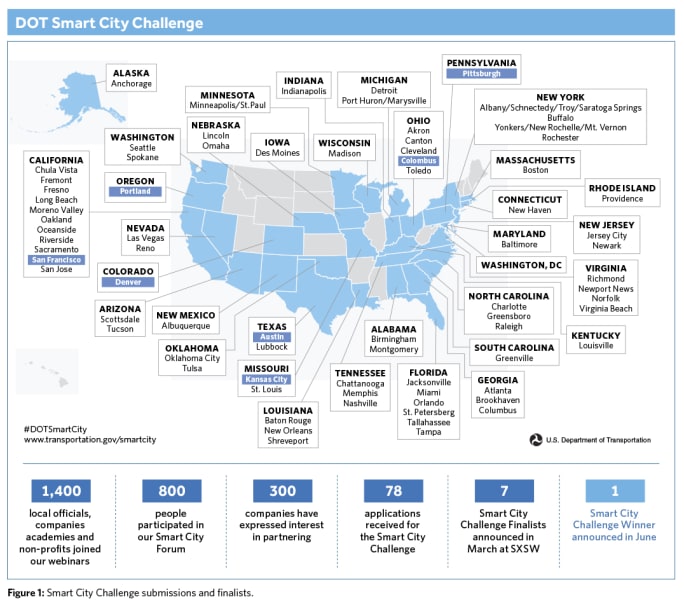
The USDOT received 78 applications for the challenge. (Figure 1) After down selecting to seven finalists, the Smart City Challenge awarded $50 million in funding to Columbus, Ohio to integrate, demonstrate, and evaluate transportation technologies with other aspects of public administration, such as energy and the environment, transportation, governance, workforce development and economic development, and digital connectivity.
These government funds are matched by significant private sector contributions. The Smart City Challenge represents one of the first initiatives to advance understanding of smart cities and to recognize how strategic partnerships among public sector agencies; institutions; and private sector technology providers can make cities more livable, efficient, environmentally sustainable, and equitable.
Both the Smart City Challenge and the Smart Cities and Communities Initiative offer insights into how smart cities evolve, the characteristics that make smart cities more successful, and the role of pilot projects. These and other policies and programs have pushed visions of smart cities from the fringe to the mainstream, as cities across the globe have fostered concepts for environmental sustainability, government efficiency, and integrated smart transportation systems that leverage innovation, data, and technology to help enhance livability and quality of life in communities.
What is a Smart City?
A smart city is a region of collaborators and innovators working to improve the quality of life of its residents. This collaborative process can be described as a pyramid of innovation that starts with the individual innovator and becomes progressively more advanced with greater regional innovation and multi-stakeholder collaboration. In other words, smart city attainment is the sum of regional innovators, and every stakeholder plays a critical role. Smart cities go beyond technological applications and big data to address city challenges.
Smart cities require omni-directional leadership vertically through an organization and laterally across agencies and stakeholder groups. This requires executive-level champions of innovation and staff that are empowered to support and carry initiatives forward. Additionally, distributed leadership across organizations is required to foster partnerships and breakdown silos. The presence of multiple champions can encourage innovation and create institutional resiliency that can transcend political and staff changes. (Figure 2)
Ad Loading...
4 Types of Smart Cities
Smart cities occur in a variety of settings — urban, suburban, rural, and even regional. Smart city innovations are occurring in mature cities, often involving issues of infill development, congestion management, social equity, and efforts to revive blighted urban centers. Smart city strategies are also occurring in fast growing suburban areas developing for the first time, attempting to address issues of new infrastructure, site planning, and open space preservation.
Smart city approaches are also happening in small towns and rural areas that include improving access to critical services such as:
healthcare.
jobs.
economic development.
These strategies are also occurring at the regional level to maintain a jobs-housing balance, addressing issues of affordable housing and transportation, and enhancing economic competitiveness with other regions.
Our research suggests that smart cities can develop in a variety of sized communities with different built environments. Four common types of smart cities and regions are summarized in Table 1. Role of Pilots & Other Inititatives
Within each of these smart cities and regions, smart city initiatives and pilot projects can be deployed at three different scales:
Ad Loading...
Regional initiatives involve macro-level approaches to implementation (i.e., larger scale pilots covering regional geography, larger samples, and a regional study population). Examples of regional pilots include integrated payment and mobility applications, regional pricing initiatives, and smart transportation corridors.
City initiatives are undertaken by local communities, often simply to respond to citywide needs. Examples of city-level pilots include connected wireless technologies for automated vehicles and automated public transportation and city-wide equity initiatives.
Neighborhood initiatives to deploy smaller pilot projects specific to neighborhood needs. Neighborhood initiatives can also include university campuses, office parks, airports, planned unit developments, apartment complexes, and business improvement districts. Examples of neighborhood pilot projects include individual mobility hubs and neighborhood electric vehicle charging infrastructure.
This categorization can aid in organizing and understanding project dynamics and impacts so communities can understand what works and what does not work.
Role of Pilots & Demos
In the Mineta Transportation Institute Report, “A Framework for Integrating Transportation into Smart Cities,” we developed a three-phase planning, implementation, and evaluation framework that communities can employ to test innovative policies and programs (Figure 3).
The three-phase framework involves problem understanding, collaboration, and experimentation to identify best practices and lessons learned. Phase 1 is comprised of an initial assessment aimed at understanding community concerns.
Phase 2 includes a process of refinement and prioritization dedicated to creating institutional capabilities to foster collaboration and pilot experimentation. Phase 3 is focused on pilot implementation and evaluation, with the ultimate goal of replicating what works.
Ad Loading...
Ensuring Social Equity
Because smart cities are often associated with high-tech strategies to community challenges, there is an increasing concern that technology-enabled approaches may be leaving the unbanked (those without access to a bank or credit card), underserved, and digitally impoverished (those without access to a smartphone or the internet) communities behind.
There is also worry that these strategies may not be equitably serving all neighborhoods, economic strata, people with disabilities, and other groups. There is a need to ensure that smart city strategies are accessible to everyone. The public sector can play many roles in ensuring equitable cities, including acting as a facilitator, funder, regulator, and evaluator of smart city initiatives.
Looking Ahead
Smart Cities is a concept that fosters innovation in public policy and administration to foster collaboration and partnerships that focus on people-oriented solutions. Smart cities represent an ecosystem of domains, pilots, innovations, and stakeholders working together at different city scales, from neighborhoods to regional levels.
Smart cities are a collaboration process that can be depicted as a pyramid of innovation that starts with the individual innovator and becomes progressively more advanced, culminating in increased regional innovation and multi-stakeholder collaboration.
A diverse array of communities are pursuing smart cities initiatives that include a variety of small, medium, and large communities, tech-oriented regions, growth cities, economic revival metros, and small/rural communities. Rather than focusing on technology alone, smart city initiatives should leverage organizational/process innovation alongside technology to improve community outcomes (e.g., active transportation, environmental outcomes, affordability, etc.). Not surprisingly, smart cities vary by geography, economic, cultural, and other local characteristics.
Ad Loading...
The emergence of affordability, gentrification, and displacement were identified as notable challenges for many tech-oriented cities. Both economic revival cities and small and rural communities are employing strategies that emphasize workforce and economic development, along with placemaking (i.e., development for a variety of scales and built environments).
Growth cities emphasize policies and programs focused on managing growth and new infrastructure construction/financing. Pilot implementation and evaluations are critical tools to help communities test strategies, identify best practices, and replicate policies and programs that work.
To read A Framework for Integrating Transportation into Smart Cities, click here.
CEO Magnus Friberg discusses Luminator’s shift toward becoming a digital partner, the growing importance of software and interoperability, and how AI can help agencies improve operations and passenger experience.
Reliability-Centered Maintenance helps transit agencies move beyond routine checklists to focus limited resources on the assets and failures that have the greatest impact on safety, reliability, and service.
More than 1,500 buses now feature upgraded technology designed to improve arrival predictions and provide free Wi-Fi, with deployment expected to reach nearly 2,000 buses by the end of 2026.
John Hroncich discusses BAE Systems’ modular and scalable approach, lessons learned from decades of real-world operations, and how agencies can identify electrification strategies that fit their fleets.
In METRO's latest installment, we take a look at recent news from Complete Coach Works, Beep, FlixBus, and more partnerships making headlines across the transportation sector.
What if transit leaders could ask any operational question and get a trusted answer in seconds? Conversational AI is transforming how agencies use their data.
More than $191 million in federal funding will help three transit agencies replace aging rail vehicles and support a new autonomous shuttle service in Chattanooga.
LA Metro’s Obed Mejia discusses technician training, evolving maintenance technology, fleet replacement, and strategies for getting the most out of today’s transit fleets.
In METRO's latest installment, we take a look at recent news from Siemens, Prevost, Dodge, and more partnerships making headlines across the transportation sector.
Pedestrian microsimulation is helping rail planners identify bottlenecks, test station designs, and prepare complex transit hubs for growing passenger volumes.