



How can transit enhance the customer experience?
Overcome these barriers when transitioning from a traditional, business-objective approach to a customer-driven strategy.
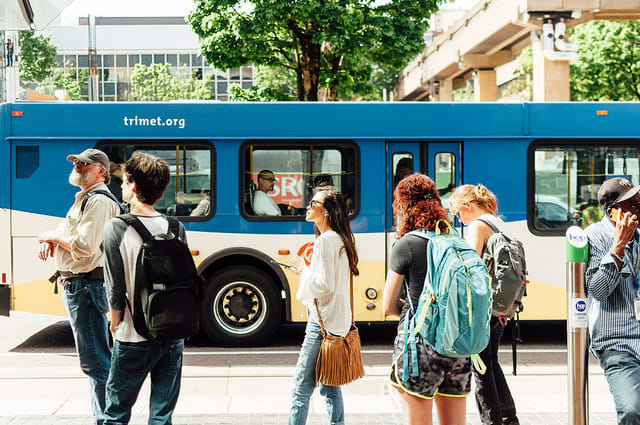
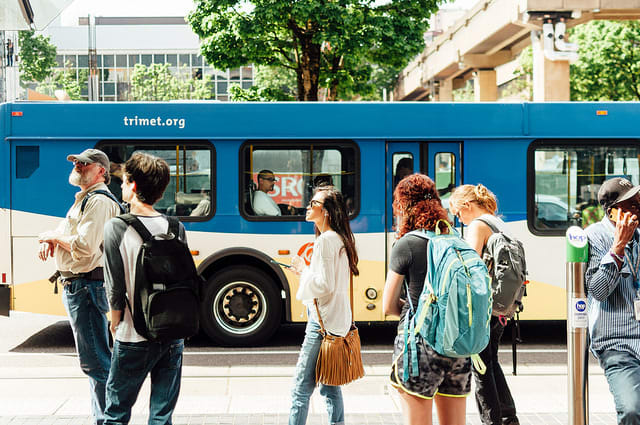
Public transit agencies need to keep up with private sector innovations that are heightening customer expectations. TriMet
Historically, the mandate for most public transportation agencies has been straightforward: Move people safely and reliably at the least cost to taxpayers. This charge worked well in environments where they had little competition outside of taxi cabs and privately-owned automobiles. New technologies, however, are squeezing agencies by simultaneously creating new forms of competition and heightening consumer expectations.
Customers are taking their experiences in the private sector transportation market and projecting them on public agencies. Lyft and Uber have made mobility seamless, ubiquitous and on-demand, creating a private Mobility as a Service (MaaS) market that is upending transportation. Driverless technologies, as they begin living up to their potential, will help MaaS further mature.
The new environment in which transit agencies are operating is causing more of them to move toward customer experience (CX) programs, such as electronic ticketing and mobile app schedules, that leverage technology. Theoretically, there is no reason commuters leaving their homes should not get push notifications from a transit authority about a subway line outage that impacts their route to work — without that notice going out to the entire city. Furthermore, a modern CX system would know a particular person’s final destination and suggest a personalized, alternate route to help minimize inconvenience.
Understandably, many agencies have been so focused on fulfilling their mandates under tight fiscal conditions that the customer experience has not been at the forefront. But technology’s potential to radically transform transportation — and signs this process is already underway — is causing that calculation to change.
In order to create forward-looking solutions that result in a better experience for passengers, it is important to understand the barriers that all types of organizations face when transitioning from a traditional, business-objective approach to a customer-driven strategy.
Lack of c-suite engagement
Lack of support from the c-suite can undermine and neutralize transformation efforts within an agency, even if CX receives tacit support. Agency leadership must embrace the significance of making customer needs a true driver of business decisions. For example, saying you’re focused on CX while leadership mandates something counter to providing that good experience kills the initiative from the start.
There is often a belief that business objectives (operations, safety mandates, etc.) conflict with a customer-first philosophy.
In reality, there just needs to be early alignment on what’s possible when it comes to improving CX without compromising other critical key performance indicators (KPIs).
Also, leadership needs to be aware of how KPIs and company policies help or hinder the customer experience. In too many cases, each function is only thinking about their own goals instead of the impact on the full CX.
The c-suite must be actively involved in the process of integrating CX strategies into their current framework, and this process involves more than just recommending a new best practice.
Rather, through an agency-wide effort, leadership needs to develop a business case for the initiative, set concrete KPIs tied to CX that will increase passenger satisfaction and drive financial results, and then hold leaders within the organization accountable to implement the plan.
Disparate legacy systems
Disparate, non-integrated software systems are limiting the ability of agencies to implement new technologies that would enable them to deliver a better CX. Many agencies are operating multiple, legacy software programs that have no way of “talking” with each other.
Establishing consistency of data across these platforms and managing the integration is costly and time intensive, but it is fundamentally important. Achieving integration is especially difficult in traditional, siloed organizational models where different departments within the same agency haven’t had to work together.
We now have the ability to collect data about the customer and their level of satisfaction throughout their entire transit experience. As other entities begin to link this information to create a more seamless, predictive and convenient interaction with the customer, it will become a benchmark for how all other interactions should work.
A truly successful CX strategy must be an enterprise-wide effort.
The customer journey crosses platforms and functional areas within an organization, and the CX roadmap must bring all of these partners to the table in a collaborative effort to create a unified experience.
The customer doesn’t care whether different departments oversee the subway and bus routes, for example, they just want a seamless experience from the start of their journey to their destination.
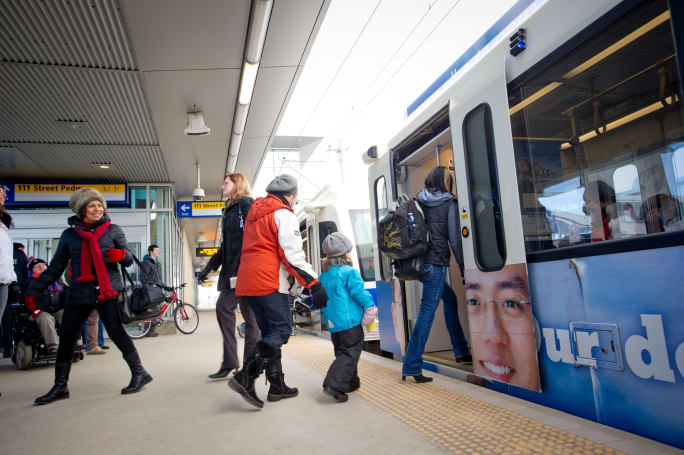
Edmonton Transit System's Century Park light rail station. ETS
Disconnected employees
Even if the CEO is championing CX, and the systems issues have been resolved, the program will suffer if transit agency workers are not empowered with the information and incentives they need to take a customer-first approach to their interactions (without sacrificing safety, of course).
Changing the mindset of workers starts by empowering them to serve people better. Transit agency employees need to understand the practical ways they can implement the strategy, and they need to be encouraged and rewarded along the way.
In order to empower workers, data must be analyzed for dynamic insights, and then leadership needs to find the appropriate channel to make this information actionable.
Insights about a particular transit rider’s needs — such as an event that triggered the need for an alternate route to work — makes it easier for workers to be proactive when they engage with this person.
The continuous process of harvesting information about customers, delivering it to employees and then taking action creates a virtuous cycle that benefits riders while proving the value of the CX program to the organization. The result is a shift in the agency’s culture as employees embrace their role as an advocate for customers.
Alaska Airlines, for example, found that providing consistently excellent service while adhering to regulations and maintaining operational efficiency would require independent decision making from their employees.
Built on four standards — safety, caring, delivery and presentation — the airline provided broad guidelines for employees’ attitudes and behaviors, and developed a comprehensive training program with an explicit goal of helping staff internalize service standards.
Through participation with the company’s top executives, managers and frontline employees, Alaska Airlines earned J.D. Power’s highest customer satisfaction ranking among traditional airlines in 2017.
Seattle’s transit agency, Sound Transit, is another organization to watch as it seeks to transform CX.
With the passage of Sound Transit 3 (ST3) in 2016, the agency began utilizing more than $50 billion in new funding to transform how passengers commute in the Seattle metropolitan area.
As part of that effort, Sound Transit established a new role of chief customer experience officer, and is working to embed CX from initial design and construction to create the ultimate passenger experience.
The transportation industry will continue to rapidly evolve. The question is whether public transit agencies will keep up with private sector innovations that are heightening customer expectations. Those organizations that see new technologies as opportunities to serve customers better and utilize workers more effectively will positions themselves for success.
Chris McCarthy leads the Transportation Practice for North Highland, a global consulting firm.
More Management

LIT Marks 10-Year Milestone at Annual Summit
Hosted by the COTA from September 10 to 13, the Summit carried the theme “Celebrating 10 Years of Excellence, Leadership, and Impact,” with every part of the program honoring the people, agencies, and partners who built LIT over its first decade.
Read More →
People Movement: Dan Dipert Coaches Adds Third-Generation Leader, Keolis Names New Valley Metro VP/GM, and More
In this edition, we also cover recent appointments and announcements at the Wabtec, SilverRide, HNTB, and more, showcasing the individuals helping to shape the future of transportation.
Read More →
METRO Opens Submissions for 2026 Motorcoach Awards
Nominations are now being accepted for METRO Magazine’s Operator of the Year and Innovative Operator of the Year awards.
Read More →

New York MTA Advances Final Contract for Second Avenue Subway Expansion
Contract Four is the largest in the Second Avenue Subway Phase 2 project and includes construction of station infrastructure, tracks, and signals for the subway expansion, MTA officials said. Work on Contract Four will begin in 2027.
Read More →
Transit Agencies Highlight Safety Gains at National Summit
Leaders from 15 major transit systems shared crime-reduction results and safety initiatives while discussing the role of continued federal support.
Read More →
NITA Names New Leadership, Expands Reduced-Fare Program at First Board Meeting
The new regional transit authority appointed its first board chair and interim executive director while extending reduced fares across CTA, Metra, and Pace for eligible riders.
Read More →
Beyond the Checklist: A Structured Approach to Transit Maintenance
Reliability-Centered Maintenance helps transit agencies move beyond routine checklists to focus limited resources on the assets and failures that have the greatest impact on safety, reliability, and service.
Read More →
APTA 2026 Nominating Committee Selects Leadership Slate, Names Chair and Vice Chair Nominees
Leadership changes will help shape the association’s priorities and its representation of the transportation industry during the 2026–2027 term.
Read More →
DART Launches Major Security, Fare Enforcement Initiative
The 90-day demonstration will deploy coordinated security teams at five light rail stations while testing controlled access and gathering data to guide future investments.
Read More →
Advancing Fare Collection Through Technology and Innovation
Learn about delivering 1300 gates at 91 stations while managing fare evasion. Explore the large scale deployment, solution customization and real-world results that affect the region. Prepare for deployment in your region now.
Read More →