States Expand Investments in Intercity Bus Service to Close Gaps
Long overshadowed by Amtrak and public transit, long-distance motorcoach travel is gaining newfound respect in statehouses.
by Joseph P. Schwieterman
March 27, 2024
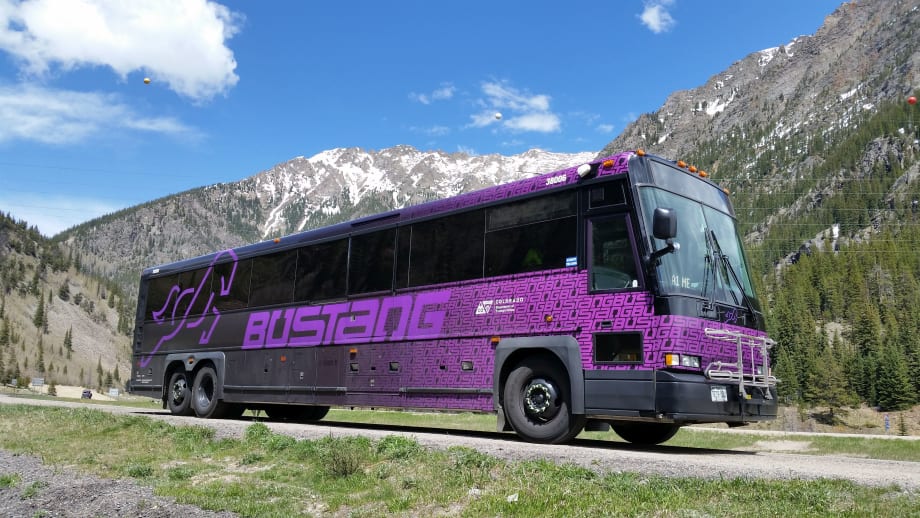
Bustang's Colorado network encompasses not only express services with full-size coaches, which run along Colorado's Front Range and the mountainous Interstate 70 Corridor between Denver and Grand Junction, but a rural -focused “Outrider” brand and the express-shuttle “Pegasus” service.
Photo: Bustang
8 min to read
Growing numbers of states are prioritizing intercity bus services to close gaps in their transportation systems and connect small cities with larger ones. Long overshadowed by Amtrak and public transit, long-distance motorcoach travel is gaining newfound respect in statehouses.
“The planets have aligned for more state-supported bus service, and we expect this alignment to continue over the next several years,” says Brian Antolin, an industry consultant and an advisor to DePaul University’s Chaddick Institute.
Ad Loading...
The trend is being fueled by the recent success of prominent state-support bus systems, such as Colorado’s Bustang, Oregon’s POINT network, Vermont Translines, Virginia Breeze, and Travel Washington. These smartly branded bus lines have enjoyed a much faster rebound since the pandemic than most city and metropolitan bus or rail systems.
While intercity bus travel is less highly regarded among some consumers, in terms of comfort than train travel, it is more amenable to experimentation, can be rolled out more quickly, and costs less per passenger carried. Plus, state-supported bus programs are being undergirded by the federal 5311(f) program, which provides funds for services to rural areas and small cities connecting to the national bus network,
“Most state-funded networks are set up to encourage transfers at connecting points, which creates synergy and helps boost the payback from public investments,” says Antolin.
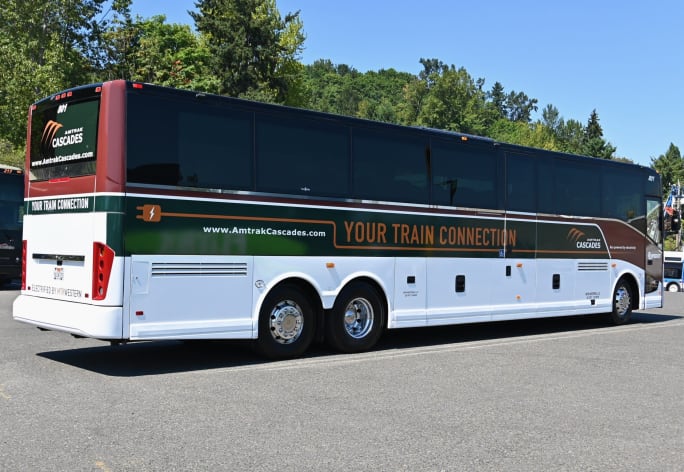
Amtrak Thruway services are thriving in states like California and Washington, where they recently introduced a plan to add zero-emission coaches.
Photo: Amtrak
Three Surprising Successes
Three state-managed systems are among last year’s biggest intercity bus stories.
North Carolina, known for having ambitious expansion plans for both intercity buses and trains, has increased the number of daily roundtrips in its state-supported bus system from nine to 12 since 2021.
Ad Loading...
Two new federally subsidized routes are part of the mix, including Mid-State Express, which links Winston-Salem and Fayetteville, with stops in Lexington and High Point.
Over the past year, total bus miles of service have expanded by 50%, and ridership on existing routes has increased by 37%. The state’s Charlotte to Wilmington (via Fayetteville) route has become its best-performing route in terms of ridership, cost per trip, and subsidy per trip.
Colorado’s Bustang is also in the spotlight, having enjoyed a 25% growth in ridership from 2022 to 2023. This network encompasses not only express services with full-size coaches, which run along Colorado's Front Range and the mountainous Interstate 70 Corridor between Denver and Grand Junction, but a rural -focused “Outrider” brand and the express-shuttle “Pegasus” service.
The ground-traveler provider also has seasonal offerings, including Snowstang and Bustang to Estes (Park). Over the past 18 months, the state has launched Bustang Outrider routes from Sterling to Denver and Greeley and from Trinidad to Pueblo, in each case using relatively small vehicles. This year, the state will improve access to Bustang in northern Colorado through the opening of three transit hubs along I-25 in Loveland, Berthoud, and Firestone.
In November, when there were 7,800 trips, 19% more than the previous year. Its newest route, the Highlands Rhythm, which links Washington, DC, to Bristol, recorded 27% traffic growth. The Capital Connector, which connects the nation’s capital to Richmond and Danville, Va, traffic grew only slightly less (25%).
DRPT is studying the feasibility of installing bus shelters, lighting, and benches at specific rural stops. The total cost of operating the system has fallen due to rising ticket revenues.
Ad Loading...
Less favorably, relatively few states have thus far developed interline (through ticketing) arrangements with Greyhound and its many service partners. Progress in this area has been slower than some have hoped.
However, South Dakota shows how this can be done, even in areas with relatively low-traffic density. Several of its rural transit operators, including Peoples Transit, based in Huron, S.D., and regional lines serving Aberdeen and Pierre, have linked up with Jefferson Lines, a Greyhound partner, to allow for through ticketing.
With a single “click” on a smartphone, passengers can buy a ticket from these places (and many rural hamlets) to any of several thousand destinations nationwide. Local providers have trained staff to assist passengers wanting to make ticket purchases. Ohio’s GoBus system also offers a similar service.
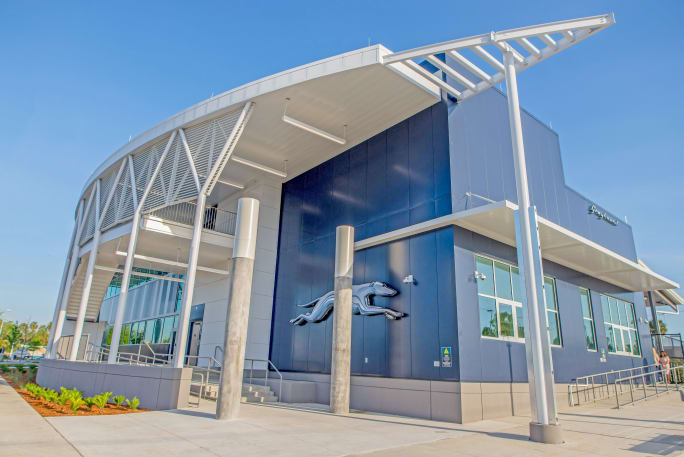
The optimism generated by rising state government support for intercity bus travel must be tempered by the mounting challenges created by the closing of privately-owned Greyhound stations.
Photo: Greyhound
Is More Bus/Train Synergy the Next Big Thing?
Gone are the days when intercity bus providers and Amtrak are regarded as being locked in a zero-sum battle for customers.
To be sure, there is intense competition between these providers. Our analysis, in fact, shows high-quality Amtrak service on certain corridors, such as Portland, Ore. – Seattle, Chicago – St. Louis, and Charlotte – Raleigh, NC, is a drag on intercity bus expansion.
Ad Loading...
Even so, as Akshara Das, a co-author of the DePaul report, notes: “efforts to jointly plan bus and train services are also rapidly accelerating as more governments tear down the barriers between them.”
California’s Amtrak Thruway bus system, long a cornerstone of the state’s ground-travel network, does a particularly good job linking rail services to offline destinations.
Recently, however, it expanded the role of Thruway by giving passengers the ability to purchase bus-only tickets on at least six routes on amtrak.com, including on several corridors where train service is available. Among the most recent routes with “bus only” ticketing on the Amtrak website is the Route 7 run linking Martinez to Arcata via Santa Rosa.
Vermont’s state-supported bus network, Vermont Translines, is another leader in bus-train integration. This state-supported carrier has a twice-daily Albany, NY – Rutland, Vt. – Burlington, Vt., service designed to connect with Amtrak and other bus services at Albany-Rensselaer.
Translines fills gaps in train schedules, has different intermediate stops, and allows travelers to reach Burlington and New York several hours earlier than train-only options. Due to added synergy, bus traffic has grown despite Amtrak extending the Ethan Allen Express, a train originating in New York, from Rutland to Burlington in 2022.
Translines ridership was 25% higher last year than in 2022 and more than one-third of its customers make train connections.
Oregon’s state-funded POINT bus system is using a similar strategy. On the Portland – Eugene leg of Amtrak's Cascades Corridor, a customer can select either a train or a Point bus service on that website, even if not connecting to or from a train. Buses and trains are attractively spaced throughout the day to maximize traveler convenience. Pennsylvania and Wisconsin also sell bus-only tickets on the Amtrak booking site.
Finally, there is Travel Washington, the Evergreen State's intercity system, which is distinguished by its high-quality transfers to both Amtrak and Greyhound.
Ad Loading...
All four of its routes, the Apple, Gold, Grape, and Dungeness lines, are set up for interline ticketing with Greyhound, which operates the Dungeness line under contract with the state. Tickets can also be purchased on Amtrak’s website with or without train connections.
Traffic has returned to 80% to 90% of pre-pandemic levels, with the Apple Line linking Omak to Ellensburg particularly strong.
The Bipartisan Infrastructure Bill is encouraging more such integration. Although the bill will spur some competing train services, we consider the legislation a “net plus” for intercity bus lines.
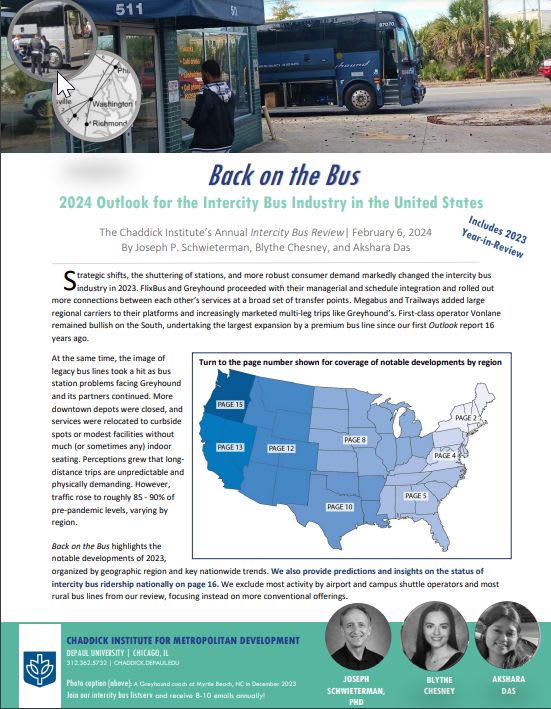
Back on the Bus: 2024 Outlook for the Intercity Bus Industry shows state-supported bus networks are creating spill-over benefits for entire national bus system, which includes major brands such as FlixBus, Greyhound, Megabus, Trailways, and Amtrak.
Photo: Chaddick Institute
The Challenges Posted by Bus Station Closing
The optimism generated by rising state government support for intercity bus travel must be tempered by the mounting challenges created by the closing of privately-owned Greyhound stations.
The situation remains a high-profile problem for public agencies and passengers that will likely grow more severe over the next several years due to the accumulating effects of station closings. Some older stations are simply too large and expensive to maintain. Several generate property tax bills exceeding $100,000/year, an amount difficult (or impossible) to recoup selling tickets that often cost less than $40. Other stations are owned by private real-estate companies on sites poised for redevelopment, often for residential towers.
Ad Loading...
Over the past several years, station closings involving Greyhound in Cincinnati and Columbus, Ohio; Chattanooga, Tenn.; Houston; Knoxville, Tenn.; Little Rock, Ark.; Louisville, Ky.; Philadelphia; and Tampa, Fla., have garnered much press coverage. Passenger convenience in most cases diminished as a result of bus lines relocating to spaces with fewer conveniences, poorer transit connections, and sparse amenities.
“Many municipal governments did little (or nothing) at all to ameliorate the problems that ensued,” notes Antolin.
Before the end of this year, more stations, possibly Chicago; Cleveland; Dallas; Kansas City, Mo.; Orlando, Fla.; and Richmond, Va., could close.
Fortunately, more public officials are taking notice, and the federal government is feeling pressure to help find a solution.
In Atlanta, a new intercity bus station, which was built with support from the State of Georgia, shows what thoughtful state-government planning can achieve.
The new facility, used by Greyhound, FlixBus, and Southeast Stages, has panoramic windows that let in much sunlight, a food stand, large restrooms, and digital departure boards. Seats have power outlets, USB chargers, cushioning, and armrests with cupholders, much like airports. A rail rapid-transit stop is next door, offering a quick ride to downtown Atlanta and Atlanta Hartsfield International Airport.
The station-closing problem has had a surprising upside: better positioning the industry for more favorable public- policy.
Ad Loading...
Growing awareness of the growing hardships facing disabled and lower-income travelers on long-distance trips has jostled some public officials into action, forcing them to address the industry’s needs. This trend, together with the success of state-supported bus systems and the push for equitable (and eco-friendly) transportation, works to the industry’s favor. All this will make the industry’s moves throughout the rest of this year fascinating to watch.
Joseph P. Schwieterman, Ph.D., is professor and director at the Chaddick Institute at DePaul University in Chicago. To access the report (PDF), click here. To receive his quarterly Intercity Bus E-News (free) or to reach the study team, contact chaddick@depaul.edu
The 2025 Motorcoach Economic Impact Report finds motorcoach travel supported nearly 25,000 jobs and generated $980 million in federal, provincial, and local taxes.
In this edition, we also cover recent appointments and announcements at the Wabtec, SilverRide, HNTB, and more, showcasing the individuals helping to shape the future of transportation.
In METRO's latest installment, we take a look at recent news from Complete Coach Works, Beep, FlixBus, and more partnerships making headlines across the transportation sector.
In METRO's latest installment, we take a look at recent news from Siemens, Prevost, Dodge, and more partnerships making headlines across the transportation sector.
In this edition, we also cover recent appointments and announcements at Pace, CamTran, MCI, and more, showcasing the individuals helping to shape the future of transportation.
In a recent episode of METROspectives, CharterUP Founder/CEO Armir Harris discussed the company’s evolution from an online charter bus marketplace into a technology platform supporting public- and private-sector mobility and much more.
In this edition, METRO also covers recent appointments and announcements at the DART, STV, and more, showcasing the individuals helping to shape the future of transportation.